
The Continuity of Ancient Indian Mathematical Practices into Modern Times


Welcome to Ancient India History, where we embark on a fascinating journey through the rich tapestry of ancient Indian civilizations. Here, we dive deep into the intriguing legacy of ancient Indian mathematics, exploring how these remarkable practices have shaped the mathematical landscape we know today. Our featured article, "The Continuity of Ancient Indian Mathematical Practices into Modern Times," invites you to unravel the profound contributions that have emerged from the Indus Valley to the Gupta Empire.
Prepare to be captivated as we illuminate the enduring influence of these ancient scholars and their timeless wisdom. Join us in exploring the wonders of a civilization that continues to inspire and innovate!

Introduction to Ancient Indian Mathematics History
The history of mathematics in ancient India is a fascinating journey that reflects the sophistication and ingenuity of one of the world's oldest civilizations. From the intricate calculations of the Indus Valley Civilization to the profound contributions of mathematicians during the Gupta Empire, ancient Indian mathematics showcases a rich tapestry of numerical systems, innovative concepts, and practical applications.
This article aims to explore the continuity of these mathematical practices into modern times, emphasizing their significance in shaping contemporary mathematical thought and education. By delving into the ancient Indian mathematics history, we will uncover the enduring legacy of these practices and their relevance in today's world.
Overview of Ancient Indian Mathematics
Ancient Indian mathematics is characterized by its comprehensive approach to numbers, geometry, and computation. Notable texts like the Sulbasutras and Aryabhata's Aryabhatiya provide insight into the mathematical knowledge prevalent in ancient India. Key areas of focus included:
- Arithmetic: Development of decimal systems and place value.
- Geometry: Principles of measurement and construction, especially in architecture.
- Algebra: Early concepts of equations and their solutions.
These foundational elements laid the groundwork for future mathematical advancements, not only in India but also across the globe.
Importance of Ancient Indian Mathematical Practices
The mathematical practices of ancient India were not merely academic; they played a crucial role in various aspects of daily life, including trade, astronomy, and architecture. Their importance can be summarized as follows:
- Cultural Influence: Mathematics was intertwined with religion and philosophy, influencing art and literature.
- Technological Advancements: Innovations in mathematics facilitated advancements in agriculture, construction, and navigation.
- Global Impact: The spread of Indian mathematical concepts through trade and cultural exchange significantly influenced the development of mathematics in other civilizations, such as the Islamic Golden Age.
Historical Context of Ancient Indian Mathematics
Understanding the historical context of ancient Indian mathematics provides a clearer picture of its evolution and significance. The timeline can be divided into several key periods that highlight the major developments in mathematical thought.
Early Mathematical Developments in the Indus Valley Civilization
The Indus Valley Civilization (c. 3300–1300 BCE) is recognized for its advanced urban planning and trade systems. Evidence suggests that the people engaged in various mathematical practices, including:
- Standardized weights and measures: Indicating a sophisticated understanding of geometry for trade.
- Construction techniques: Use of precise measurements in building structures.
These early developments laid the foundation for future mathematical inquiry in ancient India.
Contributions of Vedic Mathematics
The Vedic period (c. 1500–500 BCE) marked a significant turning point in the history of mathematics in India. The Vedas, ancient texts that form the foundation of Hindu philosophy, also contained mathematical concepts that contributed to the evolution of mathematics, including:
- Sanskrit numerical notation: The use of words and symbols to represent numbers.
- Mathematical formulas: The introduction of operations such as addition, subtraction, multiplication, and division.
This period emphasized mental calculations and quick problem-solving techniques, which are collectively referred to as Vedic Mathematics.
The Role of Mathematics in Ancient Indian Astronomy and Astrology
Mathematics played a pivotal role in ancient Indian astronomy and astrology, where precise calculations were crucial for determining celestial movements and timekeeping. Key contributions include:
- The computation of planetary positions: Ancient Indian astronomers like Aryabhata and Brahmagupta made significant advancements in understanding planetary orbits.
- Calendrical calculations: Development of accurate calendars based on lunar and solar cycles.
These mathematical applications not only enhanced scientific knowledge but also reinforced the cultural importance of astronomy and astrology in ancient Indian society.
The continuity of ancient Indian mathematical practices into modern times reflects a profound heritage that continues to influence contemporary mathematical thought and education. By recognizing the contributions and historical significance of ancient Indian mathematics, we gain a deeper appreciation for its role in shaping our understanding of mathematics today.
Key Figures in Ancient Indian Mathematics History
Ancient India boasts a rich tradition of mathematical scholarship, with several key figures contributing significantly to the field. These mathematicians not only advanced mathematical knowledge in their time but also laid the groundwork for future developments in mathematics both in India and around the world. Their works encompassed a wide range of topics, including arithmetic, algebra, geometry, and astronomy, reflecting the diverse applications of mathematics in ancient Indian society.
Aryabhata: The Pioneer of Indian Mathematics
Aryabhata, born in 476 CE, is often regarded as the first significant mathematician and astronomer in ancient India. His seminal work, the Aryabhatiya, presents a comprehensive overview of mathematics and astronomy, including the introduction of the concept of place value. Aryabhata is renowned for his calculations of the value of pi (π), which he approximated as 3.1416, and for his method of solving linear equations.
Moreover, he proposed a heliocentric model of the solar system, suggesting that the Earth rotates on its axis—a revolutionary idea for his time. Aryabhata's influence extended beyond India, impacting Islamic scholars and later European mathematicians, making him a pivotal figure in the continuity of mathematical practices.
Brahmagupta and His Innovations
Brahmagupta, a mathematician from the 7th century, is celebrated for his work Brahmasphutasiddhanta, which laid down rules for arithmetic operations, including the treatment of negative numbers and zero in calculations. He is credited with formulating rules for solving quadratic equations and providing methods for calculating areas and volumes, which were groundbreaking for his era.
One of his notable contributions is the development of Brahmagupta's formula for calculating the area of a cyclic quadrilateral. His work not only advanced the mathematical understanding of his time but also provided practical applications for astronomy and commerce. Brahmagupta's innovations played a crucial role in the evolution of mathematical thought in ancient India and beyond.
Bhaskara II: The Master of Algebra and Calculus
Bhaskara II, also known as Bhaskara the Learned, made remarkable contributions to mathematics in the 12th century. His principal work, Lilavati, is a comprehensive text on arithmetic that covers various topics, including algebra, geometry, and the theory of numbers. Bhaskara II is particularly known for his work on calculus, where he described concepts such as the derivative and the notion of infinitesimals, which predate similar ideas in European mathematics by several centuries.
He also developed a sophisticated method for solving equations, known as the "Bhaskara's lemma," which is an important precursor to modern algebraic techniques. His contributions to astronomy, particularly in calculating eclipses and planetary positions, further demonstrate the practical applications of his mathematical theories. Bhaskara II's legacy continues to resonate in contemporary mathematics, illustrating the enduring influence of ancient Indian mathematicians.
Major Concepts in Ancient Indian Mathematics
Ancient Indian mathematicians introduced several crucial concepts that have persisted and evolved into modern mathematical practices. These concepts reflect a sophisticated understanding of numerical systems and mathematical principles that were far ahead of their time.
The Decimal System and Place Value Concept
The decimal system, which is the foundation of modern arithmetic, was developed in ancient India around the 5th century CE. This numerical system employs a base-10 structure and utilizes place value to represent numbers efficiently. The inclusion of positional notation allowed for the representation of large numbers and simplified calculations, making it a revolutionary advancement in mathematics.
The place value system made it possible to perform complex arithmetic operations with ease. This system spread to other cultures through trade and scholarly exchanges, ultimately influencing the development of mathematics in the Islamic world and, later, in Europe.
The Concept of Zero and Its Significance
The introduction of zero as both a numeral and a concept was one of the most significant contributions of ancient Indian mathematics. The earliest recorded use of zero dates back to the 5th century in the work of Aryabhata, who recognized zero as a placeholder in the decimal system. This innovation allowed for the representation of numbers accurately and enabled the execution of arithmetic operations without confusion.
Zero also paved the way for the development of algebra, calculus, and complex number systems, fundamentally altering the landscape of mathematics. Its significance extends beyond mathematics into various fields, including computer science and economics, demonstrating its universal applicability.
Advanced Techniques: Algebra, Geometry, and Trigonometry
Ancient Indian mathematicians made substantial advancements in algebra, geometry, and trigonometry, which were critical for various practical applications, particularly in astronomy and architecture.
- Algebra: Mathematicians like Brahmagupta and Bhaskara II developed systematic methods for solving linear and quadratic equations, introducing algorithms that would influence future mathematicians worldwide.
- Geometry: The ancient texts outline principles of geometry, including the calculation of areas and volumes for various shapes, which were vital for land surveying and construction practices.
- Trigonometry: The works of ancient Indian scholars included the study of sine and cosine functions, laying the groundwork for modern trigonometric concepts. Aryabhata’s trigonometric tables were instrumental for astronomical calculations, demonstrating the practical use of these mathematical theories.
These advanced techniques reflect the sophisticated understanding of mathematics in ancient India and its lasting impact on the mathematical sciences. The continuity of these practices into modern times underscores the rich legacy of ancient Indian mathematics.
Continuity of Mathematical Practices into Modern Times
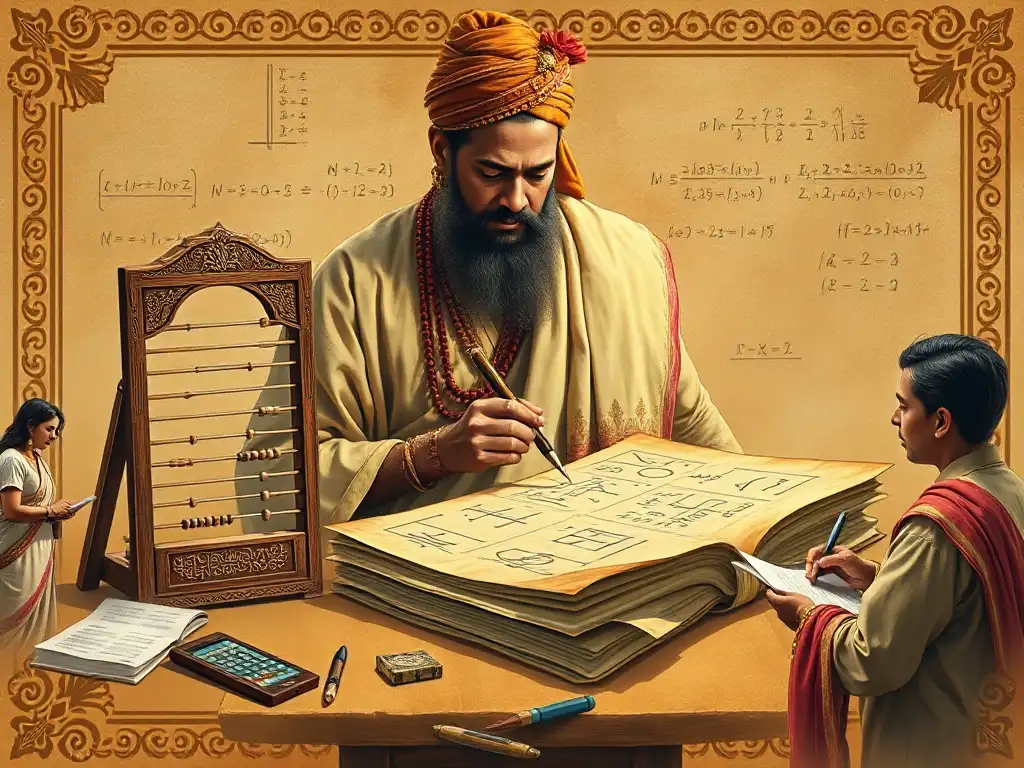
The mathematical practices established in ancient India have shown remarkable continuity, influencing various aspects of modern mathematics and education. Ancient Indian mathematicians like Aryabhata, Brahmagupta, and Bhaskara made significant contributions, including concepts such as zero, the decimal system, and intricate algorithms. These foundational ideas have transcended time, finding relevance in contemporary applications and educational frameworks. As we explore this continuity, we will see how ancient principles have been adapted and preserved, reinforcing India's rich mathematical heritage.
Influence of Ancient Indian Mathematics on Modern Indian Education
The impact of ancient Indian mathematics is deeply embedded in the educational curriculum of modern India. Concepts introduced by ancient scholars are often included in textbooks, ensuring that students have a solid understanding of their mathematical heritage. For instance, the introduction of the number zero and the place-value system are fundamental topics in mathematics education today. Schools and universities often use ancient texts, such as Aryabhata's Aryabhatiya, to teach students not only mathematics but also the historical context of these concepts, fostering a sense of pride in India's contributions to global mathematics.
Moreover, initiatives like the National Curriculum Framework have emphasized the importance of integrating traditional knowledge with contemporary teaching methods. This approach not only preserves ancient practices but also encourages innovative thinking, allowing students to appreciate the continuity and evolution of mathematical ideas through the ages.
Preservation of Ancient Texts: Manuscripts and Translations
The preservation of ancient Indian mathematical texts has played a crucial role in maintaining the continuity of mathematical practices. Numerous manuscripts, such as the Brahmasphutasiddhanta by Brahmagupta and the Lilavati by Bhaskara II, have been meticulously copied and translated over centuries, ensuring that their mathematical insights remain accessible. These texts provide invaluable knowledge about ancient methods of calculation, geometry, and astronomy.
Efforts by scholars and institutions to digitize these manuscripts have further enhanced their accessibility to researchers and enthusiasts worldwide. Organizations like the Indian National Science Academy have promoted the study and translation of these texts, allowing a broader audience to engage with ancient Indian mathematics. This preservation effort ensures that the wisdom of ancient mathematicians continues to inform modern mathematical practices.
Integration of Ancient Mathematical Concepts into Modern Mathematics
Ancient Indian mathematical concepts have been seamlessly integrated into modern mathematics, influencing various fields, including algebra, geometry, and number theory. The concept of zero, which was first recorded in ancient Indian texts, is now a fundamental element of modern arithmetic and calculus. Additionally, the decimal system, which originated in India, is the basis for numerical representation used globally today.
Mathematical algorithms developed by Indian mathematicians, such as the rules for solving quadratic equations and methods for computing square roots, are still taught and utilized in contemporary mathematics. By acknowledging and incorporating these ancient principles, modern mathematics not only respects its historical roots but also enhances its applicability in solving current mathematical problems.
Case Studies: Applications of Ancient Indian Mathematics Today
Use of Vedic Mathematics in Competitive Exams
Vedic mathematics, a system derived from ancient Indian texts, has gained popularity in modern educational settings, especially for competitive exams. Techniques from Vedic mathematics, such as the Sutras (short formulas) for rapid calculation, enable students to solve complex problems quickly and efficiently. These methods have transformed the way students approach mathematics, promoting a deeper understanding of numerical relationships and enhancing their problem-solving skills.
Many coaching institutes across India incorporate Vedic mathematics into their curricula to prepare students for exams like the IIT JEE and UPSC. As a result, students not only perform better but also develop a greater appreciation for the mathematical traditions that underpin these techniques.
Relevance of Ancient Algorithms in Computer Science
The algorithms developed by ancient Indian mathematicians continue to be relevant in today's technological landscape, particularly in computer science. Techniques for solving problems in number theory and combinatorics, as outlined in ancient texts, have influenced modern algorithm design. For example, the methods for calculating permutations and combinations can trace their roots back to Indian mathematical traditions.
Moreover, ancient algorithms for astronomical calculations have parallels in modern computational methods used in satellite navigation and space exploration. By studying these ancient techniques, computer scientists can gain insights into efficient problem-solving strategies that have stood the test of time.
Adoption of Indian Mathematical Techniques in Global Contexts
The global adoption of ancient Indian mathematical techniques is evident in various fields, including finance, engineering, and data science. Concepts such as the Fibonacci sequence, which aligns with Indian mathematical traditions, are prevalent in financial modeling and algorithmic trading. Additionally, the use of logarithmic scales, derived from ancient Indian texts, is fundamental in many engineering applications.
International conferences and research collaborations highlight the increasing recognition of India's contributions to mathematics. Scholars and practitioners from around the world are studying ancient Indian techniques, integrating them into their work, and showcasing the timeless nature of these mathematical principles. This globalization of ancient knowledge not only honors its origins but also demonstrates its applicability across diverse modern contexts.
Challenges in Tracing the Continuity of Ancient Practices
Tracing the continuity of ancient Indian mathematical practices into modern times presents several challenges. These challenges stem from various factors, including the loss of historical texts, misinterpretations of mathematical methods, and the evolving nature of mathematical understanding over centuries. Each of these aspects contributes to a complex landscape that researchers must navigate to appreciate the true legacy of ancient Indian mathematics.
Loss of Historical Texts and Knowledge
One of the primary challenges in studying ancient Indian mathematics history is the significant loss of historical texts. Many critical mathematical manuscripts, which contained valuable knowledge and insights, have been lost over time due to:
- Natural Disasters: Earthquakes, floods, and fires have destroyed libraries and collections.
- Cultural Changes: The decline of certain dynasties and the rise of new cultures often led to the neglect or destruction of previous texts.
- Colonial Impact: During colonial rule, many ancient manuscripts were either taken abroad or destroyed, leading to a significant gap in historical records.
The scarcity of primary sources makes it difficult for historians and mathematicians to reconstruct a comprehensive picture of ancient mathematical practices and their applications.
Misinterpretations and Misrepresentations of Ancient Methods
Another challenge arises from the misinterpretations and misrepresentations of ancient mathematical methods. This can occur due to:
- Language Barriers: Many ancient texts are written in languages that are not widely understood today, leading to potential misinterpretations during translation.
- Cultural Context: The mathematical concepts of ancient India were often intertwined with philosophical and cultural contexts that may be overlooked or misunderstood by modern scholars.
- Bias in Historical Narratives: Historical accounts may reflect the biases of the writers, leading to skewed representations of mathematical practices.
These factors can create misconceptions about the sophistication and contributions of ancient Indian mathematics, complicating the continuity narrative.
Conclusion: The Legacy of Ancient Indian Mathematics
The legacy of ancient Indian mathematics is profound and far-reaching, influencing not only the development of mathematics in India but also contributing to global mathematical practices.
The Enduring Impact of Ancient Indian Mathematics on Global Mathematics
The influence of ancient Indian mathematics on global mathematics is evident in various domains, such as:
- Numerical Systems: The development of the decimal system and the concept of zero, which originated in ancient India, revolutionized numerical representation and calculations worldwide.
- Algebra and Trigonometry: Ancient Indian mathematicians like Brahmagupta and Bhaskara made significant contributions to algebra and trigonometry, laying the groundwork for future developments in these fields.
The integration of these concepts into various cultures demonstrates the far-reaching impact of ancient Indian mathematics, showcasing its relevance even in contemporary mathematical discourse.
Future Directions for Research in Ancient Indian Mathematics History
Future research in ancient Indian mathematics history should focus on several key areas:
- Digital Archiving: Efforts to digitize and preserve ancient texts can help ensure that valuable mathematical knowledge is not lost.
- Interdisciplinary Studies: Collaborations between mathematicians, historians, and linguists can provide a deeper understanding of ancient practices and their implications.
- Cross-Cultural Comparisons: Exploring the interactions between ancient Indian mathematics and other mathematical traditions can highlight the interconnectedness of global mathematical history.
By addressing these areas, researchers can further illuminate the continuity of ancient Indian mathematical practices and their enduring legacy in the modern world.
- Introduction to Ancient Indian Mathematics History
- Historical Context of Ancient Indian Mathematics
- Key Figures in Ancient Indian Mathematics History
- Major Concepts in Ancient Indian Mathematics
- Continuity of Mathematical Practices into Modern Times
- Case Studies: Applications of Ancient Indian Mathematics Today
- Challenges in Tracing the Continuity of Ancient Practices
- Conclusion: The Legacy of Ancient Indian Mathematics
- What is the significance of ancient Indian mathematics history?
- How did ancient Indian mathematicians contribute to modern mathematics?
- What role did the Indus Valley Civilization play in mathematics?
- Who were some notable ancient Indian mathematicians?
- How can we see the impact of ancient Indian mathematics in today's world?
Frequently Asked Questions
What is the significance of ancient Indian mathematics history?
The ancient Indian mathematics history is significant as it laid the foundation for many mathematical concepts, including zero, decimal system, and advanced geometry, influencing mathematics worldwide.
How did ancient Indian mathematicians contribute to modern mathematics?
Ancient Indian mathematicians developed concepts such as algebra, trigonometry, and calculus, which are crucial in modern mathematics, showcasing the continuity of mathematical practices into present times.
What role did the Indus Valley Civilization play in mathematics?
The Indus Valley Civilization is known for its advanced urban planning and use of measurement systems, indicating early forms of mathematical practices that influenced later developments in ancient Indian mathematics.
Who were some notable ancient Indian mathematicians?
Notable mathematicians include Aryabhata, who introduced the concept of zero, and Brahmagupta, known for his work on algebra and rules for calculating with negative numbers.
How can we see the impact of ancient Indian mathematics in today's world?
The impact of ancient Indian mathematics is evident in various fields such as astronomy, engineering, and computer science, where concepts like the decimal system are fundamental to current practices.
Final Reflection: The Enduring Legacy of Ancient Indian Mathematics
The exploration of ancient Indian mathematics history reveals a profound connection between the past and present, illustrating how these timeless practices continue to shape modern mathematical thought. As we delve into the intricate systems developed by ancient mathematicians, we uncover not only their brilliance but also their relevance in today's technological and scientific advancements. The wisdom of these ancient scholars transcends time, reminding us that the foundations of our current mathematical understanding are deeply rooted in their discoveries.
Cultural and social landscapes have been significantly influenced by the principles laid down by ancient Indian mathematicians. Their work in areas such as algebra, geometry, and calculus has not only enriched the global mathematical community but has also fostered a sense of pride in the intellectual heritage of India. As we reflect on this legacy, we can appreciate the words of the mathematician Srinivasa Ramanujan, who said, An equation for me has no meaning unless it represents a thought of God.
This perspective highlights the spiritual and philosophical dimensions of mathematics, encouraging us to view it as more than just a tool, but as a bridge connecting us to deeper truths.
As we conclude this exploration, I invite you to reflect on the lessons embedded in the history of ancient Indian mathematics. Consider how these principles can inspire your own journey in understanding and applying mathematics in your life. Whether you are a student, educator, or simply a curious mind, let the ingenuity of these ancient practices motivate you to embrace the beauty and complexity of mathematics. Together, we can honor this rich legacy by fostering a deeper appreciation for the mathematical wonders that continue to shape our world today.
Embrace the Wisdom of Ancient Indian Mathematics Today!
Thank you for diving into the fascinating journey of ancient Indian mathematical practices! You’ve uncovered insights that bridge the past and present, demonstrating how these timeless ideas continue to shape our understanding of mathematics today. Now, it's your turn to bring this knowledge to life!
Here are a few empowering actions you can take:
- Explore ancient mathematical techniques further by experimenting with Vedic math strategies in your daily calculations—notice how they transform your approach!
- Share this article with friends or on social media to spark conversations about the incredible contributions of ancient Indian mathematics to modern practices.
- Consider starting a local community group or workshop focused on ancient techniques. Invite others to join you in exploring and learning together!
What new connections do you see between ancient mathematics and your everyday life? Let's keep the discussion going!