
Mathematics in the Gupta Era: The Birth of Zero and Its Impact


Welcome to Ancient India History, where we embark on a fascinating journey through the vibrant tapestry of ancient Indian civilizations. Here, we delve deep into the remarkable Gupta Empire, a period renowned not only for its cultural richness but also for groundbreaking advancements in mathematics. Are you ready to uncover the secrets behind the birth of zero and its profound impact on the world?
Join us as we explore how this revolutionary concept emerged during the Gupta Era, reshaping the course of mathematical history and laying the foundation for modern mathematics. Your adventure into the past begins now—let's explore the wonders of ancient Indian contributions!
- Introduction to Gupta Empire Mathematics and Zero
- The Birth of Zero in the Gupta Empire
- The Development of Mathematical Concepts during the Gupta Empire
- The Impact of Gupta Empire Mathematics on Global Knowledge
- Case Studies: Notable Mathematicians of the Gupta Era
- Conclusion: The Legacy of Gupta Empire Mathematics and Zero
-
Frequently Asked Questions
- What is the significance of the Gupta Empire in the history of mathematics?
- How did the birth of zero influence mathematics during the Gupta period?
- What are some key mathematical achievements from the Gupta era?
- Who were the prominent mathematicians of the Gupta Empire?
- How did the concept of zero spread from the Gupta Empire to the rest of the world?
- Final Reflection: The Enduring Legacy of Gupta Empire Mathematics and the Birth of Zero
- Unveil the Power of Zero: Take Action Today!
Introduction to Gupta Empire Mathematics and Zero

The Gupta Empire, often hailed as a golden age of Indian civilization, played a pivotal role in the development of mathematics, particularly with the remarkable concept of zero. This period, spanning from approximately 320 to 550 CE, was characterized by significant advancements in various fields, including mathematics, astronomy, and philosophy.
The innovations that emerged during this time laid the groundwork for mathematical principles that continue to influence the world today. In this article, we will explore the key contributions of Gupta Empire mathematics, the birth of zero, and the profound impact these developments had on both ancient and modern societies.
Overview of the Gupta Era
The Gupta Era is marked by a flourishing of knowledge and culture, often referred to as the "Golden Age of India." Under the rule of the Gupta dynasty, a climate of intellectual freedom and creativity was fostered, leading to groundbreaking advancements in science, literature, and the arts. Prominent figures such as Aryabhata and Brahmagupta emerged during this time, making significant contributions to mathematics and astronomy.
Key features of the Gupta Era include:
- Cultural Flourishing: A revival of arts, literature, and sciences, with notable works produced in various disciplines.
- Political Stability: The Gupta Empire unified a large part of the Indian subcontinent, facilitating trade and intellectual exchange.
- Religious Tolerance: An environment that encouraged a blend of various religious and philosophical ideas, contributing to a rich cultural mosaic.
This era's emphasis on learning and inquiry led to the formulation of mathematical concepts that transformed how numbers were understood and utilized, ultimately paving the way for future developments in mathematics worldwide.
Significance of Mathematics in Ancient Indian Civilization
Mathematics has been a cornerstone of ancient Indian civilization, with its roots tracing back to the Vedic period. However, the Gupta period stands out for its systematic approach to mathematical concepts and the formalization of various principles.
The significance of mathematics during this period can be understood through several key aspects:
- Introduction of the Concept of Zero: The most notable contribution of Gupta mathematicians was the formal introduction of zero as a numeral. This revolutionary idea allowed for the representation of large numbers and facilitated complex calculations, marking a turning point in mathematical thought.
- Advancements in Arithmetic: Gupta mathematicians developed methods for arithmetic operations, including addition, subtraction, multiplication, and division, using the place-value system. This laid the foundation for modern arithmetic practices.
- Geometry and Trigonometry: The Gupta period saw significant advancements in geometry and trigonometry, with mathematicians exploring concepts such as area, volume, and the properties of shapes, which were crucial for architecture and astronomy.
- Influence on Future Generations: The contributions made during the Gupta Empire influenced subsequent generations of mathematicians in India and beyond. The mathematical texts produced during this time were studied and expanded upon in later centuries, impacting the development of mathematics globally.
The Gupta Empire's emphasis on mathematics not only transformed the field within India but also had lasting implications for the evolution of mathematics as a whole. The birth of zero, in particular, is a testament to the innovative spirit of this era, highlighting the profound legacy of Gupta mathematics that continues to resonate today.
The Birth of Zero in the Gupta Empire

The Gupta Empire, which flourished from approximately 320 to 550 CE, is often referred to as the "Golden Age" of India due to its remarkable advancements in various fields, including mathematics. Among these advancements, the introduction and conceptualization of zero stand out as one of the most significant contributions to mathematics not only in India but worldwide. The birth of zero during this period facilitated complex calculations and laid the groundwork for modern mathematics.
Historical Context of Zero in Mathematics
The concept of zero has its roots in ancient Indian mathematics. Prior to the Gupta Empire, numeral systems were primarily based on counting numbers, but the need for a symbol to represent the absence of quantity became increasingly apparent. The earliest known use of zero as a placeholder can be traced back to the 5th century CE, notably in the works of Indian mathematicians.
The mathematician Brahmagupta, who lived during the later Gupta period, played a critical role in formalizing the rules surrounding zero. In his seminal work, Brahmasphutasiddhanta, he defined zero and its operations, stating that "a number plus zero is the number itself." This marked a significant shift in mathematical thought, as it allowed for the development of algebra and complex arithmetic.
Key Milestones in the Historical Context:
- Placeholder in Numerals: The use of zero as a placeholder in the numeral system allowed for more efficient calculations and the representation of large numbers.
- Brahmagupta's Contributions: Brahmagupta's work on operations involving zero set the stage for future mathematical advancements in both India and the Islamic world.
- Cultural Exchange: The Gupta Empire was a hub of trade and cultural exchange, facilitating the dissemination of mathematical ideas, including the concept of zero, beyond India.
The Concept of Nothingness: Philosophical Implications
The introduction of zero into mathematics was not merely a mathematical innovation; it also carried deep philosophical implications. In ancient Indian philosophy, the idea of "shunya," or nothingness, became a subject of contemplation and debate. The acceptance of nothingness as a concept was pivotal in shaping both mathematical thought and spiritual perspectives.
Philosophical Dimensions of Zero:
- Shunyata in Buddhism: The Buddhist philosophy of "shunyata" emphasizes the idea of emptiness, paralleling the mathematical notion of zero as the absence of quantity. This correlation highlights the intertwining of mathematics and spirituality in ancient Indian thought.
- Dualistic Perspectives: The acceptance of zero allowed for a dualistic understanding of existence—where something could exist in relation to nothingness, thus enriching philosophical discussions.
- Metaphysical Considerations: The implications of nothingness fostered discussions on the nature of existence itself, impacting various fields such as theology and metaphysics.
The Role of Aryabhata in Advancing Zero
Aryabhata, one of the most renowned mathematicians and astronomers of the Gupta Empire, made significant strides in the use of zero within mathematical calculations. His influential work, Aryabhatiya, completed in 499 CE, incorporated zero in a manner that revolutionized mathematical practices.
Contributions of Aryabhata:
- Mathematical Innovations: Aryabhata utilized zero in his calculations of astronomical phenomena, demonstrating its practical application in real-world problems.
- Decimal System: He is credited with promoting the positional decimal system, where zero functions as a crucial component, allowing for more sophisticated calculations.
- Legacy: Aryabhata's work laid the foundation for subsequent mathematicians, both in India and abroad, ensuring that the concept of zero would become integral to mathematics as we know it today.
The Gupta Empire was pivotal in the conceptualization and adoption of zero in mathematics, with historical contexts, philosophical implications, and the contributions of key figures like Aryabhata shaping its legacy. The impact of these developments extends far beyond ancient India, influencing mathematical systems globally and marking a significant milestone in the history of mathematics.
The Development of Mathematical Concepts during the Gupta Empire

The Gupta Empire, which flourished from approximately 320 to 550 CE, is often hailed as a golden age for mathematics in ancient India. During this period, there was a significant advance in mathematical concepts, particularly in the realms of arithmetic, algebra, geometry, and trigonometry. The Gupta mathematicians made monumental contributions that not only transformed the mathematical landscape of their time but also laid the groundwork for future advancements in mathematics globally. This section explores the key innovations and their lasting impact.
Innovations in Arithmetic and Algebra
One of the most revolutionary contributions of Gupta Empire mathematics was the introduction and formalization of the concept of zero. The mathematician Brahmagupta, in his seminal work "Brahmasphutasiddhanta," elaborated on rules for arithmetic operations involving zero and negative numbers. His insights marked a watershed moment in mathematical history. Here are some key points regarding innovations in arithmetic and algebra:
- Representation of Numbers: The Gupta mathematicians used a place-value system that made complex calculations more manageable. They represented numbers using a decimal system, which was a significant improvement over previous numeral systems.
- Rules for Zero: Brahmagupta defined zero as a number and established rules for its operation. For example:
- \( a + 0 = a \)
- \( a - 0 = a \)
- \( 0 \times a = 0 \)
- \( a / 0 \) was noted as undefined, which was an early acknowledgment of the complexities of division.
- Algebraic Solutions: Gupta mathematicians developed methods for solving linear and quadratic equations, introducing concepts such as "kuttaka," which is akin to the method of solving equations by balancing. They formulated algorithms that would later influence algebraic practices.
Advancements in Geometry and Trigonometry
The Gupta Empire also saw remarkable advancements in geometry and trigonometry, which were crucial for various applications, including astronomy and architecture. Key advancements include:
-
Geometric Principles: Mathematicians like Aryabhata contributed significantly to geometry, particularly in the calculation of areas and volumes of various shapes. For instance, he provided a formula for the area of a triangle:
\[
\text{Area} = \frac{1}{2} \times \text{base} \times \text{height}
\] -
Trigonometric Functions: The concept of sine (jya) was used to solve problems involving triangles, paving the way for future explorations in trigonometry. Aryabhata's sine table was a crucial tool for astronomers and navigators.
-
Astronomical Calculations: Geometry and trigonometry were integral for calculating the positions of celestial bodies. The Gupta mathematicians used mathematics to predict eclipses and determine the timing of various astronomical events.
Influence of Gupta Mathematicians on Future Generations
The innovations in mathematics during the Gupta Empire had a profound impact on both contemporary and future generations. The following points highlight this influence:
- Transmission of Knowledge: The mathematical texts produced during the Gupta period were translated and studied across the world, influencing scholars in the Islamic Golden Age and later in Europe. The transmission of the concept of zero had a cascading effect on mathematics globally.
- Foundation for Modern Mathematics: The principles of arithmetic, algebra, geometry, and trigonometry developed during this era served as foundational concepts in modern mathematics. The use of a positional numeral system and the understanding of zero are considered cornerstones of mathematical education today.
- Cultural Integration: The Gupta period's emphasis on mathematics influenced other fields such as astronomy, architecture, and engineering, demonstrating the interconnectedness of knowledge. The mathematical achievements of this era are celebrated not only in India but also recognized as a significant contribution to the world's intellectual heritage.
The Gupta Empire was pivotal in shaping the course of mathematics. The innovations that emerged during this golden age laid a robust foundation for future developments, making the contributions of Gupta mathematicians indispensable in the history of mathematics.
The Impact of Gupta Empire Mathematics on Global Knowledge

The Gupta Empire, often referred to as the Golden Age of India, was a period marked by remarkable advancements in various fields, including mathematics. The innovations that emerged during this era not only laid the groundwork for future developments in India but also significantly influenced global mathematical knowledge.
The most pivotal contribution from Gupta mathematicians was the conceptualization of zero as a numeral and its integration into the decimal system. This innovation transformed mathematical calculations and record-keeping, facilitating more complex operations and paving the way for higher mathematics.
Transmission of Mathematical Ideas to Other Cultures
The Gupta Empire's mathematical advancements were transmitted to other cultures through trade, conquests, and scholarly exchanges. Indian mathematicians, particularly during the Gupta period, were highly regarded for their knowledge. This reputation led to the dissemination of their works across Asia and beyond.
- Trade Routes: The extensive trade networks connecting India with regions such as the Middle East, Southeast Asia, and even parts of Europe played a crucial role in the exchange of mathematical knowledge. Merchants and travelers carried not only goods but also ideas and techniques in mathematics.
- Cultural Exchanges: As scholars from other regions visited the Gupta Empire to learn about its advancements, they brought back mathematical concepts, including the use of zero and the decimal system, to their own cultures. This cross-pollination of ideas enriched mathematical practices worldwide.
- Translation and Adaptation: Many texts written by Gupta mathematicians were translated into other languages. For instance, Aryabhata’s works were translated into Arabic, making them accessible to scholars in the Islamic world and beyond. These translations were crucial in preserving and spreading Gupta mathematics.
The Influence of Gupta Mathematics on Islamic Scholars
The Islamic Golden Age, which followed the Gupta period, witnessed a profound appreciation for Indian mathematics, heavily influenced by the works that originated in the Gupta Empire. The adoption of the numeral system, including the concept of zero, had a lasting impact on Islamic scholarship.
- Key Figures: Scholars such as Al-Khwarizmi, often referred to as the father of algebra, incorporated Indian mathematical concepts into their works. Al-Khwarizmi's texts introduced the decimal system to the Arab world, which subsequently influenced European mathematics.
- Mathematical Texts: The translations of Indian mathematical texts into Arabic provided Islamic scholars with advanced tools for calculations and problem-solving. This knowledge was pivotal in the development of algebra and trigonometry.
- Cultural Integration: The fusion of Indian and Islamic mathematical ideas led to innovations in various fields, including astronomy and navigation. This collaboration not only preserved Gupta knowledge but also enhanced it, leading to further advancements in mathematics.
Lasting Effects of Gupta Innovations on Modern Mathematics
The mathematical innovations from the Gupta Empire have had enduring effects, shaping the foundations of modern mathematics. The introduction of zero and the decimal system are cornerstones of mathematical education today.
- Foundation of the Decimal System: The decimal system, which is still used globally, originated from the Gupta’s numeric ideas. This system's efficiency in calculation and representation of numbers has made it a universal standard.
- Zero as a Concept: The acceptance of zero as a number revolutionized mathematics. It enabled more complex arithmetic operations and led to the development of calculus, algebra, and computer science. Its significance is evident in various branches of mathematics today.
- Mathematical Education: The educational frameworks established on the basis of Gupta mathematics continue to influence teaching methodologies. Concepts like place value and positional notation are integral to how mathematics is taught in schools worldwide.
The Gupta Empire's contributions to mathematics, particularly the birth of zero, have left an indelible mark on global knowledge. The transmission of these ideas through cultural exchanges, their influence on Islamic scholars, and their lasting effects on modern mathematics underscore the profound legacy of Gupta mathematics in shaping the world we know today.
Case Studies: Notable Mathematicians of the Gupta Era
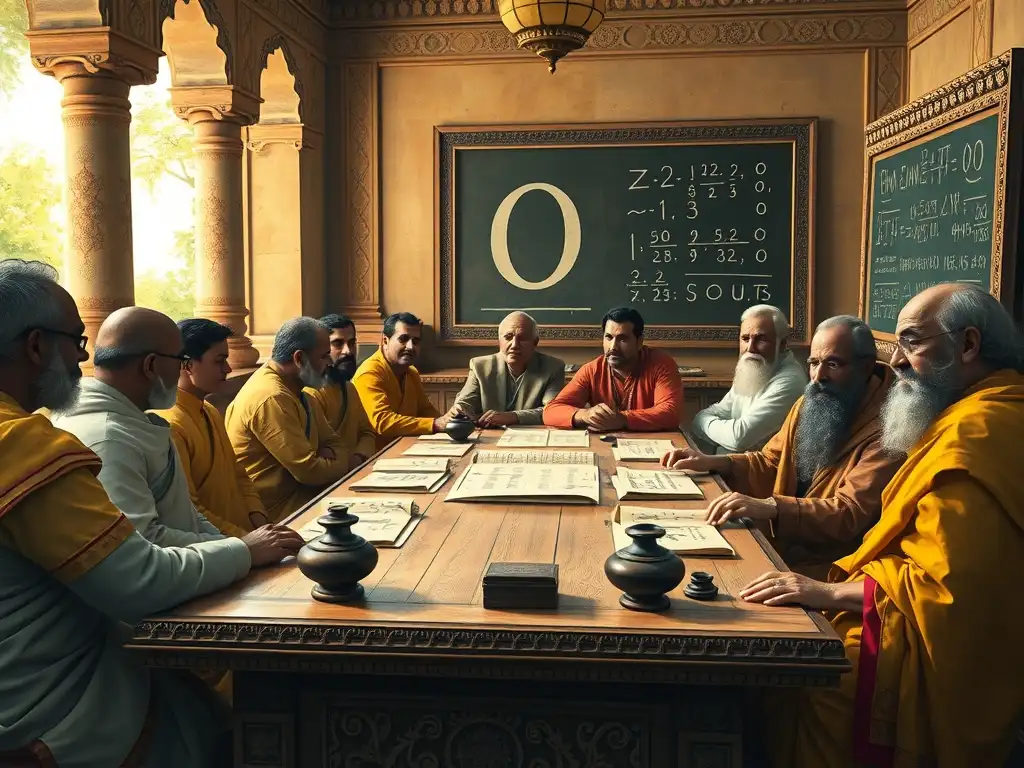
The Gupta Empire, often referred to as the Golden Age of India, witnessed remarkable advancements in various fields, particularly in mathematics. This period produced several influential mathematicians whose contributions not only shaped the mathematical landscape of their time but also laid the groundwork for future developments. Below, we explore the lives and works of some of the most notable mathematicians from this era.
Aryabhata: Contributions to Mathematics and Astronomy
Aryabhata, born in 476 CE, is one of the most celebrated mathematicians and astronomers of the Gupta Era. His seminal work, the Aryabhatiya, encompasses a wide array of topics, including arithmetic, algebra, and astronomy.
Key Contributions:
- Place Value System: Aryabhata employed a positional decimal numeral system, which not only enhanced calculations but also established the foundation for the modern numeral system.
- Value of Pi: He calculated the value of π (pi) to an accuracy of four decimal places, demonstrating a sophisticated understanding of geometry.
- Trigonometry: Aryabhata introduced sine functions, significantly contributing to the field of trigonometry. His work on sine tables aided in various astronomical calculations.
- Astronomical Calculations: He proposed that the Earth rotates on its axis, providing an early understanding of heliocentrism, and calculated the length of the solar year with impressive precision.
Aryabhata's innovative methods and theories set a precedent for future mathematicians, influencing both Indian and global mathematics.
Brahmagupta: The First to Formalize Zero in Calculations
Brahmagupta, born in 598 CE, was another pivotal figure in the evolution of mathematics during the Gupta Empire. His key work, the Brahmasphutasiddhanta, was groundbreaking, particularly in its treatment of zero.
Key Contributions:
- Formalization of Zero: Brahmagupta was the first to define zero as a number and outline its properties. He stated that:
- The sum of any number and zero is the number itself.
- The difference between a number and itself is zero.
- Arithmetic Operations with Zero: He provided rules for performing arithmetic operations with zero, thus allowing for more complex calculations and paving the way for algebra.
- Quadratic Equations: Brahmagupta also developed methods for solving quadratic equations, providing systematic approaches that would influence future mathematicians.
His work on zero was revolutionary, fundamentally changing the way mathematics was approached, both in India and beyond.
Other Influential Mathematicians and Their Works
In addition to Aryabhata and Brahmagupta, several other mathematicians from the Gupta Era made significant contributions:
Varahamihira (505-587 CE)
- Astrology and Mathematics: Varahamihira combined astrology with mathematics, contributing to trigonometry and providing extensive astronomical tables in his work, the Panchasiddhantika.
Bhaskara I (600-680 CE)
- Astronomy and Mathematics: Known for his work on the sine function, Bhaskara I created sine tables and introduced the concept of applying zero in calculations in his commentary on Aryabhata's work.
Mahavira (9th Century CE)
- Mathematical Treatises: Mahavira's Ganita Sara Samgraha elaborated on arithmetic and geometry, strengthening the foundation laid by earlier mathematicians.
These mathematicians collectively contributed to the development of Gupta Empire mathematics and zero, influencing fields such as algebra, astronomy, and arithmetic, and establishing a legacy that would resonate through centuries. Their works not only reflect the intellectual richness of the Gupta Era but also highlight the importance of mathematical innovation in shaping civilization.
Conclusion: The Legacy of Gupta Empire Mathematics and Zero

Recap of Key Contributions to Mathematics
The Gupta Empire, often referred to as the "Golden Age of India," was a period marked by significant advancements in mathematics. Among the most notable contributions was the formalization of the concept of zero, which revolutionized not only Indian mathematics but had a profound impact on the global mathematical landscape. Here are some key highlights of Gupta Empire mathematics:
- Invention of Zero: Zero, represented as a symbol and a concept, emerged during the Gupta period. It allowed for the simplification of calculations and the representation of large numbers, fundamentally changing mathematical operations.
- Decimal System: The use of a decimal place-value system was refined during this era. This system, which included the use of zero as a placeholder, enhanced computational efficiency and accuracy.
- Arithmetic Operations: Mathematicians like Brahmagupta developed rules for arithmetic operations involving zero, including addition, subtraction, and division by zero—an area that sparked significant philosophical and mathematical debates.
- Geometry and Algebra: Gupta scholars made strides in geometry and algebra. They explored topics such as quadratic equations and geometric principles that laid the groundwork for later mathematical developments.
These contributions were not only pivotal for their time but also served as a foundation for future mathematical thought and development across cultures.
The Enduring Importance of Zero in Mathematics Today
The introduction of zero by Gupta Empire mathematicians cannot be overstated; it is considered one of the most significant achievements in the history of mathematics. Here are several ways in which the legacy of zero continues to influence modern mathematics:
- Foundation of Modern Mathematics: Zero is essential in the field of mathematics today, acting as a fundamental building block for various branches, including algebra, calculus, and number theory.
- Computational Efficiency: The decimal system and the inclusion of zero allow for efficient calculations, enabling complex mathematical operations and the development of computer algorithms.
- Mathematical Notation: The way we express numbers today, including whole numbers, fractions, and decimals, heavily relies on the concept of zero. Without it, representing and calculating would be cumbersome and less effective.
- Philosophical Implications: The concept of zero also raises intriguing philosophical questions about the nature of nothingness and existence, influencing not only mathematics but also fields like physics and metaphysics.
The impact of the Gupta Empire's contributions to mathematics, particularly the concept of zero, resonates throughout history and remains integral to contemporary mathematical practices. The legacy of these ancient scholars is felt in classrooms, scientific research, and technological advancements globally, highlighting the enduring significance of Gupta Empire mathematics and zero.
Frequently Asked Questions
What is the significance of the Gupta Empire in the history of mathematics?
The Gupta Empire is often regarded as a golden age for mathematics, where significant contributions were made, particularly in the development of the concept of zero.
How did the birth of zero influence mathematics during the Gupta period?
The introduction of zero as a number allowed for the creation of a place-value system, which greatly simplified calculations and paved the way for advanced mathematics.
What are some key mathematical achievements from the Gupta era?
During the Gupta era, mathematicians like Aryabhata made groundbreaking advancements in algebra, geometry, and trigonometry, laying the foundation for future mathematical studies.
Who were the prominent mathematicians of the Gupta Empire?
Notable figures include Aryabhata, who is credited with concepts such as the approximation of pi and the place-value system, significantly impacting mathematics.
How did the concept of zero spread from the Gupta Empire to the rest of the world?
The concept of zero was transmitted through trade routes and cultural exchanges, eventually influencing mathematical practices in Islamic and European cultures.
Final Reflection: The Enduring Legacy of Gupta Empire Mathematics and the Birth of Zero
The Gupta Empire's contributions to mathematics, particularly the invention of zero, resonate profoundly in our modern world. This pivotal concept not only revolutionized mathematical calculations but also laid the groundwork for advancements in science, technology, and economics that we often take for granted today. The legacy of Gupta Empire mathematics is a testament to human ingenuity and the power of ideas to transcend time and culture.
The influence of Gupta mathematics is woven into the fabric of our daily lives, shaping everything from the way we conduct business to how we understand the universe. The introduction of zero as a numeral was not merely a mathematical innovation; it was a philosophical shift that changed our perception of value and existence. As the mathematician and philosopher Alfred North Whitehead once said, Mathematics is a science of patterns.
This pattern of thought, initiated during the Gupta Era, continues to inspire generations, reminding us that the pursuit of knowledge knows no bounds.
As we reflect on the profound impact of the Gupta Empire's mathematical advancements, let us embrace the lessons of innovation and curiosity that they impart. I invite you to explore how the principles of mathematics, particularly the concept of zero, can inspire your own journey of discovery and creativity.
Consider how you can apply these timeless ideas in your life, whether in problem-solving, critical thinking, or simply appreciating the beauty of numbers. The legacy of the Gupta Empire is not just a historical footnote; it is a call to action for all of us to engage with the world of mathematics and its infinite possibilities.
Unveil the Power of Zero: Take Action Today!
Thank you for exploring the fascinating world of mathematics during the Gupta Era! You've discovered how the groundbreaking concept of zero reshaped not only mathematics but also our perception of the universe. Now, it’s time to translate that inspiration into action!
Here are some ways to harness the legacy of zero in your life:
- Explore the history of mathematics: Delve deeper into ancient mathematical concepts that laid the groundwork for modern science. Consider reading insightful books or watching documentaries on this subject.
- Share your newfound knowledge: Initiate a conversation with friends or family about the significance of zero and its impact on daily life. Spread the inspiration!
- Create a small project: Write a blog post or produce a video explaining how the invention of zero has influenced contemporary mathematics.
As you reflect on these ideas, ask yourself: How can understanding the history of mathematics transform your perspective on problem-solving today?