
The Impact of Hindu Philosophy on Global Spiritual Movements


Welcome to Ancient India History, where we embark on a fascinating journey through the rich tapestry of India's past. Dive deep into the impact of Hindu philosophy on global spiritual movements, a compelling exploration of how ancient wisdom has transcended borders and influenced countless cultures worldwide. As you navigate through our site, you'll uncover the profound contributions of ancient Indian civilizations, from the enigmatic Indus Valley to the illustrious Gupta Empire.
Prepare to be intrigued and inspired as we reveal the timeless principles that continue to shape spiritual thought across the globe. Let your curiosity guide you as you explore the depths of this remarkable heritage!

Introduction to Hindu Philosophy and Its Global Influence
Hindu philosophy, with its profound insights and diverse perspectives, has played a pivotal role in shaping not only the spiritual landscape of India but also the broader canvas of global spiritual movements. Rooted in ancient texts such as the Vedas, Upanishads, and the Bhagavad Gita, Hindu philosophy offers a rich tapestry of concepts that explore the nature of existence, morality, and the pursuit of truth.
As we delve into the impact of Hindu philosophy on global spiritual movements, it becomes evident that its core teachings have transcended geographical boundaries, influencing various cultures and belief systems across the world. This article will explore the key tenets of Hindu philosophy, highlighting its enduring legacy and relevance in contemporary spiritual discourse.
Understanding Hindu Philosophy
Hindu philosophy is not monolithic; it encompasses six orthodox schools (Darshanas) that offer unique interpretations of reality and the self. These schools—Nyaya, Vaisheshika, Samkhya, Yoga, Mimamsa, and Vedanta—provide frameworks for understanding the universe, the nature of consciousness, and the path to liberation.
- Nyaya focuses on logic and epistemology, emphasizing the importance of reasoning in the pursuit of knowledge.
- Vaisheshika explores the nature of reality through an atomistic lens, categorizing existence into substances, qualities, and actions.
- Samkhya presents a dualistic view, distinguishing between consciousness (Purusha) and matter (Prakriti).
- Yoga offers practical techniques for self-realization and mastery over the mind, as outlined in the Yoga Sutras of Patanjali.
- Mimamsa emphasizes ritualistic practices and the power of dharma (duty) in maintaining cosmic order.
- Vedanta delves into the ultimate nature of reality, advocating for the realization of the self (Atman) as one with the universal consciousness (Brahman).
These philosophical frameworks have laid the groundwork for understanding the interconnectedness of all beings and the pursuit of a higher consciousness, serving as a foundation for various global spiritual movements.
Overview of Global Spiritual Movements
The influence of Hindu philosophy can be observed in numerous spiritual movements around the globe. From the New Age movement in the West to the resurgence of interest in Eastern philosophies, the principles of Hindu thought have found resonance in diverse contexts.
- Buddhism, which originated in India, shares many philosophical tenets with Hinduism, particularly the concepts of karma and moksha.
- Transcendental Meditation and other mindfulness practices have drawn heavily from Hindu meditative techniques, promoting mental well-being and spiritual growth.
- Theosophy, a spiritual movement that emerged in the late 19th century, incorporated Hindu ideas about karma, reincarnation, and the evolution of the soul.
As these movements continue to evolve, Hindu philosophy remains a significant reference point for seekers of spiritual truth across various cultures.
Key Tenets of Hindu Philosophy That Shaped Spiritual Thought
The Concept of Dharma and Its Worldwide Relevance
At the heart of Hindu philosophy lies the concept of dharma, which refers to the moral and ethical duties that govern an individual's life. This principle emphasizes the importance of righteousness, duty, and social responsibility, guiding individuals in their personal and communal lives.
- Global Relevance: The idea of dharma resonates with contemporary ethical discussions, promoting values such as justice, compassion, and integrity in various cultures.
The Principle of Karma and Its Impact on Global Ethics
The principle of karma, the law of cause and effect, underlines the belief that every action has consequences. This concept has profound implications for ethical behavior and social responsibility.
- Universal Appeal: The notion of karma has been embraced in various spiritual traditions, encouraging individuals to act with mindfulness and accountability.
The Pursuit of Moksha: Liberation and Spiritual Awakening
The ultimate goal of Hindu philosophy is the pursuit of moksha, or liberation from the cycle of birth and rebirth (samsara). This aspiration for spiritual awakening inspires seekers worldwide to explore deeper states of consciousness and transcendental experiences.
- Spiritual Movements: Many global spiritual movements advocate for personal enlightenment and liberation, echoing the Hindu quest for moksha.
The impact of Hindu philosophy on global spiritual movements is profound and multifaceted, influencing ethical frameworks, spiritual practices, and the quest for understanding the self and the universe. Through its key tenets, Hindu philosophy continues to inspire and shape spiritual thought across diverse cultures.
Historical Context: The Spread of Hindu Philosophy
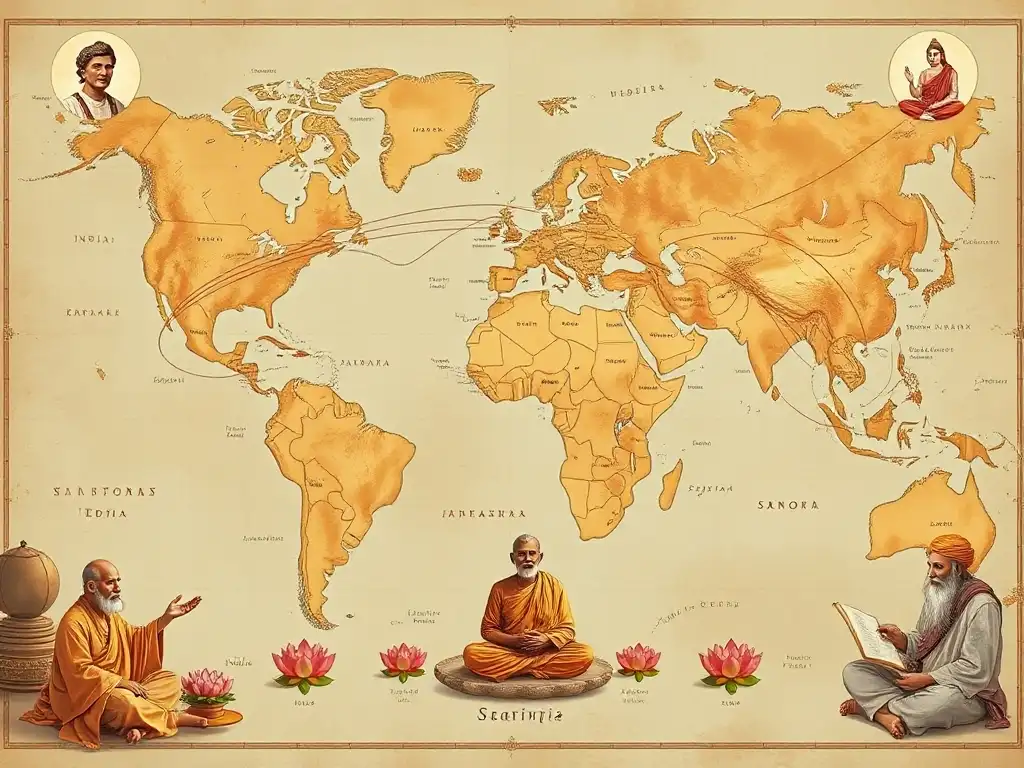
Hindu philosophy has played a significant role in shaping spiritual movements across the globe. Its roots trace back to ancient India, where it began to crystallize through various texts and teachings, including the Vedas, Upanishads, and later, the Bhagavad Gita. As trade routes expanded and cultural exchanges flourished, the philosophical tenets of Hinduism began to permeate other cultures, influencing a variety of spiritual traditions. This dissemination was not merely due to geographic spread but was also propelled by the rich dialogues between different civilizations, which fostered a deeper understanding of existential questions, morality, and the nature of reality.
Ancient Trade Routes and Cultural Exchange
The ancient trade routes, particularly the Silk Road, were instrumental in the spread of Hindu philosophy. These routes facilitated not only the exchange of goods but also ideas and beliefs. Merchants, travelers, and scholars traversed these paths, bringing with them philosophical texts and teachings. Cities that served as trading hubs, such as Taxila and Nalanda, became melting pots of diverse ideas.
This cultural exchange allowed for the synthesis of Hindu philosophical ideas with local beliefs, leading to the emergence of hybrid spiritual practices. For instance, as Hindu merchants traveled to Southeast Asia, they introduced elements of Hindu cosmology and ethics, which integrated with indigenous traditions, ultimately giving rise to unique spiritual systems in places like Bali and Cambodia.
The Role of Indian Scholars and Travelers in Disseminating Ideas
Indian scholars and travelers played a pivotal role in the global influence of Hindu philosophy. Figures such as Fa-Hien and Xuanzang were instrumental in documenting and interpreting Indian philosophical ideas during their travels through ancient India. These scholars not only translated texts but also engaged in dialogues with local philosophers, creating a bridge between different intellectual traditions.
Moreover, the establishment of universities like Nalanda attracted students from various regions, including China, Tibet, and Persia. The curriculum included a deep dive into Hindu philosophy, which influenced the intellectual landscape of these cultures. As these students returned home, they carried with them the teachings of Hinduism, further enhancing its global influence.
Comparative Analysis: Hindu Philosophy and Other Global Spiritual Traditions
Hindu philosophy presents a rich tapestry of ideas that resonate with various global spiritual traditions. By exploring these connections, we can discern the profound impact Hindu thought has had on the spiritual landscape worldwide.
Similarities Between Hindu Philosophy and Buddhism
Hindu philosophy and Buddhism share several foundational concepts, such as karma, dharma, and moksha, despite their distinct identities. Both traditions emphasize the importance of ethical living and the pursuit of liberation from the cycle of birth and rebirth (samsara).
While Buddhism emerged as a reform movement within Hinduism, it retained many philosophical elements, such as meditation practices and the quest for enlightenment. The dialogue between these two traditions has led to a mutual reinforcement of ideas, particularly regarding the nature of suffering and the path to spiritual awakening.
The Influence of Hindu Thought on New Age Spirituality
In contemporary times, Hindu philosophy has significantly influenced the New Age spiritual movement. Concepts such as yoga, meditation, and the notion of higher consciousness, rooted in Hindu teachings, have gained immense popularity in the West.
New Age practitioners often draw on Hindu texts like the Bhagavad Gita and Upanishads, adapting their teachings to promote personal growth and spiritual exploration. The focus on self-realization and interconnectedness with the universe, central to Hindu thought, resonates deeply within New Age ideologies, illustrating the enduring legacy of Hindu philosophy in modern spiritual practices.
Connections Between Hindu Philosophy and Western Philosophical Traditions
Hindu philosophy has also left an indelible mark on Western philosophical thought. The Enlightenment period saw a growing interest in Eastern philosophies, with many Western thinkers, such as Ralph Waldo Emerson and Aldous Huxley, finding inspiration in Hindu concepts of reality and consciousness.
The notion of non-duality (Advaita) in Hindu philosophy parallels ideas found in existentialism and phenomenology, prompting discussions on the nature of self and existence. Furthermore, the emphasis on intuitive knowledge and experiential understanding in Hinduism resonates with certain strands of Western thought that prioritize subjective experience over empirical reasoning.
The global influence of Hindu philosophy is a testament to its profound depth and adaptability. Through historical exchanges, cross-cultural dialogues, and evolving interpretations, Hindu thought continues to inspire and shape spiritual movements across the world.
Case Studies: Notable Global Movements Influenced by Hindu Philosophy
Hindu philosophy has played a significant role in shaping various global spiritual movements, demonstrating its profound influence beyond the Indian subcontinent. This section highlights notable movements and their connections to Hindu philosophical tenets, illustrating how these ideas have permeated different cultures and societies.
The Transcendentalist Movement in America
Emerging in the early 19th century, the Transcendentalist Movement in America was marked by a deep belief in the inherent goodness of people and nature. Central figures like Ralph Waldo Emerson and Henry David Thoreau drew inspiration from Hindu texts, particularly the Upanishads. They emphasized concepts such as the interconnectedness of all life and the importance of intuition and spiritual experience over empirical knowledge.
- Key Influences:
- Unity with Nature: Transcendentalists echoed the Hindu belief in the sacredness of nature, advocating for a harmonious relationship with the environment.
- Self-Reliance: Emerson's essay "Self-Reliance" reflects the Hindu notion of Atman, the inner self, promoting individualism and personal spiritual exploration.
This philosophical exchange laid the groundwork for a broader spiritual awakening in the United States, encouraging a more profound connection to nature and self-discovery.
The Beat Generation and Eastern Philosophy
The Beat Generation of the 1950s was a literary and cultural movement that sought to challenge the norms of American society. Writers like Jack Kerouac and Allen Ginsberg were instrumental in introducing Eastern philosophies, including Hinduism, into the Western literary canon. The Beats embraced Hindu concepts of spirituality, non-attachment, and the quest for enlightenment.
- Key Elements:
- Spiritual Exploration: Kerouac's works, especially "On the Road," reflect a quest for spiritual truth akin to the Hindu pursuit of Moksha (liberation).
- Meditative Practices: Ginsberg’s poetry often incorporated elements of Hindu meditation and mindfulness, showcasing the influence of these practices on creative expression.
This movement significantly contributed to the popularization of Eastern thought in America, paving the way for a more open engagement with diverse spiritual practices.
Yoga as a Global Phenomenon: From India to the West
Yoga, with its rich philosophical roots in Hinduism, has transformed into a global phenomenon that transcends cultural boundaries. While traditionally a spiritual practice aimed at achieving union with the divine, it has been adapted in various ways to suit contemporary lifestyles.
- Global Adaptation:
- Physical Fitness: In the West, yoga is often marketed as a physical exercise regimen, focusing on breath control, flexibility, and strength, yet it retains its philosophical foundations.
- Holistic Wellness: Many practitioners incorporate the principles of yoga, such as mindfulness and ethical living (Yamas and Niyamas), into their daily lives, promoting overall well-being.
This evolution not only illustrates the adaptability of Hindu philosophy but also highlights its capacity to influence global health and wellness trends.
Modern Adaptations of Hindu Philosophy in Global Context
As Hindu philosophy continues to resonate worldwide, modern adaptations showcase its relevance in addressing contemporary spiritual and existential questions. This section examines how these philosophies have been integrated into various global contexts, enriching spiritual dialogues.
The Rise of Meditation and Mindfulness Practices
In recent years, meditation and mindfulness have gained immense popularity, often linked to Hindu practices like Dhyan (meditative contemplation). These techniques are now widely recognized for their mental health benefits and are employed in various settings, from corporate environments to educational institutions.
- Key Aspects:
- Stress Reduction: Many individuals practice mindfulness to alleviate stress, a concept deeply rooted in Hindu teachings that emphasize the importance of being present.
- Psychological Benefits: Research supports the effectiveness of meditation in enhancing focus and emotional regulation, echoing the Hindu understanding of the mind's nature.
The global embrace of these practices illustrates a growing recognition of the value of ancient philosophical insights in promoting mental well-being.
Contemporary Spiritual Leaders and Their Hindu Influences
Modern spiritual leaders, such as Deepak Chopra and Sadhguru, draw heavily from Hindu philosophy, bridging ancient wisdom with contemporary issues. Their teachings often focus on personal transformation, holistic health, and global consciousness.
- Prominent Figures:
- Deepak Chopra: Emphasizes the integration of science and spirituality, promoting concepts such as consciousness and the interconnectedness of all beings—central tenets of Hindu thought.
- Sadhguru: Advocates for inner engineering and self-awareness, encouraging individuals to tap into their inner potential, reminiscent of the Hindu pursuit of self-realization.
These leaders not only popularize Hindu philosophy but also inspire individuals worldwide to explore deeper spiritual truths, illustrating the enduring global influence of Hindu thought.
Critiques and Misinterpretations of Hindu Philosophy
Hindu philosophy, with its intricate doctrines and diverse interpretations, has faced various critiques and misinterpretations over the years. One of the main criticisms revolves around the perceived complexity and obscurity of its concepts, which some argue can lead to confusion among both adherents and outsiders. Critics often highlight the variability in interpretations of key texts like the Vedas, Upanishads, and the Bhagavad Gita, suggesting that this lack of a singular perspective can dilute the philosophy's core teachings.
Moreover, certain Western philosophical frameworks may critique Hindu philosophy for its metaphysical assumptions or its emphasis on spirituality over empirical reasoning. This has led to a perception that Hindu philosophy is less rigorous compared to Western philosophical traditions. Such critiques generally stem from a misunderstanding of the non-dualistic approach adopted in Hindu thought, which prioritizes experiential knowledge over purely rational analysis.
Common Misunderstandings of Hindu Concepts
One common misunderstanding of Hindu philosophy is the concept of "karma." Often simplistically interpreted as a form of fate or destiny, karma actually encompasses a complex system of ethical causation where individual actions (both good and bad) shape future experiences. This nuanced understanding emphasizes personal responsibility and moral integrity rather than a deterministic view of life.
Another frequently misinterpreted concept is "moksha," or liberation from the cycle of birth and rebirth. Many view moksha merely as a personal escape from suffering, neglecting its broader implication of achieving unity with the divine. This misunderstanding reduces the rich philosophical discussions around interconnectedness and the ultimate purpose of life to a singular, self-centered pursuit.
Furthermore, the term "yoga" is often associated solely with physical postures in the West, overshadowing its philosophical roots and ethical dimensions as outlined in texts like the Yoga Sutras of Patanjali. Yoga, as articulated in Hindu philosophy, is a comprehensive system for personal development encompassing ethical conduct, self-discipline, meditation, and the attainment of knowledge.
The Appropriation of Hindu Philosophy in Western Contexts
The appropriation of Hindu philosophy in Western contexts raises important discussions about authenticity and respect. Many Western movements, particularly during the 20th century, have drawn upon Hindu principles, often recontextualizing them to fit contemporary spiritual practices. While this cross-pollination can foster greater appreciation for Hindu thought, it can also lead to superficial interpretations that strip away the richness of the original concepts.
For instance, the adoption of meditation practices in the West has often sidelined the philosophical underpinnings that emphasize mindfulness and the nature of consciousness found in Hindu texts. Such adaptations may inadvertently commercialize sacred practices, transforming them into mere wellness trends devoid of their spiritual significance.
Additionally, the use of symbols such as the lotus or the Om symbol in fashion and branding often lacks an understanding of their deeper meanings within the Hindu tradition. This can result in a disconnection from the cultural and religious contexts from which these symbols originate, leading to feelings of cultural insensitivity among practitioners.
Conclusion: The Lasting Impact of Hindu Philosophy on Global Spirituality
The lasting impact of Hindu philosophy on global spirituality is profound and multifaceted. Its principles have not only influenced various spiritual movements but have also fostered a greater appreciation for the interconnectedness of all life. Concepts like non-dualism and the pursuit of inner truth resonate deeply within various contemporary spiritual practices, promoting a holistic approach to understanding existence.
Hindu philosophy's emphasis on self-inquiry and introspection has inspired many to explore their spiritual paths more deeply, transcending cultural and geographical boundaries. As a result, its teachings continue to encourage individuals to seek their own truths and connect with the broader universe.
Reflecting on the Future of Hindu Philosophy in Global Movements
Looking ahead, the future of Hindu philosophy within global spiritual movements holds immense potential for fostering dialogue and understanding. As more individuals seek spiritual depth in an increasingly interconnected world, the teachings of Hindu philosophy can provide invaluable insights into the nature of consciousness and the pursuit of harmony.
Promoting authentic engagement with Hindu philosophy, rather than superficial appropriation, can pave the way for enriched spiritual practices that respect and uphold the integrity of its teachings. This can encourage a more profound appreciation of the wisdom encapsulated within Hindu texts, fostering a global community that values diversity in spiritual exploration.
Encouraging Cross-Cultural Understanding and Respect
Encouraging cross-cultural understanding and respect is vital in navigating the complexities of Hindu philosophy's global influence. Educating individuals about the nuances and context of Hindu teachings can help dispel misconceptions and promote a more accurate understanding.
Initiatives that foster interfaith dialogue and collaborative learning can further bridge cultural divides, allowing for a richer exchange of ideas and practices. By creating spaces for open discussion, individuals from different backgrounds can share their interpretations and experiences, enriching the global spiritual landscape.
Ultimately, fostering respect for the origins and authenticity of Hindu philosophy will not only honor its historical significance but also enhance its relevance in contemporary spiritual practices across cultures. This commitment to understanding and respect can lead to a more harmonious coexistence and a deeper appreciation for the diverse tapestry of human spirituality.
- Introduction to Hindu Philosophy and Its Global Influence
- Understanding Hindu Philosophy
- Overview of Global Spiritual Movements
- Key Tenets of Hindu Philosophy That Shaped Spiritual Thought
- Historical Context: The Spread of Hindu Philosophy
- Comparative Analysis: Hindu Philosophy and Other Global Spiritual Traditions
- Case Studies: Notable Global Movements Influenced by Hindu Philosophy
- Modern Adaptations of Hindu Philosophy in Global Context
- Critiques and Misinterpretations of Hindu Philosophy
- Common Misunderstandings of Hindu Concepts
- The Appropriation of Hindu Philosophy in Western Contexts
- Conclusion: The Lasting Impact of Hindu Philosophy on Global Spirituality
- What is the primary focus of Hindu philosophy in relation to global influence?
- How has Hindu philosophy contributed to modern spiritual teachings?
- Which global spiritual movements have been influenced by Hindu philosophy?
- What are some key texts of Hindu philosophy that have gained global recognition?
- How do scholars view the impact of Hindu philosophy on Western thought?
Frequently Asked Questions
What is the primary focus of Hindu philosophy in relation to global influence?
Hindu philosophy emphasizes spiritual growth and self-realization, which have significantly influenced various global spiritual movements and practices, including yoga and meditation.
How has Hindu philosophy contributed to modern spiritual teachings?
Hindu philosophy's principles of non-attachment and unity have been integrated into many contemporary spiritual teachings, promoting a holistic approach to personal development and well-being.
Which global spiritual movements have been influenced by Hindu philosophy?
Several movements, such as New Age spirituality and Buddhism, have drawn from Hindu concepts like karma, reincarnation, and the pursuit of enlightenment, showcasing its wide-reaching impact.
What are some key texts of Hindu philosophy that have gained global recognition?
Texts such as the Bhagavad Gita, Upanishads, and Yoga Sutras are pivotal in conveying Hindu philosophical ideas, gaining international acclaim and inspiring countless spiritual seekers worldwide.
How do scholars view the impact of Hindu philosophy on Western thought?
Scholars note that Hindu philosophy has deeply influenced Western thinkers and movements, particularly in the areas of metaphysics, ethics, and psychology, fostering a greater understanding of spiritual interconnectedness.
Final Reflection: The Enduring Legacy of Hindu Philosophy on Global Spiritual Movements
The profound insights of Hindu philosophy continue to resonate in today's world, shaping spiritual practices and beliefs across cultures. As we navigate an increasingly interconnected global landscape, the teachings of Hinduism offer timeless wisdom that transcends geographical boundaries and cultural divides. The relevance of these philosophies in contemporary spiritual movements underscores their significant impact and enduring legacy.
Hindu philosophy has not only enriched individual spiritual journeys but has also fostered a collective awakening in the global consciousness. The principles of interconnectedness, mindfulness, and the pursuit of truth have found their way into various spiritual practices worldwide, influencing everything from yoga to meditation. As noted by spiritual leader Deepak Chopra, Hinduism is the only religion that has a concept of the universe as a living entity, which is a profound insight that can transform our understanding of existence.
This perspective invites us to explore the deeper connections we share with one another and the universe, highlighting the ongoing relevance of Hindu thought in shaping our cultural and social landscapes.
As we reflect on the teachings of Hindu philosophy, let us embrace the invitation to deepen our understanding of ourselves and our place in the world. Consider how these ancient principles can inspire your personal spiritual journey and foster a greater sense of unity and compassion in your interactions with others. In a time when division often prevails, let the wisdom of Hindu philosophy guide you toward a path of enlightenment, encouraging you to contribute positively to the global spiritual movement.
Embrace Global Spirituality Through Hindu Wisdom!
Thank you for exploring the profound influence of Hindu philosophy on spiritual movements worldwide. You've uncovered the timeless values and insights that can enrich your own spiritual journey. Now, it's time to take action and deepen your connection with these transformative teachings.
Here are a few ways you can continue your exploration:
- Dive Deeper: Read more about essential Hindu texts such as the Bhagavad Gita and the Upanishads to understand their relevance in today's spiritual landscape.
- Join a Community: Connect with a local or online spiritual group that focuses on Hindu philosophy and its influence on global spirituality, fostering enriching conversations with others who share your interests.
- Share the Knowledge: Create a blog or organize a discussion group to exchange your insights regarding the impact of Hindu philosophy on various spiritual movements.
What aspect of Hindu philosophy resonates most with you, and how will you incorporate it into your daily life?