
The Interplay of Nyaya and Vaisheshika: A Synergistic Approach to Philosophy


Welcome to Ancient India History, where we embark on a fascinating journey through the rich tapestry of ancient Indian civilizations! In this exploration, we delve into the profound realms of art, architecture, and philosophy, uncovering the intricate contributions that have shaped India's cultural heritage.
Our featured article, "The Interplay of Nyaya and Vaisheshika: A Synergistic Approach to Philosophy," invites you to discover the depths of Nyaya Vaisheshika philosophy in India—a captivating blend of logic and metaphysics that continues to influence contemporary thought. Join us as we unravel the mysteries of this dynamic philosophical discourse and inspire your curiosity to learn more!

Introduction to Nyaya and Vaisheshika Philosophy in India
The philosophical landscape of ancient India is as rich and intricate as its history, with the Nyaya and Vaisheshika schools standing out as pivotal contributors to the discourse on logic, epistemology, and metaphysics. Together, these two schools offer a synergistic approach that not only deepens our understanding of philosophical inquiry but also underscores the interconnectedness of various strands of thought within Indian philosophy. The interplay of Nyaya, which emphasizes logic and reasoning, with Vaisheshika, focused on atomic theory and categorization of reality, provides a unique framework to explore fundamental questions about existence, knowledge, and the nature of the universe.
As we delve into the significance of these schools, we will uncover their profound impact on subsequent philosophical developments, not only within India but also across the philosophical traditions of the world. This exploration serves to illustrate how the Nyaya Vaisheshika philosophy of India is not merely an academic subject, but a living tradition that continues to inform contemporary discussions on metaphysics and epistemology.
Overview of Indian Philosophy
Indian philosophy encompasses a diverse array of thought systems, each characterized by its unique methodologies and epistemological approaches. It is traditionally divided into two broad categories: Astika (the orthodox schools that accept the authority of the Vedas) and Nashtika (the heterodox schools that do not). The Nyaya and Vaisheshika schools fall under the Astika category, sharing foundational texts and concepts that reflect a sophisticated engagement with the nature of knowledge, reality, and ethics.
Key features of Indian philosophy include:
- Diversity of Thought: Various schools such as Sankhya, Yoga, Mimamsa, and Vedanta, each with its distinct focus, contribute to a rich dialogue.
- Emphasis on Logical Analysis: Especially pronounced in Nyaya, where logic is not just a tool but a means to attain liberation (moksha).
- Integration of Ethical Dimensions: Philosophical inquiry often intertwines with ethical considerations, reflecting the holistic nature of Indian thought.
Significance of Nyaya and Vaisheshika in Ancient India
The significance of Nyaya and Vaisheshika in ancient Indian philosophy cannot be overstated. They were instrumental in establishing a rigorous framework for debate and discourse, influencing not only other philosophical schools but also various aspects of Indian culture, including law, ethics, and educational practices.
Key contributions include:
- Logical Framework: Nyaya introduced precise categories of reasoning that became foundational for subsequent philosophical arguments.
- Metaphysical Insights: Vaisheshika's analysis of the nature of substances and their properties laid the groundwork for discussions on reality and existence.
- Dialogical Tradition: Both schools emphasized the importance of dialogue and debate, fostering a culture of intellectual exchange that is still relevant today.
Key Concepts and Terminology in Nyaya Vaisheshika Philosophy
Understanding Nyaya and Vaisheshika requires familiarity with specific concepts and terminology that define their philosophical inquiries. Some of the key terms include:
- Pramana: The means of knowledge, including perception, inference, and testimony.
- Padarthas: Categories of existence, which Vaisheshika articulates into six main types, including substances, qualities, and actions.
- Nyaya Sutras: The foundational texts of Nyaya philosophy, attributed to the sage Gautama, which outline the principles of logic and epistemology.
Historical Context of Nyaya and Vaisheshika
To fully appreciate the interplay between Nyaya and Vaisheshika, it is essential to examine their historical contexts, origins, and development.
Origins of Nyaya Philosophy
Nyaya philosophy traces its origins to the ancient texts known as the Nyaya Sutras, composed around the 2nd century BCE. Gautama, its founder, established a systematic approach to logic and epistemology that sought to address the nature of knowledge and the process of valid reasoning. Nyaya philosophy emphasizes:
- The Four Pramanas: Identifying valid means of acquiring knowledge.
- Debate and Disputation: Establishing a method for philosophical discourse that was rigorous and methodical.
Development of Vaisheshika Philosophy
Vaisheshika, often seen as complementary to Nyaya, emerged around the same period and is associated with the sage Kanada. Its core focus on the material world and the classification of substances led to significant advancements in metaphysical thought. Key aspects include:
- Atomic Theory: The idea that everything in the universe is composed of indivisible particles (anu).
- Categorization of Reality: Vaisheshika delineates various categories of existence, providing a comprehensive framework for understanding the natural world.
Influences and Interactions Between Nyaya and Vaisheshika
The interaction between Nyaya and Vaisheshika is characterized by mutual influence and shared concepts. While Nyaya focuses on logic and epistemology, Vaisheshika complements this with its ontological inquiries. This synergy has resulted in:
- Integrated Philosophical Framework: Together, they provide a holistic approach to understanding reality, knowledge, and existence.
- Influence on Later Philosophical Schools: The concepts developed in Nyaya and Vaisheshika continued to influence later thinkers and philosophical traditions, shaping the trajectory of Indian philosophy.
As we explore these intricate connections further, we will uncover the profound legacy of Nyaya and Vaisheshika in the philosophical discourse of ancient India and beyond.
Core Principles of Nyaya Philosophy
Nyaya philosophy, one of the six orthodox schools of Indian philosophy, primarily focuses on logic, epistemology, and the nature of knowledge. Its foundational aim is to establish valid means of acquiring knowledge and to clarify the methods of reasoning. The Nyaya system, attributed to the sage Gautama, emphasizes the significance of logical analysis and debate, encouraging a rigorous examination of arguments and counterarguments. This systematic approach to philosophy seeks to discern truth from falsehood, thereby providing a framework for understanding the universe and our place within it.
At the heart of Nyaya philosophy lies the belief that knowledge can be attained through reliable means, known as "pramanas." These pramanas include perception (pratyaksha), inference (anumana), comparison (upamana), and testimony (sabda). By critically evaluating these sources, Nyaya philosophers aim to construct a coherent and comprehensive understanding of reality, addressing questions of existence, causation, and the nature of the self.
The Nature of Knowledge in Nyaya
In Nyaya philosophy, knowledge is classified into two main categories: "prama" (valid knowledge) and "aprama" (invalid knowledge). Valid knowledge is characterized by its ability to accurately represent the world and is obtained through the pramanas. Nyaya philosophers meticulously outline the criteria for valid knowledge, asserting that it must be free from doubt and error.
Furthermore, Nyaya distinguishes between "anubhava" (immediate experience) and "pratyaksha" (perception), emphasizing that true knowledge arises from direct experience and not merely from conjecture or assumptions. This focus on empirical validation underscores the importance of sensory experience in the pursuit of knowledge, setting the stage for a philosophical discourse that prioritizes observation and logical reasoning.
Logic and Reasoning in Nyaya
Logic, or "nyaya," is the cornerstone of this philosophical school, where it is used as a tool for discerning truth. The Nyaya system comprises a detailed framework for argumentation, involving premises, conclusions, and the relationships between them. This logical structure is designed to ensure clarity and precision in philosophical discussions.
Additionally, Nyaya philosophers developed the "Nyaya Sutras," which serve as a foundational text outlining the principles of logic and reasoning. The sutras provide insights into syllogisms and valid inferential reasoning, illustrating how conclusions can be drawn from established premises. This rigorous approach to logic not only aids in philosophical discourse but also influences various fields, including law and science, by promoting critical thinking and analytical skills.
The Role of Perception and Inference in Nyaya
In Nyaya philosophy, perception and inference are crucial pramanas for acquiring knowledge. Perception (pratyaksha) is considered the most direct means of knowledge, allowing individuals to gather information about the world through their senses. Nyaya philosophers argue that perception must be immediate and unmediated to be valid, emphasizing the importance of clarity in sensory experience.
Inference (anumana), on the other hand, involves drawing conclusions based on the observations made through perception. It allows for the understanding of unobservable phenomena by reasoning from known facts. The Nyaya system meticulously categorizes types of inference, differentiating between direct inference and indirect inference, thus highlighting the complexity and sophistication of logical reasoning in the pursuit of knowledge.
Core Principles of Vaisheshika Philosophy
Vaisheshika philosophy, also one of the six orthodox schools, is often associated with its atomistic theory and a systematic classification of reality. Founded by the sage Kanada, Vaisheshika presents a unique perspective on the nature of existence and emphasizes the material world as composed of distinct entities. This philosophical framework seeks to understand the fundamental building blocks of reality, focusing on the nature of substances, their qualities, and their interactions.
The Vaisheshika system categorizes reality into various elements, including substances, qualities, actions, and universals, providing a comprehensive lens through which to examine the universe. This categorization allows for a nuanced understanding of how different entities interact and exist in relation to one another, ultimately contributing to a broader comprehension of the cosmos.
The Atomistic Theory in Vaisheshika
At the core of Vaisheshika philosophy is the atomistic theory, which posits that all material objects are composed of indivisible particles called "anu" (atoms). This idea marks a significant departure from earlier philosophical thought, introducing a systematic approach to understanding the material world. According to Vaisheshika, these atoms combine to form various substances, each with distinct qualities.
The atomistic theory not only lays the groundwork for a materialistic understanding of reality but also addresses questions about the nature of change and permanence. By explaining how atoms combine and interact, Vaisheshika offers insights into the processes of creation, destruction, and transformation, thus enriching the discourse on the nature of existence.
Categories of Existence in Vaisheshika
Vaisheshika philosophy classifies existence into seven fundamental categories, known as "padarthas." These categories are:
- Substance (Dravya): The basic entities that exist independently, such as earth, water, fire, air, and space.
- Quality (Guna): Attributes or characteristics that substances possess, such as color, taste, and smell.
- Action (Karma): The activities or processes that substances undergo, indicating change and interaction.
- Generality (Samanya): The universal qualities that can be attributed to multiple substances.
- Particularity (Vishesha): The unique characteristics that distinguish one substance from another.
- Inherence (Samavaya): The relationship between substances and their qualities, indicating how qualities reside in substances.
- Non-existence (Abhava): The concept of absence, which is essential for understanding the nature of reality in contrast to existence.
This categorization not only aids in the philosophical investigation of reality but also provides a framework for exploring the relationships between different entities and their attributes, thereby enriching the understanding of the material world.
The Concept of Substance and Quality in Vaisheshika
In Vaisheshika philosophy, the concepts of substance and quality are intricately linked. Substances are viewed as the foundational elements of reality, while qualities serve to describe and differentiate these substances. The relationship between substances and their qualities is crucial for understanding how entities manifest in the world.
Vaisheshika philosophers argue that substances can exist independently, whereas qualities cannot exist without a substance to embody them. This distinction underscores the importance of both concepts in the framework of reality. Furthermore, the exploration of qualities leads to a deeper understanding of how substances interact and change over time, contributing to the dynamic nature of existence.
Through this examination of substance and quality, Vaisheshika provides a comprehensive philosophical approach that complements the logical rigor of Nyaya, showcasing the rich interplay between these two influential schools of thought in ancient India.
The Synergistic Relationship Between Nyaya and Vaisheshika
The relationship between Nyaya and Vaisheshika represents a profound philosophical synergy that has shaped ancient Indian thought. Both schools emerged around the same time, with Nyaya primarily focusing on logic and epistemology, while Vaisheshika delved into metaphysics and atomism. Their interplay is characterized by mutual reinforcement, where the logical frameworks of Nyaya provide a robust basis for the ontological assertions of Vaisheshika.
The combined strength of these philosophies lies in their shared goal of understanding reality and human experience through rigorous analysis. Nyaya’s emphasis on valid reasoning and critical inquiry complements Vaisheshika’s categorization of the physical universe into atoms and substances, creating a more comprehensive worldview. This synergistic approach allows for a more textured understanding of existence, bridging the gap between abstract reasoning and tangible reality.
How Nyaya Complements Vaisheshika's Atomism
Nyaya philosophy, with its focus on the principles of logic, plays a critical role in reinforcing Vaisheshika’s theory of atomism. The Vaisheshika school posits that all objects are composed of indivisible particles, or "anu," which are the fundamental building blocks of the universe. However, the assertion of atomism requires logical justification, which is where Nyaya comes into play.
Nyaya philosophers develop a systematic methodology for establishing the existence of atoms as a concept. Through the use of syllogisms and logical arguments, scholars like Gautama (the founder of Nyaya) provide a framework that validates the existence and interactions of these atoms. For instance, they argue that the observable effects in the world can be logically traced back to the actions of these atoms, thereby strengthening Vaisheshika's claims about the nature of reality.
The Role of Logic in Understanding Vaisheshika's Categories
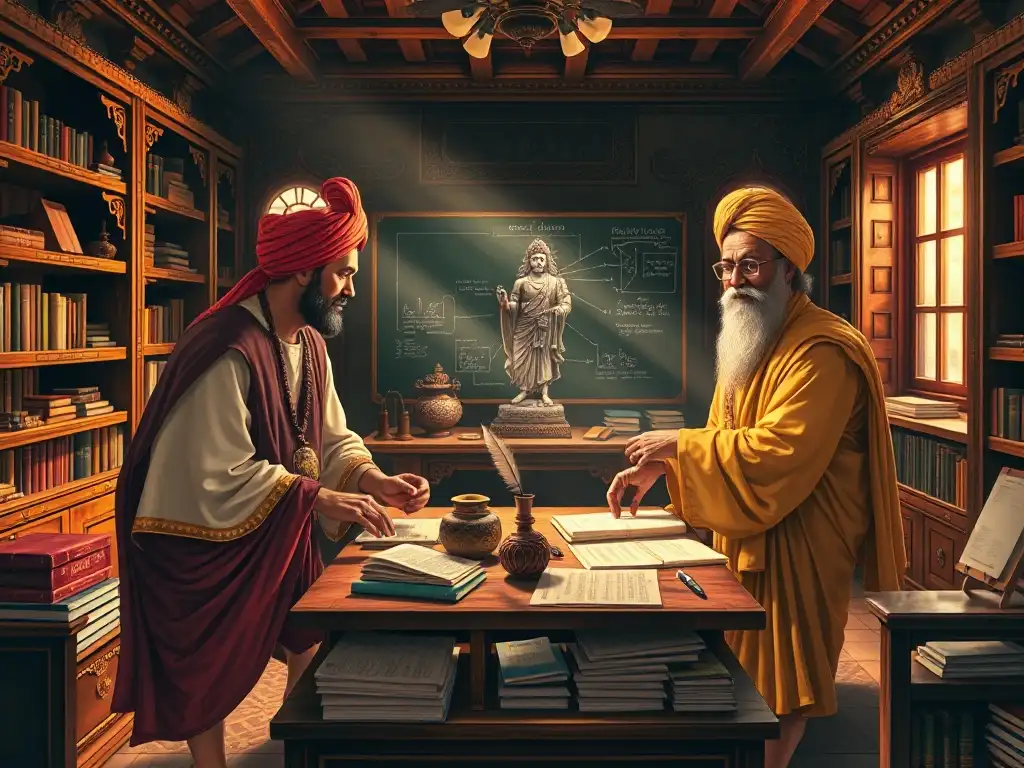
Logic is central to the exploration of Vaisheshika’s categories, which classify the entire universe into distinct entities such as substances, qualities, actions, and universals. The Nyaya school provides the tools necessary to analyze and interpret these categories effectively.
Nyaya’s logical techniques, including the formulation of valid arguments and the use of inference, enable philosophers to dissect each category thoroughly. This logical scrutiny helps in demonstrating how these categories interact and relate to one another, fostering a deeper understanding of both the physical and metaphysical aspects of existence in Vaisheshika philosophy. Consequently, the interplay between logic and categorization becomes a fundamental element in the study of Indian philosophy, enhancing the richness of both schools.
Mutual Influence on Ethical and Epistemological Perspectives
The dialogue between Nyaya and Vaisheshika extends beyond metaphysics into ethical and epistemological realms. Nyaya's focus on epistemology—specifically, the sources of knowledge such as perception, inference, and testimony—provides a framework within which Vaisheshika's metaphysics can be interpreted and understood.
The ethical implications of both schools also come into play, particularly in how they define the right course of action based on logical reasoning and an understanding of the material world. Nyaya’s method of logical inquiry informs Vaisheshika's ethical considerations, suggesting that knowledge derived from logical reasoning should guide moral actions. This mutual influence cultivates a comprehensive philosophical landscape where ethics and epistemology are intertwined, leading to a more holistic approach to understanding human conduct and the nature of knowledge.
Comparative Analysis of Nyaya and Vaisheshika
The comparative analysis between Nyaya and Vaisheshika reveals significant insights into their distinct yet complementary philosophies. While both schools aim to elucidate the nature of reality, they do so from different angles, emphasizing different aspects of philosophical inquiry.
Differences in Epistemology: Nyaya vs. Vaisheshika
Nyaya's epistemology is characterized by a detailed analysis of knowledge sources, primarily focusing on perception and inference as the main paths to truth. In contrast, Vaisheshika, while acknowledging these sources, places greater emphasis on the categories of existence itself, which shapes its understanding of knowledge. The two schools differ in their approach to validating knowledge: Nyaya employs rigorous logical analysis, while Vaisheshika relies on the categorization of the material world to support its claims about knowledge.
Contrasting Metaphysical Views of Nyaya and Vaisheshika
Metaphysically, Nyaya and Vaisheshika diverge in their foundational views. Nyaya is concerned with the nature of reality as it pertains to logical relationships and the validity of arguments, while Vaisheshika focuses on the categorical nature of the universe, asserting that everything is composed of atoms and their interactions. This contrast highlights Nyaya’s broader philosophical inquiries against Vaisheshika’s specific interest in the material composition of reality.
The Integration of Logic and Reality in Both Philosophies
Despite their differences, both Nyaya and Vaisheshika integrate logic and reality in unique ways. Nyaya provides a systematic approach to reasoning, which helps to substantiate the claims made by Vaisheshika regarding the existence and behavior of atoms and substances. Conversely, the categorization principles of Vaisheshika enhance the logical inquiries of Nyaya by providing a concrete framework within which logical arguments can be applied. This integration fosters a rich philosophical discourse that continues to influence contemporary discussions in philosophy and science in India and beyond.
Impact of Nyaya and Vaisheshika on Later Philosophical Developments

The Nyaya and Vaisheshika schools of thought have had a profound influence on the trajectory of Indian philosophy, shaping various subsequent philosophical developments. Together, they laid a robust foundation for epistemology, logic, and metaphysics, which were instrumental in the evolution of later schools such as Advaita Vedanta and Buddhist philosophy. Their emphasis on rigorous reasoning and the classification of knowledge prompted scholars to explore the nature of reality and human understanding from diverse angles.
One of the most significant impacts of these philosophies was the introduction of systematic logic, particularly through the Nyaya school. The Nyaya Sutras, authored by Gautama, articulated formal logic and critical reasoning, which became essential tools for philosophical inquiry. This logical framework was later adopted and adapted by other schools, enriching their discourse. The Vaisheshika school contributed through its unique ontological categorizations, influencing how subsequent philosophers approached the concepts of substance, quality, and action.
Influence on Other Indian Philosophical Schools
The interplay between Nyaya and Vaisheshika significantly influenced other Indian philosophical schools, particularly in their approach to epistemology and logic. For instance, the Advaita Vedanta school, founded by Adi Shankaracharya, integrated elements of Nyaya's logical analysis, especially in its arguments against dualistic interpretations of reality. The rigorous methods of debate and reasoning from Nyaya provided tools for Advaita scholars to articulate their non-dualistic views more clearly and convincingly.
Additionally, the Buddhist philosophical tradition, particularly the Madhyamaka school, engaged deeply with Nyaya's logical principles. Figures like Dharmakirti utilized Nyaya's framework to critique the notions of self and permanence, fostering a vibrant discourse that enriched Buddhist thought. This cross-pollination illustrates the dynamic nature of Indian philosophy, where ideas from Nyaya and Vaisheshika were not only preserved but also transformed and expanded upon by later thinkers.
Legacy in Contemporary Indian Philosophy
The legacies of Nyaya and Vaisheshika continue to resonate in contemporary Indian philosophy. Modern philosophers, while often engaging with Western philosophical traditions, find inspiration in the analytical rigor and metaphysical inquiries of these ancient schools. The revival of interest in Indian philosophy has led to the re-examination of Nyaya and Vaisheshika, prompting discussions around epistemological methods and the nature of reality.
Moreover, contemporary thinkers have explored the implications of Nyaya and Vaisheshika in areas such as ethics, political philosophy, and the philosophy of science. Their frameworks provide valuable insights into debates surrounding knowledge production, the nature of truth, and the ethical implications of philosophical inquiry. This legacy underscores the enduring relevance of ancient philosophical traditions in addressing modern issues.
Relevance of Nyaya Vaisheshika Philosophy in Modern Thought
The relevance of Nyaya and Vaisheshika philosophy in modern thought is evident in several ways. Their emphasis on logical reasoning and systematic inquiry resonates with contemporary scientific methods, where critical analysis and evidence-based conclusions are paramount. In an age marked by information overload and varying interpretations of truth, the principles of rigorous reasoning championed by these schools can guide individuals and societies in discerning fact from opinion.
Furthermore, the dialogue between Nyaya and Vaisheshika encourages a pluralistic worldview that acknowledges multiple perspectives. This is particularly pertinent in today's globalized society, where diverse philosophical traditions converge. Engaging with the insights of Nyaya and Vaisheshika can foster deeper intercultural dialogues, enriching our understanding of philosophy as a dynamic and evolving discipline.
Conclusion
Summary of the Interplay between Nyaya and Vaisheshika
The interplay between Nyaya and Vaisheshika reflects a unique synergistic approach to philosophy in ancient India. Their collaboration in addressing fundamental questions of existence, knowledge, and reality has created a rich philosophical landscape that continues to inspire inquiry. By synthesizing elements of logic and metaphysics, these schools not only established foundational concepts but also influenced a wide array of philosophical traditions that followed.
The Significance of Understanding These Philosophies Today
Understanding Nyaya and Vaisheshika is crucial today as it provides insights into the development of analytical thought and the philosophical methodologies that underpin modern inquiry. Their emphasis on reason and evidence offers valuable lessons for contemporary discourse, promoting a culture of critical thinking and open dialogue. This understanding encourages us to appreciate the depth of Indian philosophical traditions and their contributions to global philosophical thought.
Final Thoughts on the Synergistic Approach to Philosophy in Ancient India
The synergistic approach of Nyaya and Vaisheshika exemplifies the collaborative spirit of ancient Indian philosophy. Their mutual engagement not only advanced individual schools of thought but also enriched the entire philosophical milieu of the time. By studying their interplay, we gain a deeper appreciation for the complexity and richness of philosophical inquiry in ancient India, highlighting the timeless relevance of these ideas in our quest for knowledge and understanding today.
References
The exploration of Nyaya and Vaisheshika philosophies has been enriched by various key texts and scholarly sources. This section highlights significant writings that provide foundational knowledge and insights into these philosophical systems, as well as recommendations for further reading.
Key Texts and Sources on Nyaya Vaisheshika Philosophy
- Nyaya Sutras by Gautama: This foundational text of Nyaya philosophy outlines the principles of logic, epistemology, and argumentation. It serves as a crucial resource for understanding the methodology of Nyaya thinkers and their approach to knowledge.
- Vaisheshika Sutras by Kanada: This work presents the metaphysical framework of the Vaisheshika school. It discusses categories of existence, substances, and the nature of reality, making it essential for those interested in the distinctions and overlaps between Nyaya and Vaisheshika.
- Tattva Chintāmaṇi by Gangesha Upadhyaya: This comprehensive text integrates Nyaya and Vaisheshika philosophies and presents a detailed analysis of their concepts. It is noteworthy for its systematic argumentation and clarity in addressing philosophical questions.
- Brahma Sutras: Although primarily associated with Vedanta, the Brahma Sutras include discussions relevant to Nyaya and Vaisheshika, especially concerning epistemology and the nature of reality. The commentaries on this text by various philosophers also provide valuable perspectives.
- Philosophy of Nyaya and Vaisheshika: Scholarly articles and journals dedicated to ancient Indian philosophy often explore the interplay between these two schools. These sources critically analyze their methodologies and contributions to the broader philosophical discourse.
Suggested Further Reading on Ancient Indian Philosophy
- A History of Indian Philosophy by Surendranath Dasgupta: This extensive work covers various Indian philosophical traditions, including Nyaya and Vaisheshika, providing a historical context and a comparative analysis of different schools.
- An Introduction to Indian Philosophy by Christopher Bartley: This accessible text presents key concepts from ancient Indian philosophy, including discussions on logic and metaphysics relevant to Nyaya and Vaisheshika.
- Indian Philosophy: A Very Short Introduction by Sue Hamilton: This concise overview introduces readers to the main ideas and figures in Indian philosophy, including the significance of Nyaya and Vaisheshika in the philosophical landscape.
- The Nyaya-Vaisheshika System: A Critical Study by R. K. Sharma: This work provides a detailed critical examination of both philosophical schools, discussing their methodologies, key arguments, and the historical context in which they developed.
- Indian Philosophy: An Historical Introduction by Jonardon Ganeri: This book explores the evolution of Indian philosophy, with special attention to Nyaya and Vaisheshika, making it a valuable resource for understanding their impact on later philosophical developments.
By engaging with these texts and resources, readers can deepen their understanding of Nyaya and Vaisheshika philosophies and appreciate their contributions to the rich tapestry of ancient Indian thought.
- Introduction to Nyaya and Vaisheshika Philosophy in India
- Historical Context of Nyaya and Vaisheshika
- Core Principles of Nyaya Philosophy
- Core Principles of Vaisheshika Philosophy
- The Synergistic Relationship Between Nyaya and Vaisheshika
- How Nyaya Complements Vaisheshika's Atomism
- The Role of Logic in Understanding Vaisheshika's Categories
- Mutual Influence on Ethical and Epistemological Perspectives
- Comparative Analysis of Nyaya and Vaisheshika
- Differences in Epistemology: Nyaya vs. Vaisheshika
- Contrasting Metaphysical Views of Nyaya and Vaisheshika
- The Integration of Logic and Reality in Both Philosophies
- Impact of Nyaya and Vaisheshika on Later Philosophical Developments
- Influence on Other Indian Philosophical Schools
- Legacy in Contemporary Indian Philosophy
- Relevance of Nyaya Vaisheshika Philosophy in Modern Thought
- Conclusion
- References
Frequently Asked Questions
What is Nyaya Vaisheshika philosophy in India?
Nyaya Vaisheshika philosophy is a dual school of thought that combines logic (Nyaya) and atomism (Vaisheshika) to explore the nature of reality, knowledge, and existence in ancient Indian philosophy.
How did Nyaya and Vaisheshika philosophies influence each other?
These two philosophies interact synergistically, with Nyaya providing a logical framework for the metaphysical insights of Vaisheshika, leading to a more comprehensive understanding of epistemology and ontology.
What are the main contributions of Nyaya Vaisheshika philosophy?
The main contributions include advancements in logic, epistemology, and the classification of reality, which laid the groundwork for later philosophical developments in India and influenced the Indian intellectual tradition.
Who were the key figures associated with Nyaya Vaisheshika philosophy?
Prominent figures include Gautama, the founder of Nyaya, and Kanada, the founder of Vaisheshika, both of whom made significant contributions to the development and systematization of these philosophical systems.
How is Nyaya Vaisheshika philosophy relevant today?
Today, Nyaya Vaisheshika philosophy continues to be relevant in discussions about logic, epistemology, and metaphysics, influencing contemporary debates in both Indian philosophy and global philosophical discourse.
Final Reflection: The Harmonious Fusion of Nyaya and Vaisheshika Philosophy
The interplay of Nyaya and Vaisheshika philosophy remains profoundly relevant today, as it invites us to explore the intricate relationship between logic and metaphysics in our understanding of reality. In a world increasingly dominated by fragmented perspectives, the synthesis of these two philosophical schools offers a holistic approach that encourages critical thinking and comprehensive inquiry. This synergy not only enriches our intellectual landscape but also serves as a reminder of the importance of integrating diverse viewpoints in our quest for knowledge.
The influence of Nyaya and Vaisheshika extends beyond academic discourse; it permeates the cultural and social fabric of India. Their teachings encourage a rigorous examination of our beliefs and the nature of existence, fostering a culture of dialogue and debate. As we navigate the complexities of modern life, the principles derived from these philosophies can guide us in making informed decisions and understanding the world around us. Philosophy is not a theory but an activity.
– Ludwig Wittgenstein. This quote resonates deeply with the essence of Nyaya and Vaisheshika, emphasizing the active engagement required in philosophical inquiry.
As we reflect on the lessons imparted by Nyaya and Vaisheshika, I invite you to embrace the spirit of inquiry in your own life. Consider how the principles of logic and metaphysics can inform your understanding of personal and societal challenges. Let the harmonious fusion of these philosophies inspire you to seek clarity in your thoughts, engage in meaningful discussions, and cultivate a deeper appreciation for the complexities of existence. In doing so, we not only honor the legacy of these ancient schools of thought but also contribute to a more thoughtful and interconnected world.
Unveil the Wisdom of Nyaya and Vaisheshika Together!
Thank you for diving deep into the transformative philosophies of Nyaya and Vaisheshika! We've explored how their principles can enrich our understanding and encourage logical reasoning in everyday life. Now, it's your turn to take inspiration from this ancient wisdom.
Here’s how you can engage further:
- Implement the principles of Nyaya in your daily decision-making— consider maintaining a journal to reflect on your thought processes and logical deductions!
- Join a community of like-minded philosophy enthusiasts— share your insights or questions on dedicated forums or social media platforms that focus on Ancient Indian philosophy.
- Explore further reading on these philosophies— choose a book or an academic article to deepen your understanding and foster engaging discussions with friends or family about your discoveries.
What insights from Nyaya and Vaisheshika do you believe could transform modern philosophical debates?