
Vaisheshika’s Contribution to Science: The Birth of Atomism in Ancient India


Welcome to Ancient India History, where we embark on a journey through the fascinating tapestry of India's past. Here, we delve into the intricate layers of culture, philosophy, and scientific thought that shaped one of the world's oldest civilizations. In our featured article, "Vaisheshika’s Contribution to Science: The Birth of Atomism in Ancient India," we invite you to explore the groundbreaking ideas of ancient Indian atomism and uncover how these early concepts laid the groundwork for modern scientific inquiry.
Prepare to be captivated as we unravel the profound insights of ancient thinkers and their lasting impact on the world. Join us in this exploration, and let the story of ancient India's contributions spark your curiosity!
- Introduction to Vaisheshika Philosophy and Atomism in Ancient India
- Historical Context of Vaisheshika Philosophy
- Fundamental Concepts of Vaisheshika Philosophy
- Vaisheshika’s Contribution to Science and Philosophy
- The Impact of Vaisheshika on Science and Thought
- Legacy of Vaisheshika Philosophy in Ancient India
- Conclusion: The Enduring Influence of Vaisheshika on Science
-
Frequently Asked Questions
- What is the Vaisheshika school of philosophy?
- How did the Vaisheshika philosophy contribute to the concept of atomism?
- Who was the key figure behind the development of Vaisheshika philosophy?
- What are the main principles of Vaisheshika atomism?
- How did ancient Indian atomism influence modern science?
- Final Reflection: Embracing the Legacy of Ancient Indian Atomism
- Unveil the Legacy of Atomism and Take Action!
Introduction to Vaisheshika Philosophy and Atomism in Ancient India
The Vaisheshika philosophy, one of the six orthodox schools of Indian thought, offers profound insights into the nature of reality and the fundamental principles that govern the universe. Originating around the 6th century BCE, this philosophical framework is particularly noted for its pioneering contributions to the concept of atomism.
Central to Vaisheshika is the idea that the universe is composed of indivisible particles, or "anu," which interact in various ways to form the diverse phenomena we observe. This innovative perspective not only laid the groundwork for scientific inquiry in ancient India but also influenced subsequent philosophical discussions and scientific advancements.
The exploration of ancient Indian atomism contributions reveals a rich tapestry of thought that intertwines philosophy and science, showcasing how early scholars sought to understand the intricacies of the natural world. The Vaisheshika school, led by the sage Kanada, established a systematic approach to categorizing substances and their properties, marking a significant milestone in the history of science. By investigating the fundamental elements of existence, Vaisheshika contributed to a broader understanding of matter, causality, and the cosmos, demonstrating the depth and sophistication of ancient Indian intellectual traditions.
Overview of Ancient Indian Atomism Contributions
The contributions of ancient Indian atomism extend beyond mere theoretical constructs; they represent a critical turning point in human knowledge. The Vaisheshika philosophy posits that all physical objects are composed of atoms, which are eternal and unchanging. This notion predates similar theories in the Western world by several centuries, highlighting the advanced state of scientific thought in ancient India.
Key contributions include:
- Concept of Anu (Atoms): The term "anu" refers to the indivisible units that form the basis of all matter. This concept establishes a foundation for understanding complex substances as aggregations of simpler components.
- Categorization of Substances: Vaisheshika philosophy classifies substances into distinct categories, including earth, water, fire, air, and space. This classification system aids in the study of relationships among different forms of matter.
- Theories of Motion and Interaction: The school also delves into the interactions between atoms, proposing that these interactions lead to the formation of various entities in the universe. This idea foreshadows modern discussions on physical forces and chemical reactions.
- Influence on Later Philosophical Schools: The principles laid down by Vaisheshika have had a lasting impact on subsequent schools of thought, including Nyaya and Sankhya, thereby enriching the philosophical discourse of ancient India.
Significance of Vaisheshika in Philosophical Discourse
The significance of Vaisheshika philosophy in the broader context of Indian philosophical thought cannot be overstated. It represents a unique intersection between metaphysical inquiry and empirical observation, fostering a culture of intellectual rigor and debate.
Several aspects underline its importance:
- Integration of Logic and Observation: Vaisheshika emphasizes the importance of logical reasoning in conjunction with empirical observation. This approach has implications not only for philosophy but also for the development of scientific methodologies.
- Foundation for Later Scientific Developments: The principles established by Vaisheshika paved the way for advancements in fields such as physics and chemistry, influencing scholars across centuries.
- Dialogue with Other Philosophical Systems: Vaisheshika’s discussions on the nature of reality and existence prompted dialogues with other philosophical schools, enriching the overall discourse and promoting a diverse intellectual landscape in ancient India.
- Enduring Legacy: The ideas of atomism and the classification of matter continue to resonate in contemporary scientific discussions, illustrating the timeless relevance of ancient Indian philosophical contributions.
The Vaisheshika school not only contributed significantly to the development of atomism in ancient India but also played a crucial role in shaping the philosophical landscape of the time. Its lasting impact on both science and philosophy underscores the richness of ancient Indian intellectual traditions.
Historical Context of Vaisheshika Philosophy

The Vaisheshika school of philosophy, one of the six orthodox systems of Indian philosophy (Darshanas), emerged during a time of profound intellectual exploration and cultural growth in ancient India. This philosophical tradition, primarily concerned with the nature of reality and the classification of objects in the universe, played a pivotal role in the development of scientific thought in the region. The origins of Vaisheshika can be traced back to the early centuries of the first millennium BCE, with its foundational texts, particularly the Vaisheshika Sutras attributed to the sage Kanada.
Origins and Development of Vaisheshika School
The Vaisheshika system is characterized by its unique approach to categorizing the physical world. It posits that the universe is composed of paramanus (atoms), which are the smallest, indivisible particles. Kanada's groundbreaking ideas revolved around the concept that all material objects are formed from these atoms, which combine in various ways to create the diverse phenomena we observe in nature.
Kanada's philosophy can be understood in the context of earlier Vedic and Upanishadic traditions, which began to question the nature of reality and existence. The transition from metaphysical inquiry to a more empirical approach in Vaisheshika marked a significant shift in Indian philosophical thought. The school emphasizes pratyaksha (perception) as a valid means of knowledge, thus laying the groundwork for a more scientific investigation of the world.
Key stages in the development of Vaisheshika philosophy include:
- Early Formulations (circa 6th century BCE): Initial discussions on metaphysical questions regarding existence and reality.
- Kanada's Contributions (circa 2nd century BCE): Formulation of the Vaisheshika Sutras, introducing atomism and systematic categorization of substances.
- Integration with Nyaya (circa 2nd century CE): The merger with Nyaya philosophy to form a more comprehensive logical framework that included epistemology and ontology.
- Later Developments (circa 8th century CE onwards): Further refinements by philosophers such as Udayana and Prashastapada, who expanded on the implications of atomism in metaphysics and ethics.
The significance of Vaisheshika lies not only in its contributions to philosophy but also in its influence on the scientific discourse of ancient India. The notions of atomic theory, though nascent, provided a foundation for later advancements in various fields of science, including physics and chemistry.
Key Figures in Vaisheshika Philosophy
Several prominent thinkers have contributed to the evolution of Vaisheshika philosophy, each adding depth and nuance to its principles and applications.
- Kanada (c. 6th century BCE): The founder of the Vaisheshika school, Kanada is revered for his innovative ideas on atomism and the categorization of substances. His assertion that matter is composed of indivisible atoms was groundbreaking for its time and laid the groundwork for future scientific inquiry.
- Udayana (c. 10th century CE): A significant figure in the later development of Vaisheshika, Udayana was known for his work on logic and epistemology. He integrated the ideas of Nyaya philosophy with Vaisheshika, enhancing its logical rigor and application in philosophical debates.
- Prashastapada (c. 8th century CE): Another influential philosopher, Prashastapada expanded on Kanada’s theories and offered detailed commentaries on the Vaisheshika Sutras. His contributions include explanations of the properties of atoms and their role in forming complex substances.
- Vatsyayana (c. 200 CE): While primarily recognized for his work on the Nyaya philosophy, Vatsyayana also engaged with Vaisheshika concepts, providing a synthesis of logical reasoning and atomistic theories.
These key figures have not only shaped the trajectory of Vaisheshika philosophy but have also influenced the broader landscape of ancient Indian thought, particularly in their contributions to the understanding of the material world and the principles governing it. Through their works, the foundations of ancient Indian atomism contributions continue to resonate in contemporary discussions of philosophy and science.
Fundamental Concepts of Vaisheshika Philosophy

The Nature of Reality: Dravya, Guna, and Karma
In Vaisheshika philosophy, the fundamental constituents of reality are categorized into three primary categories: Dravya (substance), Guna (quality), and Karma (action). Each of these concepts plays a crucial role in understanding the atomistic framework that Vaisheshika presents.
- Dravya (Substance):
- Dravya refers to the physical entities that exist in the universe. According to Vaisheshika, substances can be classified into nine categories:
- Earth (prithvi)
- Water (apā)
- Fire (tejas)
- Air (vāyu)
- Ether (ākāśa)
- Time (kāla)
- Space (dik)
- Soul (ātman)
- Mind (manas)
- Each of these substances is considered to be a fundamental building block of reality, which can combine and interact to form the material world.
- Dravya refers to the physical entities that exist in the universe. According to Vaisheshika, substances can be classified into nine categories:
- Guna (Quality):
- Guna denotes the attributes or qualities that substances possess. These qualities determine the characteristics of each substance. For example:
- Color, taste, smell, and touch are qualities associated with physical substances like earth and water.
- Guna is essential for differentiating between various substances and understanding their interactions. The Vaisheshika school emphasizes that these qualities can change without altering the underlying substance.
- Guna denotes the attributes or qualities that substances possess. These qualities determine the characteristics of each substance. For example:
- Karma (Action):
- Karma refers to the actions or movements of substances. This concept is crucial for understanding the dynamics of the universe. The interactions between substances, driven by their inherent qualities and actions, lead to the formation of complex structures and phenomena.
- In Vaisheshika, karma also encompasses the causal relationships that govern the behavior of substances, suggesting that every action has a corresponding effect, a principle that aligns with atomistic explanations of matter.
These foundational concepts of Dravya, Guna, and Karma are integral to Vaisheshika's philosophical framework and provide a robust basis for further explorations into atomism.
Understanding Atomism: Paramaṇu and Its Implications
The concept of atomism in Vaisheshika is centered around the idea of Paramaṇu, which translates to "ultimate particle" or "atom." This notion marks a significant milestone in the history of scientific thought, particularly in ancient India.
- Definition of Paramaṇu:
- Paramaṇu is considered the smallest indivisible particle of matter. The Vaisheshika philosophers argued that all physical substances are composed of these atoms, which combine in various ways to form larger entities.
- Notably, Paramaṇus are described as having their own specific qualities, yet they are incapable of existing independently; they require the presence of other Paramaṇus to form composite substances.
- Combination of Atoms:
- The Vaisheshika school posited that Paramaṇus combine in various configurations to create different substances. This idea of combination is akin to modern atomic theory, where atoms bond to form molecules.
- For example, the combination of Paramaṇus in different ratios results in distinct physical properties, which can explain the diversity of material forms in the universe.
- Implications of Atomism:
- The implications of Vaisheshika atomism extend beyond mere physical description; they provide a philosophical framework for understanding change and permanence in the universe.
- The interaction of Paramaṇus through their qualities leads to the emergence of all observable phenomena, illustrating the interconnectedness of matter and the laws governing it.
The pioneering ideas on atomism by the Vaisheshika philosophers represent a profound contribution to the scientific discourse of ancient India. Their insights not only laid the groundwork for future philosophical inquiries but also resonated through time, influencing various fields such as physics and chemistry in subsequent civilizations.
Vaisheshika’s Contribution to Science and Philosophy
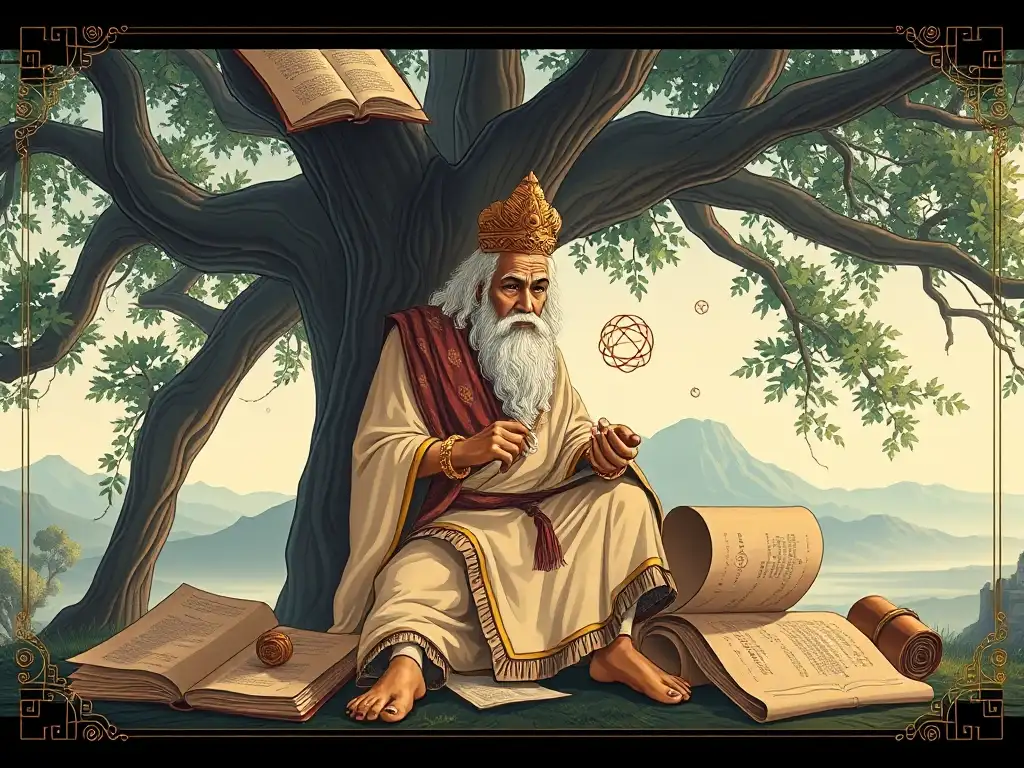
The Vaisheshika school of philosophy, founded by the sage Kanada around the 2nd century BCE, is notable for its significant contributions to the understanding of the physical world, particularly through its development of atomism. This philosophical school posited that the universe is composed of indivisible particles called anu (atoms), which combine to form various substances. The Vaisheshika system is one of the oldest known formulations of atomic theory, predating similar concepts in Western philosophy by centuries.
The fundamental tenet of Vaisheshika is that all material objects are composed of atoms, which are eternal, indivisible, and capable of combining with each other in different ways to form the diverse array of substances we observe in the world. According to Vaisheshika, these atoms are not merely theoretical constructs but are essential in explaining the properties and behaviors of matter. The school categorized substances into different types, such as earth, water, fire, air, and space, and proposed that the interactions between these substances are governed by specific natural laws.
Kanada’s work, primarily encapsulated in the Vaisheshika Sutras, laid the groundwork for a systematic understanding of nature. The text outlines a comprehensive epistemology that includes perception, inference, and testimony as valid means of knowledge acquisition. This methodological approach underlines the scientific rigor of the Vaisheshika tradition, which sought to explain phenomena through logical reasoning and empirical observation.
Overall, Vaisheshika’s atomism not only advanced the philosophical discourse of ancient India but also contributed to the broader scientific understanding of matter. This foundational concept influenced later philosophical and scientific developments in India, integrating metaphysics and empirical observation in a manner that resonates with contemporary scientific inquiry.
Atomism in Relation to Other Philosophical Schools
In the context of ancient Indian philosophy, atomism as articulated by the Vaisheshika school has notable parallels and divergences with other philosophical schools, particularly Nyaya and Sankhya.
- Nyaya School:
- Epistemological Foundations: Like Vaisheshika, Nyaya emphasizes the importance of logic and epistemology. However, Nyaya focuses more on the means of acquiring knowledge and the nature of inference, rather than the material composition of the universe.
- Ontology: While both schools recognize the existence of atoms, Nyaya does not delve deeply into the physical properties of these atoms. Instead, it considers them primarily as part of a broader discussion on the nature of existence and reality.
- Sankhya School:
- Dualistic Approach: The Sankhya philosophy presents a dualistic system that distinguishes between Prakriti (nature) and Purusha (consciousness). In contrast, Vaisheshika is more materialistic, focusing predominantly on the physical aspects of the universe and the interactions of atoms.
- Cosmology: Sankhya provides a detailed cosmological framework, explaining the evolution of the universe from unmanifest to manifest forms, integrating ideas of evolution and the cyclical nature of existence. Vaisheshika, on the other hand, emphasizes discrete particles and their combinations without a comprehensive cosmological narrative.
- Integration of Concepts:
- The interplay between these schools illustrates a rich tapestry of philosophical inquiry in ancient India. While Vaisheshika lays the groundwork for understanding the material world, Nyaya and Sankhya contribute to a more holistic understanding of reality, encompassing both the physical and metaphysical realms.
Through this comparative lens, it becomes evident that Vaisheshika's atomism serves as a critical component of a broader philosophical discourse, influencing and being influenced by contemporaneous thoughts on existence, knowledge, and the nature of reality.
Comparison with Western Atomism: Similarities and Differences
The concept of atomism in Vaisheshika bears striking resemblances to Western atomism, particularly as articulated by philosophers like Democritus and later, Epicurus. However, there are also notable differences that highlight the uniqueness of the Indian perspective.
- Similarities:
- Indivisible Particles: Both Vaisheshika and Western atomism propose the existence of indivisible particles as the fundamental building blocks of matter. In Vaisheshika, these are called anu, while Western philosophy refers to them as atoms.
- Material Composition: Both systems acknowledge that complex substances are formed through the combination of these fundamental particles, suggesting a shared understanding of material composition.
- Differences:
- Philosophical Context: Vaisheshika's atomism is deeply embedded within a broader metaphysical and epistemological framework that integrates logical reasoning and observation, while Western atomism often arose in a context of natural philosophy seeking to explain the physical world without necessarily linking it to ethics or epistemology.
- Nature of Atoms: In Vaisheshika, atoms are not only physical entities but are also imbued with properties that influence their interactions and the formation of substances. In contrast, early Western atomism focused predominantly on the mechanical properties of atoms, often neglecting their qualitative aspects.
- Causality and Interaction: Vaisheshika also emphasizes the role of causation and the interconnectedness of matter, suggesting that the interactions of atoms lead to observable phenomena. Western atomism, particularly in its early formulations, often approached causality from a more deterministic perspective, focusing on the predictable behavior of particles without considering the broader implications of those interactions.
While there are clear parallels between Vaisheshika’s contributions to atomism and Western thought, the philosophical underpinnings and implications of these ideas reveal a rich diversity in understanding the nature of reality. The exploration of atomism in ancient India not only reflects a sophisticated grasp of the physical world but also invites a deeper inquiry into the nature of existence itself.
The Impact of Vaisheshika on Science and Thought

Influence on Later Philosophical Developments
The Vaisheshika school of philosophy, founded by the sage Kanada, significantly influenced subsequent philosophical discourse in India. Its foundational concepts, particularly those regarding atomism, provided a framework for later thinkers to build upon. The notion that the universe is composed of indivisible particles called anu (atoms) brought forth a scientific approach to understanding the material world, which was rare for its time.
The ideas presented in Vaisheshika were not isolated; they intersected with the Nyaya school, leading to a rich dialogue on epistemology and logic. This inter-school exchange fostered a more robust understanding of reality, where the empirical and the rational coexisted harmoniously.
- Key Influences:
- Nyaya Philosophy: Incorporation of logical reasoning in exploring metaphysical concepts.
- Sankhya System: Enhanced understanding of the interaction between matter (Prakriti) and consciousness (Purusha).
Notably, the integration of Vaisheshika concepts into the broader Indian philosophical landscape laid the groundwork for later developments in both philosophy and science. The emphasis on individual substances and their properties paved the way for nuanced discussions on nature, existence, and the cosmos in subsequent schools of thought, including Buddhist philosophy.
Contributions to Natural Sciences and Metaphysics
Vaisheshika's contribution to the natural sciences is profound, particularly through its innovative approach to categorizing and understanding the physical world. The school classified reality into nine categories ( padarthas), which included substance, quality, action, and more. This classification system was revolutionary, as it allowed for a systematic study of nature.
Key Categories of Vaisheshika:
- Dravya (Substance): This includes both living and non-living entities, which are further divided into categories such as earth, water, fire, air, and ether.
- Guna (Quality): The characteristics of substances, such as color, taste, and smell, which can be observed and measured.
- Karma (Action): The activities performed by substances, which are essential to understanding their behavior and interactions.
- Samanya (Universality): The shared characteristics that allow for the grouping of substances.
- Vishesha (Particularity): The unique attributes that distinguish one entity from another.
The concept of atomism within Vaisheshika also introduced the idea that these atoms combine to form larger entities, a precursor to modern chemical theories. This understanding of material composition linked metaphysical principles with empirical observations, allowing for a more comprehensive exploration of nature.
Impact on Modern Science
Vaisheshika’s atomistic theories bear a striking resemblance to modern atomic theory, which posits that all matter is composed of atoms. The recognition of atoms as the fundamental building blocks of nature demonstrates an advanced level of scientific thought in ancient India. Moreover, the emphasis on observation and logical deduction resonated with the scientific method that dominates contemporary inquiry.
The contributions of Vaisheshika to both natural sciences and metaphysics highlight a sophisticated understanding of the universe that continues to inspire philosophical and scientific exploration today. The integration of these ideas into the broader fabric of ancient Indian philosophy underscores the rich legacy of Ancient Indian atomism contributions, which remain relevant in modern discussions on science and philosophy.
Legacy of Vaisheshika Philosophy in Ancient India

The Vaisheshika philosophy, founded by the sage Kanada in the 6th century BCE, is a significant cornerstone of ancient Indian thought, particularly in the realm of science and metaphysics. This philosophical school introduced the concept of atomism, which posited that everything in the universe is composed of indivisible particles, or atoms (paramanu). The legacy of Vaisheshika is marked by its systematic approach to categorizing the natural world, facilitating a deeper understanding of both physical and metaphysical phenomena.
One of the most notable contributions of Vaisheshika is its classification of substances into categories, which includes earth, water, fire, air, and ether. This classification reflects an early attempt to understand the composition and interaction of matter. Additionally, the text "Vaisheshika Sutras," attributed to Kanada, systematically outlines these concepts, providing a foundation for subsequent philosophical inquiry. The clarity and precision of these sutras have preserved the atomistic ideas through centuries, influencing various schools of thought in India, including Nyaya, which further developed logical analysis and epistemology.
Moreover, the integration of atomism into the broader philosophical discourse of ancient India highlights the interconnectedness of science and metaphysical inquiry. The discussions around the nature of atoms, their qualities, and interactions laid the groundwork for later advancements in both philosophy and natural sciences, showcasing the profound impact of Vaisheshika on Indian intellectual history.
Preservation and Transmission of Atomistic Ideas
The preservation and transmission of Vaisheshika's atomistic ideas can be traced through various historical developments. Following the initial formulation of these concepts by Kanada, they were further elaborated upon by later philosophers such as Prashastapada and Udayana. These scholars not only preserved the original texts but also engaged in critical commentary, expanding the understanding of atomism and its implications.
The methodical approach of the Vaisheshika school ensured that its ideas were documented and circulated among scholars. The Vaisheshika Sutras became a part of the curriculum in ancient Indian universities, such as Nalanda and Takshashila, where students studied various philosophical traditions. The integration of atomistic thought into the educational systems of ancient India played a crucial role in its preservation.
In addition to formal education, oral traditions and debates among scholars helped in the transmission of these ideas across generations. The discussions surrounding atomism were often linked with practical applications in fields such as medicine, alchemy, and metallurgy, further embedding these concepts within the cultural fabric of ancient Indian society.
Modern Relevance of Ancient Indian Atomism Contributions
The contributions of ancient Indian atomism, particularly through the Vaisheshika school, resonate in modern scientific discourse. The notion of indivisible particles forming the basis of matter aligns closely with contemporary atomic theory. While the scientific understanding of atoms has evolved, the fundamental idea that complex structures are built from simpler components can be traced back to early Indian philosophical thought.
Furthermore, the systematic approach of the Vaisheshika school towards categorizing and analyzing phenomena has parallels in modern scientific methodologies. The emphasis on observation, classification, and logical reasoning reflects a scientific rigor that is still valued today. Scholars in the field of philosophy of science recognize the importance of ancient Indian atomism as a precursor to modern scientific inquiry, showcasing the global heritage of knowledge.
In addition, the revival of interest in ancient Indian philosophies in contemporary discussions about science and spirituality underscores the relevance of Vaisheshika. As scientists and philosophers explore the intersections of consciousness, matter, and the universe, the atomistic ideas from ancient India provide valuable insights and perspectives that can contribute to ongoing debates in both fields.
Overall, the legacy of Vaisheshika's atomism is not only a significant chapter in the history of science in ancient India but also a testament to the enduring influence of these ideas on modern thought and inquiry. The exploration of these contributions continues to inspire scholars and practitioners alike, bridging the ancient with the contemporary.
Conclusion: The Enduring Influence of Vaisheshika on Science

The Vaisheshika school of philosophy has left an indelible mark on the scientific landscape of ancient India, particularly through its pioneering contributions to the concept of atomism. This philosophical framework not only provided a systematic approach to understanding matter but also laid the groundwork for subsequent scientific inquiry in various fields. The meticulous categorization of substances and their attributes by thinkers like Kanada demonstrates a profound understanding of physical reality and its components.
Reflection on the Contributions of Ancient Indian Atomism
The contributions of ancient Indian atomism, particularly through the lens of Vaisheshika, can be categorized into several significant aspects:
- Conceptualization of Atoms:
- The notion of "anu" (atom) as an indivisible entity that combines to form larger substances is a remarkable insight into the nature of matter.
- Kanada’s assertion that atoms possess distinct qualities and can combine in various ways parallels modern atomic theory, showcasing an advanced understanding of physical sciences.
- Classification of Substances:
- The Vaisheshika system classifies substances into categories such as dravya (substance), guna (quality), karma (action), and samanya (universal). This classification system not only organized knowledge but also influenced the development of scientific methodologies.
- By identifying nine fundamental substances, including earth, water, fire, air, and ether, the Vaisheshika philosophy paved the way for comprehensive studies in chemistry and physics.
- Influence on Other Philosophical Schools:
- The principles of atomism articulated by the Vaisheshika school were not confined to its own philosophy but significantly influenced the Nyaya school and other Indian philosophical traditions, fostering a rich dialogue on metaphysics and epistemology.
Overall, the sophisticated ideas surrounding atomism in ancient Indian philosophy reflect a nuanced understanding of nature that resonates with modern scientific paradigms.
Future Perspectives on Vaisheshika Philosophy in Contemporary Discourse
As we look toward the future, the relevance of Vaisheshika philosophy in contemporary discourse is increasingly recognized. Here are some key areas where its contributions may continue to inspire and inform modern thought:
- Interdisciplinary Research:
- The principles of Vaisheshika can foster interdisciplinary research that bridges philosophy, physics, and chemistry, encouraging collaborative approaches to understanding complex scientific problems.
- Philosophical Inquiry:
- The questions posed by Vaisheshika on the nature of reality, existence, and knowledge remain pertinent today, inviting philosophers to explore and critique these ancient ideas within modern contexts.
- Cultural Renaissance:
- As global interest in ancient philosophies grows, Vaisheshika’s insights into atomism can contribute to a broader understanding of scientific heritage, promoting a cultural renaissance in the appreciation of Indian philosophical contributions.
- Educational Initiatives:
- Incorporating Vaisheshika philosophy into educational frameworks can enhance curricula in philosophy and science, providing students with a diverse perspective on the evolution of scientific thought.
The legacy of Vaisheshika extends beyond its historical context, offering profound insights that continue to resonate within both philosophical and scientific communities. The exploration of ancient Indian atomism not only enriches our understanding of the past but also shapes the discourse for future generations.
Frequently Asked Questions
What is the Vaisheshika school of philosophy?
The Vaisheshika school is one of the six classical systems of Indian philosophy that focuses on the nature of reality and the classification of substances, leading to significant contributions in atomism.
How did the Vaisheshika philosophy contribute to the concept of atomism?
The Vaisheshika philosophy introduced the idea that all matter is made up of indivisible particles, or atoms, which are the building blocks of the universe, marking a significant early understanding of atomism.
Who was the key figure behind the development of Vaisheshika philosophy?
Kanada, an ancient Indian philosopher, is credited with founding the Vaisheshika school and laying the groundwork for the development of atomism in ancient Indian thought.
What are the main principles of Vaisheshika atomism?
The main principles of Vaisheshika atomism include the existence of eternal atoms, the classification of substances based on their properties, and the belief that these atoms combine to form the physical world.
How did ancient Indian atomism influence modern science?
The concepts of atomism proposed by the Vaisheshika school laid early groundwork for later scientific inquiry, influencing modern atomic theory and providing insights into the nature of matter.
Final Reflection: Embracing the Legacy of Ancient Indian Atomism
The exploration of Vaisheshika's contributions to science reveals a profound connection between ancient wisdom and modern scientific thought. Today, as we stand on the shoulders of giants, the insights of ancient Indian atomism remind us that the quest for knowledge is timeless and universal. The principles laid down by thinkers like Kanada not only laid the groundwork for atomic theory but also challenge us to appreciate the depth of intellectual traditions that have shaped our understanding of the universe.
Cultural and scientific landscapes are continuously influenced by the foundational ideas established by ancient scholars. The legacy of Vaisheshika is not merely a historical footnote; it is a vibrant thread in the tapestry of scientific inquiry that continues to inspire contemporary thinkers. As we navigate the complexities of modern science, we should remember the words of Albert Einstein: A human being is part of the whole called by us universe, a part limited in time and space. He experiences himself, his thoughts and feeling as something separated from the rest—a kind of optical delusion of his consciousness.
This quote encapsulates the interconnectedness that ancient Indian atomism sought to express, urging us to look beyond the surface and recognize the unity in diversity.
As we reflect on the teachings of Vaisheshika, let us embrace the call to explore, question, and innovate in our own lives. The principles of atomism invite us to dissect our understanding of the world, encouraging a spirit of inquiry that transcends time and culture. I invite you, dear reader, to engage with these ancient ideas, allowing them to inspire your own journey of discovery. In doing so, we honor the legacy of those who came before us and pave the way for future generations to continue the pursuit of knowledge and understanding.
Unveil the Legacy of Atomism and Take Action!
Thank you for diving deep into the significant contributions of Vaisheshika to the world of science and the birth of atomism in Ancient India! Your interest in this remarkable topic not only enriches your understanding but also celebrates a pivotal moment in intellectual history. Now, let's take your curiosity a step further.
Here’s how you can keep the momentum going:
- Explore further: Dive into related texts or resources about ancient Indian philosophy and its influence on modern science.
- Share your insights: Engage with friends or on social media— discuss what atomism means in today’s world and how it shapes contemporary science.
- Join a discussion group: Find or form a community focused on ancient philosophies to exchange ideas and gain fresh perspectives.
What impact do you believe the concept of atomism has had on modern scientific thought and philosophy? Your thoughts could spark an enlightening conversation!