

Significant Mathematicians

Significant Mathematicians
54 articles in this topic
Read more about this topic
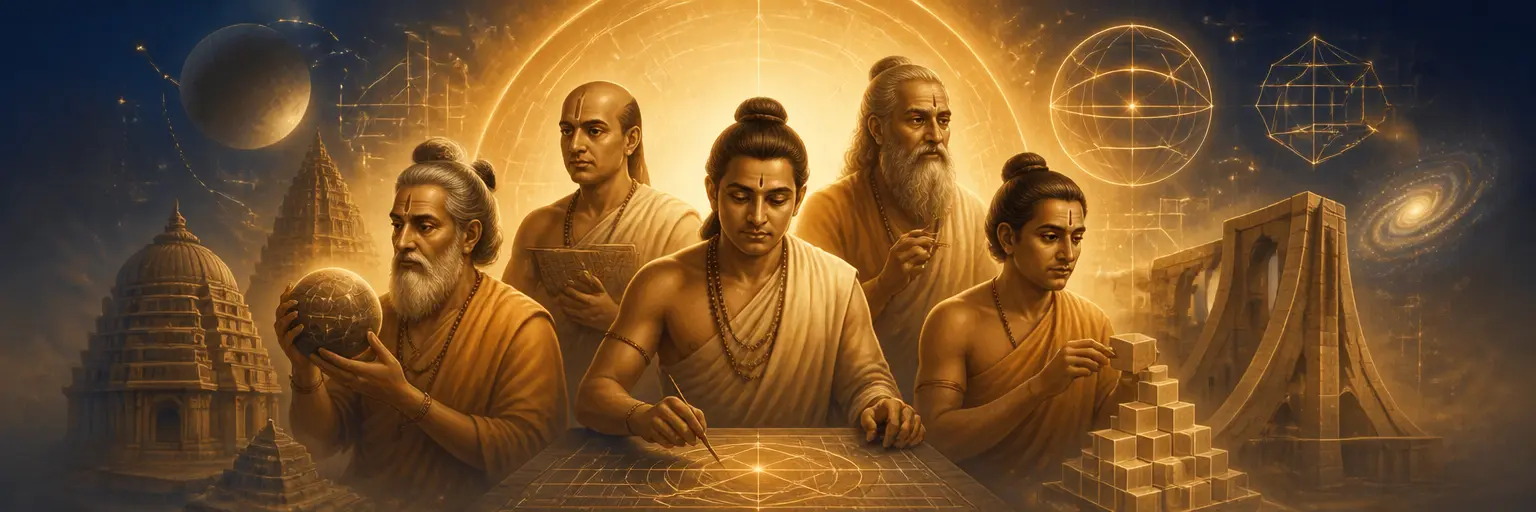
Discover the brilliant minds who shaped ancient Indian mathematics 📚✨ Explore the groundbreaking ideas, discoveries, and lasting contributions of significant mathematicians whose work advanced arithmetic, algebra, geometry, astronomy, and the concept of zero. Their remarkable achievements continue to influence modern mathematics and reveal the intellectual richness of India’s ancient civilizations.
More in Significant Mathematicians

Significant Mathematicians
How Ancient India Predicted Eclipses: The Math Behind the Science

Significant Mathematicians
Understanding the Mathematical Contributions of Ancient Indian Scholars to the World

Significant Mathematicians
How Ancient Indian Mathematicians Addressed Complex Problems

Significant Mathematicians
The Symbolism of Numbers in Ancient Indian Culture: A Mathematical Analysis

Significant Mathematicians
The Genius of Aryabhata: Revolutionizing Mathematics in Ancient India

Significant Mathematicians
How Ancient Indian Mathematics Influenced Navigation and Exploration

Significant Mathematicians
The Historical Context of Mathematics in the Gupta Empire

Significant Mathematicians
The Lost Works of Varahamihira: Astrology Meets Mathematics
📐 Significant Mathematicians of Ancient India
Discover the brilliant thinkers who shaped the history of mathematics in ancient India. This subcategory explores the lives, theories, discoveries, and lasting influence of significant Indian mathematicians whose work transformed arithmetic, algebra, geometry, astronomy, and number theory. From the development of the decimal place-value system to groundbreaking ideas about zero, equations, and infinite series, these scholars made contributions that influenced India, the Islamic world, Europe, and modern mathematics.
🌟 Aryabhata: Pioneer of Indian Mathematics and Astronomy
Learn about Aryabhata, one of the most influential mathematicians and astronomers of ancient India. His celebrated work, the Aryabhatiya, presented important ideas about arithmetic, algebra, geometry, trigonometry, planetary motion, and the calculation of astronomical constants. Readers can explore how Aryabhata used sophisticated mathematical methods to calculate the value of pi and explain celestial phenomena.
This section examines Aryabhata’s place in the Gupta-era intellectual tradition and his influence on later Indian mathematicians. It also explains why his work remains significant in the study of ancient Indian mathematics, astronomy, numerical computation, and the history of science.
🔢 Brahmagupta and the Mathematical Rules of Zero
Explore the achievements of Brahmagupta, a pioneering Indian mathematician and astronomer whose writings provided some of the earliest systematic rules for working with zero and negative numbers. His seventh-century treatise, the Brahmasphutasiddhanta, addressed arithmetic operations, quadratic equations, geometry, and astronomical calculations.
Readers will discover how Brahmagupta helped establish zero as a number rather than merely a placeholder. His mathematical rules influenced later scholars and traveled through intellectual networks into the medieval Islamic world, making his work an essential part of the global history of mathematics.
📚 Bhaskara I and the Transmission of Mathematical Knowledge
Discover Bhaskara I, an important commentator and mathematician who helped preserve, interpret, and expand Aryabhata’s mathematical and astronomical ideas. His writings made complex concepts more accessible while demonstrating the advanced level of scientific scholarship in early medieval India.
This section highlights Bhaskara I’s work in arithmetic, algebra, astronomy, and trigonometry. It also considers the role of commentaries in ancient Indian education and explains how scholars transmitted mathematical knowledge across generations through Sanskrit texts and scholarly traditions.
🧮 Bhaskara II and Advanced Algebraic Thought
Learn about Bhaskara II, also known as Bhaskaracharya, whose influential works include the Lilavati, Bijaganita, and Siddhanta Shiromani. His writings covered arithmetic, algebra, geometry, equations, astronomy, and mathematical problem-solving, often using elegant examples and engaging questions.
Readers can explore Bhaskara II’s treatment of indeterminate equations, mathematical procedures, and advanced astronomical calculations. His work demonstrates the sophistication of medieval Indian mathematics and offers valuable insight into the teaching methods, numerical techniques, and intellectual achievements of the Indian subcontinent.
♾️ Madhava of Sangamagrama and Infinite Series
Examine the groundbreaking ideas of Madhava of Sangamagrama, the founder of the Kerala school of mathematics and astronomy. Madhava is associated with infinite series for trigonometric functions and highly accurate calculations of pi, anticipating concepts later central to calculus and mathematical analysis.
This section explains the importance of Madhava’s work in the history of infinite series, trigonometry, approximation methods, and early calculus. It also introduces the Kerala school’s scholarly environment and considers how mathematical knowledge developed through teacher-student lineages and detailed commentarial traditions.
🏛️ The Kerala School of Mathematics and Astronomy
Explore the wider intellectual movement associated with the Kerala school, which flourished in southern India from the late medieval period. Its scholars studied astronomy, geometry, trigonometry, infinite processes, and numerical approximation, creating a remarkable tradition of mathematical research.
Readers will learn how figures such as Madhava and later commentators contributed to the refinement of mathematical formulas and astronomical models. This topic places Indian mathematical discoveries within the broader history of science while emphasizing the importance of regional scholarship, Sanskrit learning, and ancient Indian scientific traditions.
🌍 The Global Influence of Indian Mathematicians
Understand how the achievements of Indian mathematicians traveled beyond the subcontinent. Numerical notation, the decimal place-value system, zero, algebraic techniques, astronomical calculations, and trigonometric knowledge were transmitted through scholarly exchanges linking India with the Islamic world and, eventually, Europe.
This section reveals why the contributions of ancient and medieval Indian scholars remain essential to the history of mathematics. By studying these intellectual connections, readers gain a clearer understanding of how Indian mathematical knowledge shaped global science, commerce, astronomy, education, and modern numerical systems.
❓ Frequently Asked Questions About Significant Mathematicians
Who is considered the most famous mathematician of ancient India?
Aryabhata is often regarded as one of the most famous mathematicians of ancient India. His work addressed arithmetic, algebra, trigonometry, astronomy, and the calculation of pi. Brahmagupta and Bhaskara II are also widely recognized for their major contributions to Indian mathematics.
Who invented zero in ancient India?
Zero developed gradually within Indian mathematical traditions, but Brahmagupta was the first known mathematician to provide systematic arithmetic rules for zero as a number. Indian scholars also played a crucial role in developing the decimal place-value system that made zero mathematically powerful.
What did Aryabhata contribute to mathematics?
Aryabhata contributed to arithmetic, algebra, geometry, trigonometry, and astronomy. He developed methods for calculating astronomical quantities, provided an approximation of pi, and used sophisticated numerical techniques in the Aryabhatiya.
Why is Brahmagupta important in the history of mathematics?
Brahmagupta is important because he established rules for calculations involving zero, negative numbers, positive numbers, and equations. His writings helped advance algebra and astronomy and later influenced mathematical scholarship beyond India.
Did ancient Indian mathematicians influence modern mathematics?
Yes. Indian mathematicians made foundational contributions to the decimal place-value system, zero, arithmetic, algebra, trigonometry, numerical approximation, and infinite series. These ideas became part of global mathematical knowledge and continue to support modern science, technology, engineering, and education.