

Sanskrit Language Development

Sanskrit Language Development
57 articles in this topic
Read more about this topic
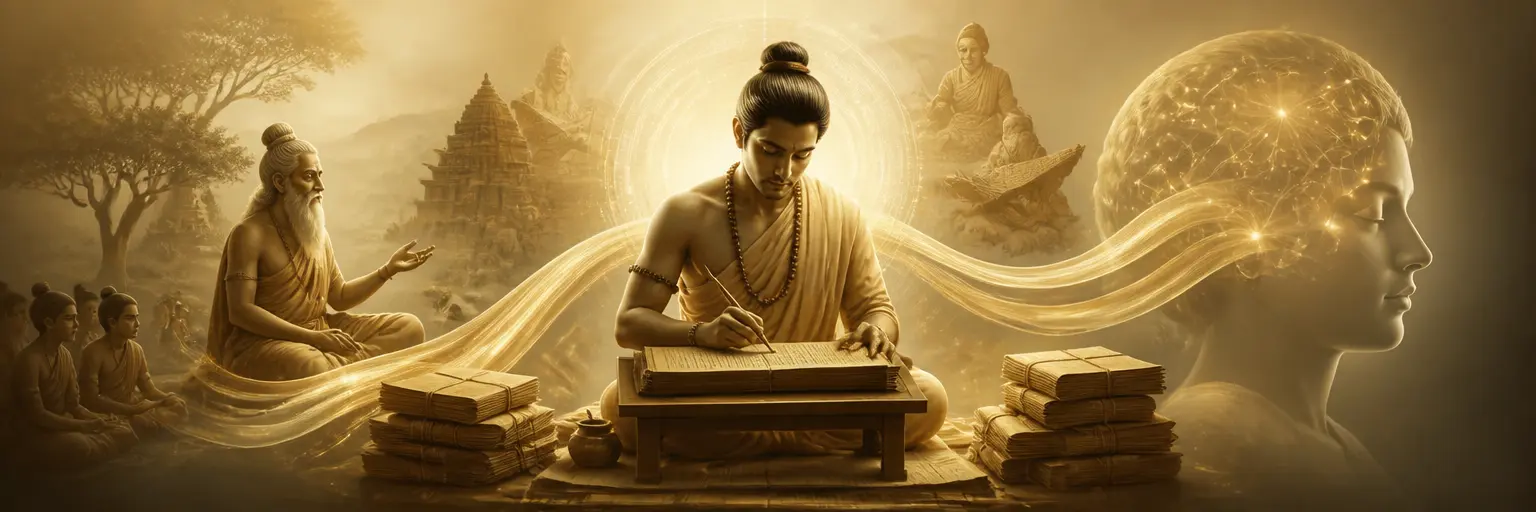
Explore the evolution of Sanskrit language development—from its early roots in ancient Indian civilization to the refined linguistic traditions that shaped literature, philosophy, science, religion, and education. Discover how Sanskrit grammar, vocabulary, scripts, and influential texts contributed to India’s intellectual and cultural heritage, offering valuable insight into the history of language and scripts in Ancient India.
More in Sanskrit Language Development

Sanskrit Language Development
The Evolution of Sanskrit: From Ancient Roots to Modern Relevance

Sanskrit Language Development
The Spiritual Significance of Learning Sanskrit

Sanskrit Language Development
How to Engage with Sanskrit Literature: A Beginner's Guide

Sanskrit Language Development
The Connection Between Sanskrit and Yoga: A Linguistic Perspective
Sanskrit Language Development
Sanskrit as a Tool for CrossCultural Communication

Sanskrit Language Development
How to Learn Sanskrit: Resources and Tips for Beginners
Sanskrit Language Development
The Revival of Sanskrit: Why It Matters Today
Sanskrit Language Development
How Sanskrit Influenced Global Languages: A Cultural Legacy
📚 Sanskrit Language Development in Ancient India
Explore the fascinating development of Sanskrit language, one of the most influential classical languages of ancient India. This subcategory examines how Sanskrit evolved from early Indo-Aryan speech traditions into a refined language of religion, philosophy, literature, science, law, and education. Discover the history of Vedic Sanskrit, Classical Sanskrit, Sanskrit grammar, ancient Indian writing systems, and the enduring influence of Sanskrit on South Asian languages and culture.
🕉️ Origins and Early History of Sanskrit
Learn about the origins of Sanskrit within the wider development of the Indo-Aryan languages and the cultural world of early ancient India. Articles explore linguistic evidence, oral traditions, and the historical setting in which Sanskrit became an important language of ritual, learning, and social identity.
Readers can expect accessible explanations of how early Sanskrit relates to Vedic civilization, the spread of religious ideas, and the intellectual traditions that shaped Indian history. Topics may also consider debates surrounding chronology, language change, and the relationship between Sanskrit and other ancient languages.
📜 Vedic Sanskrit and the Sacred Texts
Discover the distinctive features of Vedic Sanskrit, the language associated with the Rigveda, Samaveda, Yajurveda, Atharvaveda, Brahmanas, Aranyakas, and Upanishads. This section explains how pronunciation, accent, poetic structure, and oral memorization preserved sacred knowledge across generations.
Explore how Vedic Sanskrit developed through religious practice and became central to ancient Indian philosophy, ritual, mythology, and spiritual thought. Readers will gain insight into the language of the Vedas while learning why accurate recitation and traditional transmission were so important.
🔤 Panini, Sanskrit Grammar, and Language Standardization
Study the groundbreaking work of Panini, whose Ashtadhyayi provided one of the most systematic descriptions of Sanskrit grammar in the ancient world. This subcategory explores Sanskrit phonetics, morphology, syntax, word formation, and the sophisticated rules that helped establish a standardized form of the language.
Learn how Paninian grammar influenced Indian linguistics and shaped the study of language long before the development of modern linguistic theory. Explanations focus on the historical importance of grammatical analysis, Sanskrit vocabulary, and the preservation of linguistic precision.
🏛️ Classical Sanskrit and the Gupta Age
Examine the emergence and cultural expansion of Classical Sanskrit as a major language of literature, administration, scholarship, and elite communication. The Gupta period is especially important because Sanskrit flourished in royal inscriptions, poetry, drama, religious texts, and intellectual works.
Discover the contributions of celebrated authors such as Kalidasa and learn how Sanskrit literature reflected ancient Indian ideas about kingship, society, aesthetics, morality, and nature. This section connects language development with the political and cultural achievements of ancient Indian kingdoms.
✍️ Sanskrit Scripts, Inscriptions, and Manuscripts
Learn how Sanskrit was recorded in different scripts, including Brahmi, Gupta script, Sharada, Grantha, and later Devanagari. Articles explain the difference between a language and a script, showing how Sanskrit texts could be written using regional writing systems across the Indian subcontinent.
Explore the importance of stone inscriptions, copper plates, palm-leaf manuscripts, and scholarly copies for understanding Sanskrit history. Readers can discover how epigraphy, manuscript studies, and digital preservation help historians reconstruct the development and transmission of ancient Sanskrit texts.
🌏 Sanskrit and the Languages of South Asia
Understand the lasting influence of Sanskrit on major Indian languages, including Hindi, Bengali, Marathi, Gujarati, Odia, Nepali, Kannada, Telugu, Malayalam, and Tamil. Sanskrit contributed extensive vocabulary, religious terminology, literary forms, and concepts to many regional language traditions.
This section also examines language contact, translation, borrowing, and the interaction between Sanskrit and Prakrit languages. Readers will see how Sanskrit functioned alongside Pali, Ardhamagadhi, and other linguistic traditions in the religious and cultural history of ancient India.
📖 Sanskrit Literature, Philosophy, and Scientific Knowledge
Explore Sanskrit’s role as a language of epic literature, philosophy, mathematics, astronomy, medicine, politics, and law. Key traditions include the Mahabharata, Ramayana, Puranas, Dharmashastra, Arthashastra, Ayurveda, Jyotisha, and classical works on poetics and logic.
Readers can discover how Sanskrit enabled scholars to preserve complex ideas and transmit knowledge across centuries. The articles place literary and scientific texts within their historical context, making it easier to understand Sanskrit’s contribution to ancient Indian civilization.
🔎 Frequently Asked Questions About Sanskrit Language Development
What is Sanskrit language development?
Sanskrit language development refers to the historical evolution of Sanskrit from early Indo-Aryan speech forms into Vedic Sanskrit and later Classical Sanskrit. It includes changes in grammar, vocabulary, pronunciation, literature, scripts, and cultural use.
What is the difference between Vedic Sanskrit and Classical Sanskrit?
Vedic Sanskrit is the older form found mainly in the Vedas and related sacred texts. Classical Sanskrit was later standardized through grammatical traditions, especially those associated with Panini, and became widely used in literature, philosophy, inscriptions, science, and administration.
Why is Panini important to Sanskrit history?
Panini is important because his Ashtadhyayi offered a highly detailed and systematic description of Sanskrit grammar. His work helped standardize the language and remains a major achievement in the history of linguistics.
Which scripts were used to write Sanskrit?
Sanskrit was written in several scripts throughout history, including Brahmi, Gupta, Sharada, Grantha, and Devanagari. The script varied according to region and period, while the Sanskrit language remained a distinct linguistic tradition.
How did Sanskrit influence Indian languages and culture?
Sanskrit influenced Indian languages through vocabulary, religious concepts, literary styles, philosophy, law, science, and education. Its impact can be found across many Indo-Aryan and Dravidian languages and remains visible in modern Indian cultural and linguistic traditions.