
Ancient Indian Scripts and Inscriptions
Ancient Indian Scripts and Inscriptions
56 articles in this topic
Start here
Read more about this topic
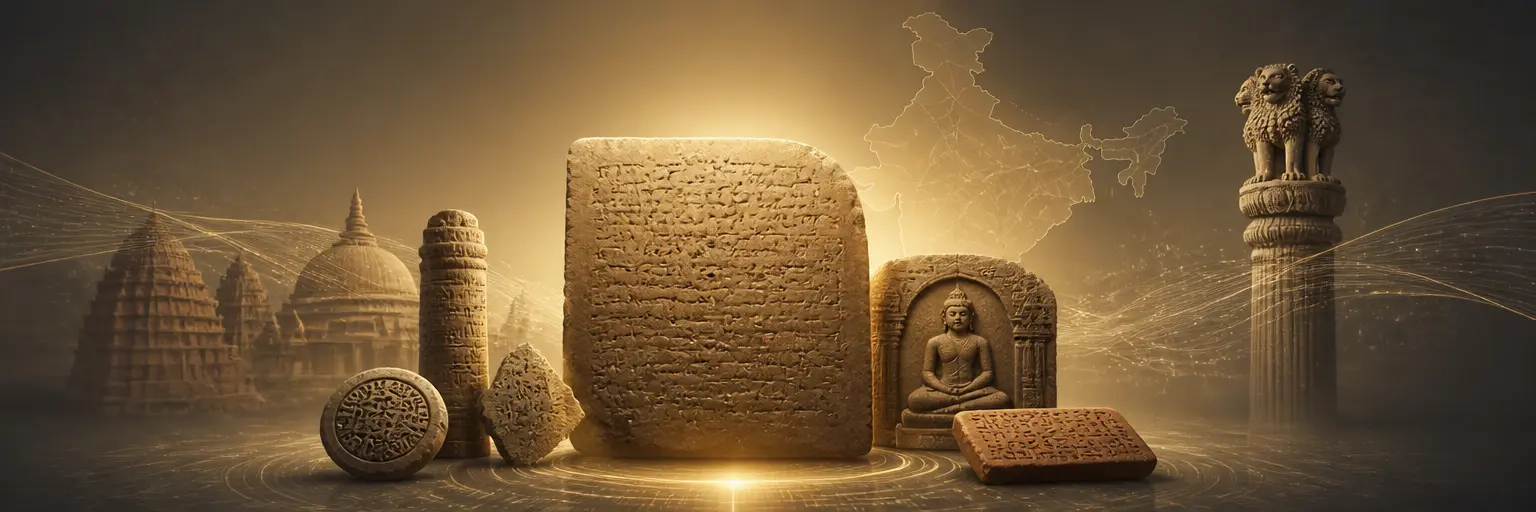
Explore Ancient Indian Scripts and Inscriptions to uncover how early civilizations recorded their languages, beliefs, laws, and daily life. From Brahmi and Kharosthi to Sanskrit inscriptions carved on pillars, rocks, coins, and temple walls, discover the evidence that helps historians understand ancient Indian history, cultural exchange, administration, religion, and artistic traditions. 📜🔍
More in Ancient Indian Scripts and Inscriptions
Ancient Indian Scripts and Inscriptions
The Intersection of Myth and Language in Ancient Indian Scripts
Ancient Indian Scripts and Inscriptions
The Role of Language in Ancient Indian Diplomacy and Political Alliances
Ancient Indian Scripts and Inscriptions
The Rise and Fall of Ancient Indian Scripts: A Historical Overview
Ancient Indian Scripts and Inscriptions
The Legacy of Ancient Indian Scripts in the Global Context

Ancient Indian Scripts and Inscriptions
How Ancient Indian Scripts Influence Modern Languages in India
Ancient Indian Scripts and Inscriptions
The Role of Inscriptions in Ancient Indian Warfare and Diplomacy
Ancient Indian Scripts and Inscriptions
The Connection Between Ancient Indian Scripts and Mathematical Concepts
Ancient Indian Scripts and Inscriptions
How Ancient Scripts Shaped Identity and Community in Ancient India
Ancient Indian Scripts and Inscriptions: Explore India’s Written Heritage
Discover the origins, development, and historical importance of Ancient Indian scripts and inscriptions through a rich collection of research-based articles at Ancient India History. This subcategory explores how civilizations from the Indus Valley to the Gupta Empire recorded religious beliefs, royal orders, trade practices, social customs, and cultural achievements. Learn about Brahmi, Kharosthi, Tamil-Brahmi, Gupta script, Sanskrit inscriptions, Prakrit records, and the continuing debate surrounding the Indus script.
🪶 Origins and Evolution of Ancient Indian Scripts
Follow the fascinating development of writing systems in the Indian subcontinent, from the symbols of the Indus Valley Civilization to the fully developed scripts used during the Mauryan, Satavahana, Kushan, and Gupta periods. Articles explain how scripts changed over time and how regional languages, political expansion, religion, and trade influenced their growth.
Readers can expect accessible explanations of paleography, script formation, letter shapes, writing materials, and chronological changes. Whether you are researching the history of writing in India or studying ancient languages, this section provides valuable context for understanding India’s early written communication.
🏛️ Brahmi Script and Its Historical Importance
Explore Brahmi, one of the most influential writing systems in ancient India. The subcategory examines its appearance in Ashokan edicts, its relationship with Prakrit and Sanskrit, and its role in the development of later Indian scripts, including Devanagari, Bengali, Gujarati, Kannada, Telugu, and other regional writing traditions.
Detailed content highlights the structure of Brahmi characters, methods used to decipher the script, and the significance of inscriptions found on pillars, rocks, caves, coins, and monuments. These resources help readers understand why Brahmi is central to the study of Indian epigraphy and ancient language history.
🗿 Ashokan Inscriptions and Imperial Edicts
Learn how Emperor Ashoka used inscriptions to communicate his principles of Dhamma, ethical governance, compassion, religious tolerance, and social responsibility. Articles cover the famous rock edicts, pillar edicts, minor inscriptions, and their distribution across the Mauryan Empire.
Readers will discover how Ashokan inscriptions provide direct evidence about Mauryan administration, Buddhist history, ancient Indian geography, and the political landscape of the third century BCE. Translations, historical interpretations, locations, and the role of James Prinsep in deciphering Brahmi are explored in clear and informative detail.
🌏 Kharosthi, Gandhari, and Northwestern Indian Writing
Investigate the Kharosthi script, an important ancient writing system used in Gandhara and northwestern India. This section explores its right-to-left writing direction, connection with the Aramaic script, use in Gandhari documents, and presence on coins, manuscripts, inscriptions, and trade records.
Content also examines the cultural links between ancient India, Central Asia, Persia, and the Hellenistic world. Readers interested in Gandhara history, Buddhist manuscripts, Indo-Greek kingdoms, and ancient Indian cultural exchange will find useful historical and linguistic insights.
📜 Tamil-Brahmi and Early South Indian Inscriptions
Discover Tamil-Brahmi inscriptions and their importance in reconstructing the history of early South India. Articles discuss inscriptions found in caves, pottery, coins, and trade centers, as well as their connections with early Tamil language, Jainism, Buddhism, and merchant communities.
This section explains how Tamil-Brahmi records illuminate Sangam-era society, personal names, occupations, religious patronage, and commercial networks. Readers can explore the emergence of regional writing traditions and the development of early Dravidian epigraphy.
🔱 Sanskrit, Prakrit, and Gupta Period Inscriptions
Explore the growing use of Sanskrit in royal inscriptions, religious records, temple grants, and commemorative monuments. The subcategory examines how Sanskrit inscriptions changed during the Kushan and Gupta periods and how rulers used language to express authority, genealogy, religious ideals, and political legitimacy.
Readers can also learn about Prakrit inscriptions and the transition between different literary and administrative languages. Topics may include Gupta script, land grants, copper-plate inscriptions, pillar records, and important evidence from the Gupta Empire and other classical Indian kingdoms.
⛏️ Epigraphy, Archaeology, and Deciphering Ancient Records
Understand how historians, archaeologists, linguists, and epigraphists study ancient inscriptions. Articles introduce techniques such as examining letter forms, comparing inscriptions, identifying historical names, studying excavation contexts, and analyzing the language and formulae used in official records.
The section also explains the importance of inscriptions as primary historical sources. By combining archaeological evidence, numismatics, literary texts, and comparative linguistics, researchers can reconstruct ancient Indian political history, social organization, religious practices, economic systems, and cultural connections.
🧭 Important Inscriptions, Locations, and Historical Sources
Explore notable inscriptions from across the Indian subcontinent, including Ashokan pillars, rock edicts, cave inscriptions, temple records, copper plates, coins, and boundary markers. Content connects each record with its location, historical period, ruling dynasty, language, script, and cultural setting.
These resources are useful for students, teachers, history enthusiasts, and researchers seeking reliable information about Indian historical inscriptions. Readers can compare regional traditions and understand how written evidence contributes to the study of ancient India’s diverse civilizations.
❓ Frequently Asked Questions About Ancient Indian Scripts and Inscriptions
What is the oldest known script in ancient India?
The Indus script is associated with the earliest known urban civilization in South Asia, but it has not yet been conclusively deciphered. Brahmi is the earliest widely accepted and successfully deciphered script used extensively in historical inscriptions, especially during the Mauryan period.
Why are Ashokan inscriptions important?
Ashokan inscriptions are important primary sources for understanding the Mauryan Empire, Emperor Ashoka’s policies, Buddhist history, administration, and ideas of Dhamma. They also provide valuable evidence about ancient Indian languages, geography, and political communication.
What is the difference between Brahmi and Kharosthi?
Brahmi was generally written from left to right and spread widely across much of India. Kharosthi was mainly used in northwestern India and Gandhara, was written from right to left, and was influenced by the Aramaic writing tradition.
How do inscriptions help historians study ancient India?
Inscriptions provide direct evidence about rulers, dynasties, land grants, religious institutions, taxes, occupations, trade, social groups, and administrative systems. They help confirm, expand, or challenge information found in literary and religious texts.
What can readers learn from Ancient Indian Scripts and Inscriptions?
Readers can learn about the evolution of Indian writing systems, the history of Brahmi and Kharosthi, Ashokan edicts, Tamil-Brahmi, Sanskrit and Prakrit records, Gupta inscriptions, epigraphy, paleography, and the role of written evidence in reconstructing ancient Indian history.