
Analyzing the Cosmology of Ancient India Through Puranic Literature

Welcome to Ancient India History, where we embark on an enlightening journey through the rich tapestry of ancient Indian civilizations. Here, you will uncover the fascinating intricacies of culture, science, and philosophy that have shaped our world. In our featured article, "Analyzing the Cosmology of Ancient India Through Puranic Literature," we delve into the mystical realms of ancient Indian cosmology, revealing how the profound insights of Puranic texts illuminate our understanding of the universe. Are you ready to explore the celestial wonders and literary legacies that define this captivating era? Dive in, and let the exploration begin!
The exploration of ancient Indian cosmology through Puranic literature offers a fascinating glimpse into the philosophical and metaphysical frameworks that shaped the understanding of the universe in ancient Indian civilization. This rich tapestry of cosmological thought, woven through myths, stories, and teachings found in the Puranas, reveals how ancient Indians perceived their existence in relation to the cosmos.
By analyzing these texts, we not only uncover the beliefs and values of the time but also appreciate the profound contributions of ancient Indian scholars to global cosmological discourse. This article aims to delve deep into the intricacies of ancient Indian cosmology as expressed in Puranic literature, emphasizing its significance and the historical context that influenced its development.
Introduction to Ancient Indian Cosmology
Definition and Importance of Cosmology in Ancient India
Cosmology in ancient India encompasses the study of the origin, evolution, and structure of the universe, integrating both scientific inquiry and spiritual philosophy. It plays a crucial role in understanding how ancient Indians conceptualized their world, with implications for religion, philosophy, and daily life. Key aspects include:
- Creation Myths: Explaining the universe's origins and the role of deities.
- Cycles of Time: The concept of time as cyclical, influencing cultural practices and beliefs.
- Interconnectedness: The link between the microcosm (individual) and macrocosm (universe), reflecting a holistic worldview.
These elements are essential for grasping the depth of ancient Indian thought and its lasting impact on subsequent cultural and intellectual developments.
Overview of Puranic Literature and Its Role in Cosmological Thought
Puranic literature, a group of ancient texts composed between 300 CE and 1500 CE, serves as a vital source for understanding ancient Indian cosmology. The Puranas, consisting of mythological narratives, hymns, and cosmological theories, provide insights into:
- Deity Worship: The portrayal of gods and goddesses, their roles in creation and destruction, and how these influence cosmological beliefs.
- Mythical Narratives: Stories that illustrate the principles of cosmology, often featuring cosmic battles, cycles of creation and dissolution, and moral lessons.
- Geographical Cosmology: Descriptions of the cosmos, including the structure of the universe, realms of existence, and the significance of sacred geography.
The Puranas thus function not only as religious texts but also as philosophical treatises that explore complex cosmological concepts.
Historical Context of Puranic Literature
Origin and Development of the Puranas
The Puranas emerged in a dynamic historical context influenced by various factors, including:
- Cultural Synthesis: The blending of Vedic traditions with local folk beliefs and practices.
- Political Changes: The rise and fall of dynasties that patronized the arts, leading to the proliferation of Puranic texts.
- Religious Evolution: The transition from Vedic rituals to more accessible forms of worship, as reflected in the narratives of the Puranas.
Over centuries, these texts evolved, incorporating diverse philosophical ideas and cosmological perspectives, thus enriching the understanding of ancient Indian cosmology.
Key Historical Events Influencing Puranic Cosmology
Several pivotal events shaped the development of Puranic cosmology:
- The Maurya and Gupta Empires: These periods saw significant advancements in literature and philosophy, as well as the establishment of Hinduism as a dominant cultural force.
- The Influence of Buddhism and Jainism: The interactions and exchanges with other religious traditions prompted adaptations in cosmological thought.
- Regional Variations: Localized beliefs and practices contributed to the diverse interpretations of cosmology found across different Puranic texts.
By examining these historical contexts, we can better understand the evolution of cosmological ideas within Puranic literature and their lasting impact on ancient Indian thought.
Main Themes of Ancient Indian Cosmology in Puranic Texts
The Puranic literature of ancient India is a treasure trove of cosmological concepts that articulate the universe's structure, creation, and the underlying principles governing existence. These texts, composed between 300 CE and 1500 CE, encapsulate a myriad of themes that reflect the philosophical and religious understanding of ancient Indian civilization. Some of the main themes include the nature of creation, the cyclical nature of time, and the intricate hierarchy of deities that maintain cosmic order. These elements not only provide insight into the worldview of ancient Indians but also reveal how they perceived their place within the cosmos.
Central to Puranic cosmology is the idea of a dynamic universe that undergoes continuous cycles of creation, preservation, and destruction. This cyclical understanding contrasts with linear cosmologies found in other cultures and emphasizes an eternal process of renewal. The Puranas articulate these themes through rich narratives, allegories, and symbolic representations, making them vital sources for studying ancient Indian cosmology.
Creation Myths and the Cosmic Cycle
Creation myths in the Puranas often depict the universe's emergence from chaos or the primordial ocean, a theme common across various cultures. The Vishnu Purana, for instance, narrates how Vishnu, in his cosmic form, rests on the serpent Ananta in the cosmic ocean before bringing forth creation. This act of creation is typically followed by periods of preservation and eventual dissolution, reflecting the cyclical nature of the universe.
The concept of the cosmic cycle, known as Kalpa, is prevalent in the Puranas. Each cycle encompasses four Yugas (ages): Satya Yuga, Treta Yuga, Dvapara Yuga, and Kali Yuga. Each Yuga represents a decline in dharma (moral order) and a corresponding deterioration of the world. The cycle culminates in destruction, after which a new cycle begins, symbolizing renewal and the eternal nature of existence.
The Concept of Time in Puranic Cosmology
Puranic literature presents a unique understanding of time, viewed as cyclical rather than linear. Time is divided into vast epochs, where each Yuga lasts for thousands of years. This cyclical perspective is crucial for understanding the nature of existence in ancient Indian thought. In the Puranas, time is not merely a measure but an essential component of the cosmic order, influencing the rise and fall of civilizations and the behaviors of deities.
The Puranas also describe the concept of Maha Yuga, a grand cycle comprising multiple Yugas, which emphasizes the vastness of time from the perspective of the cosmos. This contrasts sharply with the more immediate, human-centric timelines often found in other cultures. The extended timeframes allow for a broader understanding of cosmic law and the infinite nature of the universe.
The Role of Deities in the Cosmic Order
Deities in Puranic literature are not merely gods to be worshipped; they are integral to the functioning of the cosmos. Each deity represents various aspects of nature and cosmic principles. For instance, Brahma is the creator, Vishnu the preserver, and Shiva the destroyer. Together, they embody the trinity of creation, preservation, and dissolution, reflecting the cyclical nature of the universe.
Moreover, the Puranas elaborate on the relationships between deities, illustrating how they interact to maintain cosmic harmony. Festivals, rituals, and worship practices derived from these texts emphasize the importance of aligning human actions with divine will, thereby sustaining the cosmic order. This relationship underscores the belief that human beings play a crucial role in the universe's functioning through their adherence to dharma.
Comparative Analysis of Ancient Indian Cosmology
The cosmological views presented in Puranic literature can be compared with those from various ancient cultures, revealing both parallels and distinctions. This comparative analysis highlights the richness of ancient Indian cosmology and its unique contributions to the broader discourse on the universe's nature.
Similarities with Other Ancient Cosmologies
Ancient Indian cosmology shares several themes with other civilizations, such as the Mesopotamian, Egyptian, and Greek cosmologies. For instance, the concept of a primordial chaos giving rise to order is a common motif. In these traditions, the universe is often depicted as emerging from a watery abyss, similar to the accounts found in the Vishnu Purana.
Additionally, the cyclical nature of time is a theme that resonates with the philosophies of ancient Greece, particularly in the works of philosophers like Heraclitus and Plato. Both traditions acknowledge the transient nature of existence and the inevitability of renewal. Such similarities suggest a shared human endeavor to comprehend the cosmos and our place within it.
Unique Aspects of Puranic Cosmological Views
While there are notable similarities, Puranic cosmology possesses unique characteristics that set it apart. The intricate hierarchy and interdependence of deities in Puranic literature reflect a complex understanding of the universe, where each deity plays a specific role within the cosmic order. This contrasts with other cultures, where deities may not have such clearly defined roles.
Furthermore, the emphasis on dharma as the guiding principle for both cosmic order and human conduct is a distinctive feature of ancient Indian thought. This notion binds the microcosm of human existence to the macrocosm of the universe, establishing a profound connection between the two. The Puranic worldview thus articulates a holistic understanding of existence, where ethical and moral dimensions are deeply intertwined with cosmological beliefs.
Key Puranic Texts and Their Contributions to Cosmology
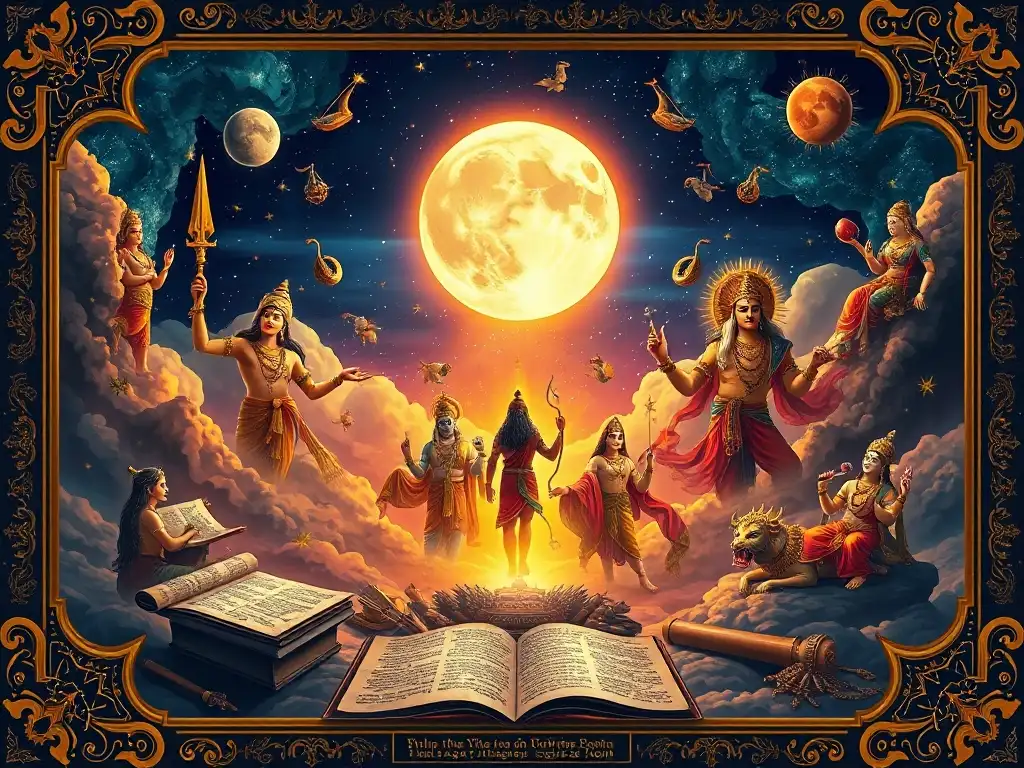
The Puranic literature is a treasure trove of ancient Indian cosmology, offering insights into the creation, structure, and purpose of the universe. Key texts, such as the Vishnu Purana, Shiva Purana, and Bhagavata Purana, provide foundational narratives that explore the interplay of creation, preservation, and destruction—a triadic framework that characterizes the cyclical nature of existence in ancient Indian thought. Each text presents unique perspectives and rich mythological narratives that contribute to a holistic understanding of the cosmos.
The Vishnu Purana emphasizes the roles of divine beings in the creation and maintenance of the universe, while the Shiva Purana delves into the transformative aspects of destruction and renewal. The Bhagavata Purana, on the other hand, focuses on the interaction between the cosmos and its inhabitants, illustrating the relationship between the divine and the mortal realms. Together, these texts form a comprehensive tapestry of ancient Indian cosmological thought, reflecting the intricate balance of forces that govern existence.
The Vishnu Purana: Creation and Preservation
The Vishnu Purana is one of the most revered texts in Puranic literature, articulating the themes of creation and preservation through the lens of the deity Vishnu. It begins with a cosmic narrative that describes the origin of the universe from the primordial waters, where Vishnu, in his divine form, is said to rest. The text elaborates on the process of creation, detailing how Vishnu manifests as Brahma, the creator god, to bring forth the cosmos.
Key concepts in the Vishnu Purana include the cyclical nature of time, represented through the Yugas (ages), which highlight the gradual decline of dharma (righteousness) over time. The text emphasizes Vishnu's role in maintaining cosmic order through his various incarnations (avatars), such as Rama and Krishna, who intervene during times of moral and cosmic crises. This portrayal underscores the belief that the preservation of the universe is as crucial as its creation, reflecting a harmonious balance in ancient Indian cosmology.
The Shiva Purana: Destruction and Renewal
The Shiva Purana presents a complementary perspective to the Vishnu Purana, focusing on the aspects of destruction and renewal associated with Lord Shiva. In this text, destruction is not viewed negatively; rather, it is essential for the regeneration of the universe. The Shiva Purana narrates the story of the cosmos's cyclical nature, emphasizing how Shiva's role as the destroyer is integral to the process of creation.
Destruction, as depicted in the Shiva Purana, leads to transformation and new beginnings. The cosmic dance (Nataraja) symbolizes this dynamic interplay, showcasing the rhythm of creation and dissolution. The text elaborates on the significance of Shiva's various manifestations and the associated myths that illustrate his role in overseeing the cycles of life and death. This duality of creation and destruction enriches the understanding of ancient Indian cosmology, portraying a universe in perpetual flux.
The Bhagavata Purana: The Universe and Its Inhabitants
The Bhagavata Purana stands out for its profound exploration of the relationship between the cosmos and its inhabitants, particularly through the lens of devotion (bhakti). This text delves into the nature of the universe, describing it as a living entity imbued with divine presence. The Bhagavata Purana illustrates the interconnectedness of all beings within the cosmic order, emphasizing that every entity, from the smallest creature to the highest gods, has a role in the grand tapestry of existence.
Central to its cosmological narrative is the depiction of the universe as consisting of multiple realms, including the material and spiritual planes. The text emphasizes the role of divine figures, particularly Krishna, in guiding and protecting the inhabitants of the universe. By illustrating stories of devotion and moral dilemmas faced by both mortals and deities, the Bhagavata Purana conveys complex philosophical ideas while reinforcing the importance of ethical living within the context of a vast and intricate cosmos.
Symbolism and Metaphors in Puranic Cosmology
Symbolism and metaphors play a crucial role in conveying the intricate concepts of Puranic cosmology. These literary devices help distill complex philosophical ideas into relatable narratives, allowing readers to grasp the essence of the universe and its workings. By employing vivid imagery and allegorical representations, the Puranas invite contemplation on the nature of existence and the divine.
The use of symbols and metaphors in Puranic literature not only enhances the poetic quality of the texts but also serves as a bridge between the abstract and the concrete. The cosmological concepts illustrated in the Puranas can thus be understood on multiple levels, from the literal to the metaphorical, enriching the reader's comprehension of ancient Indian cosmology.
Understanding Symbolic Representations of the Universe
Symbolic representations in Puranic cosmology often depict the universe as a vast, interconnected web of relationships. For instance, the concept of the cosmic ocean represents the infinite potential from which creation emerges, while Mount Meru is frequently portrayed as the axis mundi—the center of the universe that connects the earthly realm with the divine.
Such symbols serve to illustrate fundamental principles of existence, encapsulating ideas about balance, harmony, and the cyclical nature of life. They encourage a deeper understanding of the universe as not merely a physical entity but as a dynamic interplay of energies and forces. By interpreting these symbols, readers can appreciate the intricate ways in which ancient Indian thought conceptualized the cosmos.
The Use of Metaphors in Conveying Complex Ideas
Metaphors in Puranic literature are employed to simplify and communicate complex cosmological ideas effectively. For example, the metaphor of the "tree of life" is often used to illustrate the connections between various life forms and the divine essence that sustains them. This metaphor highlights the idea of growth, development, and the interconnectedness of all beings within the cosmic framework.
Additionally, metaphors related to the divine play a significant role in portraying the attributes of gods and their interactions with the universe. By likening deities to natural forces, such as storms or rivers, the texts convey the profound impact of the divine on the world. These literary devices not only enhance the narrative depth of the Puranas but also facilitate a richer engagement with the philosophical underpinnings of ancient Indian cosmology.
Influence of Puranic Cosmology on Later Philosophical Thoughts
The cosmological frameworks presented in Puranic literature have profoundly influenced later philosophical thoughts in India. The Puranas, with their intricate narratives and elaborate cosmologies, provided a foundation for various philosophical discussions, particularly concerning the nature of the universe, the concept of time, and the relationship between the divine and the material world. The ideas encapsulated in the Puranas served as a dialogue between traditional beliefs and emerging philosophical schools, enabling a rich tapestry of thought that explored metaphysical concepts.
The incorporation of cosmological principles found in the Puranas into later texts highlights their enduring significance. Thinkers such as Adi Shankaracharya and Ramanuja drew upon these ancient texts to formulate their own philosophical doctrines, emphasizing the interconnectedness of all beings and the ultimate reality of Brahman. The metaphysical themes from the Puranas have also paved the way for further inquiry into the nature of existence, thus shaping the philosophical landscape of India.
The Impact on Hindu Philosophical Schools
Hindu philosophical schools have been significantly affected by the cosmological concepts outlined in the Puranas. For instance, the Vedanta school, particularly in its non-dual interpretation, sees the cosmos as part of a singular reality—Brahman. This notion resonates with the Puranic portrayal of the universe as an emanation of the divine, reinforcing the idea that all existence is interconnected.
Moreover, the Samkhya school, with its dualistic perspective, incorporates elements of Puranic cosmology in understanding the interplay between Purusha (consciousness) and Prakriti (matter). The cyclical nature of creation and destruction, a recurring theme in the Puranas, has also influenced the Buddhist and Jain philosophies, which emphasize impermanence and the transient nature of life.
The philosophical discourse surrounding these Puranic ideas has not only provided a foundation for Hindu thought but has also facilitated dialogues between various schools, enriching the intellectual heritage of ancient India.
Transmission of Cosmological Ideas to Other Cultures
The cosmological ideas articulated in Puranic literature have transcended geographical boundaries, influencing cultures beyond India. As ancient Indian traders and scholars traveled to Southeast Asia, they carried with them these cosmological narratives, which were often integrated into local belief systems. For example, the Hindu-Buddhist cosmology seen in the temples of Angkor Wat in Cambodia reflects the adaptation of Puranic concepts within a different cultural context.
The transmission of these ideas can also be observed in the syncretic traditions that emerged in regions such as Indonesia and Malaysia, where Hindu and Buddhist cosmologies blended with indigenous beliefs. This cross-cultural exchange highlights the universal relevance of the themes within Puranic literature, such as the cycle of creation and destruction, and the quest for ultimate truth.
Furthermore, the influence of Puranic cosmology can be traced in the philosophical discourses of neighboring cultures, including the Islamic Golden Age, where scholars engaged with these ancient ideas, often interpreting them through the lens of their own belief systems.
Conclusion: The Legacy of Ancient Indian Cosmology in Puranic Literature
The legacy of ancient Indian cosmology as presented in Puranic literature is vast and multifaceted. These texts not only offer insights into the worldview of ancient Indian civilizations but also serve as a bridge to later philosophical developments. The cosmological themes present in the Puranas continue to resonate with contemporary thinkers, showcasing their enduring relevance.
Summary of Key Insights and Contributions
The Puranas present a rich cosmological framework that has significantly influenced various aspects of Indian philosophy, religion, and culture. Key insights from these texts include:
- The cyclical nature of time and existence.
- The interconnectedness of the universe and the divine.
- The exploration of metaphysical concepts that have shaped Hindu philosophical discourse.
These contributions underscore the importance of Puranic literature in understanding the evolution of ancient Indian cosmology and its impact on later intellectual traditions.
The Continued Relevance of Puranic Cosmology Today
Today, the insights derived from Puranic cosmology remain relevant as they offer valuable perspectives on contemporary issues such as environmental concerns and existential questions. The cyclical worldview, emphasizing harmony and balance, resonates with modern ecological movements advocating for sustainability and respect for nature.
Furthermore, the philosophical inquiries initiated by the Puranas encourage ongoing exploration into the nature of existence, ethics, and the pursuit of knowledge. As scholars and practitioners continue to engage with these ancient texts, the lessons of Puranic cosmology will undoubtedly inspire future generations, reinforcing their place in the tapestry of global philosophical thought.
- Introduction to Ancient Indian Cosmology
- Historical Context of Puranic Literature
- Main Themes of Ancient Indian Cosmology in Puranic Texts
- Comparative Analysis of Ancient Indian Cosmology
- Key Puranic Texts and Their Contributions to Cosmology
- Symbolism and Metaphors in Puranic Cosmology
- Influence of Puranic Cosmology on Later Philosophical Thoughts
- Conclusion: The Legacy of Ancient Indian Cosmology in Puranic Literature
- What is ancient Indian cosmology as described in Puranic literature?
- How do Puranic texts contribute to our understanding of ancient Indian civilization?
- What are some key themes found in Puranic cosmology?
- How does Puranic literature compare to other ancient Indian texts regarding cosmology?
- Why is studying ancient Indian cosmology important today?
Frequently Asked Questions
What is ancient Indian cosmology as described in Puranic literature?
Ancient Indian cosmology refers to the understanding of the universe and its creation as depicted in Puranic texts, which include myths, legends, and philosophical concepts that illustrate the structure of the cosmos.
How do Puranic texts contribute to our understanding of ancient Indian civilization?
Puranic literature offers insights into the cultural beliefs, rituals, and social structures of ancient Indian civilizations, reflecting their values and worldview, which were deeply intertwined with their cosmological beliefs.
What are some key themes found in Puranic cosmology?
Key themes include the creation and destruction cycles, the roles of deities, the concept of time (Yugas), and the interconnectedness of the universe, which emphasize the dynamic nature of existence.
How does Puranic literature compare to other ancient Indian texts regarding cosmology?
While Puranic literature focuses on mythological narratives, other texts like the Vedas and Upanishads offer philosophical insights. Together, they provide a more comprehensive view of ancient Indian cosmology.
Why is studying ancient Indian cosmology important today?
Studying ancient Indian cosmology helps us understand the historical context of cultural beliefs, influences on modern philosophies, and the interplay between science and spirituality in ancient societies.
Final Reflection: Embracing the Depths of Ancient Indian Cosmology
The exploration of ancient Indian cosmology through Puranic literature remains profoundly relevant today, as it offers us a lens through which to understand not only the universe but also our place within it. In a world increasingly driven by scientific inquiry and technological advancement, the wisdom embedded in these ancient texts serves as a reminder of the rich tapestry of human thought and belief that has shaped our understanding of existence. The Puranas, with their intricate narratives and profound philosophical insights, challenge us to consider the interconnectedness of all things and the cyclical nature of life itself.
The influence of ancient Indian cosmology is palpable in contemporary discussions surrounding spirituality, environmentalism, and the quest for meaning in our lives. As we navigate the complexities of modern existence, the teachings found within Puranic literature encourage us to reflect on our relationship with the cosmos and the responsibilities we hold towards it. The universe is a manifestation of the divine, and understanding it is essential to understanding ourselves.
This perspective not only enriches our cultural heritage but also invites us to engage with the world around us in a more mindful and respectful manner.
As we conclude this exploration, I invite you to reflect on the lessons of ancient Indian cosmology and consider how they can inform your own journey. What insights can you draw from these timeless narratives to enhance your understanding of the universe and your role within it?
Let the wisdom of the Puranas inspire you to cultivate a deeper connection with the cosmos, fostering a sense of wonder and responsibility that transcends time and space. Embrace this opportunity to integrate these ancient teachings into your life, allowing them to guide you toward a more harmonious existence with the world around you.
Unveil the Mysteries of Ancient Indian Cosmology!
Thank you for diving into our exploration of Puranic literature and its incredible insights into ancient Indian cosmology. We hope you found value in understanding how these texts shape our knowledge of the universe and cultural heritage. Now, it's time to take that inspiration and apply it!
Here’s how you can continue your journey:
- Dive Deeper: Read one of the Puranas we discussed. Experience the rich narratives and philosophical insights firsthand!
- Share Your Insights: Engage in discussions with fellow enthusiasts on our forum—connect and expand the conversation around ancient cosmology.
- Explore Further: Investigate the cosmological views of other ancient cultures and uncover fascinating parallels and differences.
As you ponder these paths, consider this: What aspect of ancient Indian cosmology resonates most with you, and how might it influence your understanding of today's universe?