
The Nyaya School’s Views on Perception and Cognition


Welcome to Ancient India History, where we embark on an enlightening journey through the rich tapestry of ancient Indian civilizations. Today, we delve into a fascinating aspect of philosophy with our main article on the Nyaya School's views on perception and cognition. Discover how this profound school of thought navigates the complexities of human understanding and the nature of reality. What insights did the ancient sages offer that still resonate today? Join us as we explore the depths of knowledge that shaped one of history's most vibrant cultures, and prepare to have your curiosity ignited!
- Overview of the Nyaya School of Thought
- Fundamental Concepts of Perception in the Nyaya School
- Cognition in the Nyaya School
- Theories of Inference and Their Connection to Perception
- The Significance of Perception and Cognition in Nyaya Philosophy
- Conclusion
-
Frequently Asked Questions
- What is the Nyaya School in ancient Indian philosophy?
- How does the Nyaya School define perception?
- What are the key components of cognition according to the Nyaya School?
- How does the Nyaya School differentiate between valid and invalid perception?
- What influence did the Nyaya School have on other philosophical traditions?
- Final Reflection: The Enduring Wisdom of the Nyaya School on Perception and Cognition
- Unlock the Secrets of Ancient Thought!
Overview of the Nyaya School of Thought

The Nyaya School of Thought is a significant philosophical tradition in ancient Indian philosophy, renowned for its rigorous approach to logic, epistemology, and metaphysics. Emerging around the 6th century BCE, Nyaya focuses extensively on the processes of perception and cognition, providing a systematic framework for understanding how knowledge is acquired and validated. This school of thought not only contributed to the broader discourse within Indian philosophy but also laid the groundwork for later philosophical developments.
By delving into the Nyaya School's views on perception and cognition, we can explore how these ancient philosophers approached the complexities of human understanding, the nature of reality, and the mechanisms of knowledge acquisition. This exploration is vital for appreciating the rich tapestry of Indian philosophical thought and its enduring relevance in contemporary discussions on epistemology.
Introduction to the Nyaya School
The Nyaya School, known as one of the six orthodox schools of Indian philosophy (Astika), primarily emphasizes logical reasoning and the art of argumentation. Founded by the sage Gautama (also known as Akshapada), this school is characterized by its systematic methodology for analyzing and critiquing various forms of knowledge. The central text of Nyaya philosophy is the "Nyaya Sutra," which comprises aphorisms detailing the principles of logic and epistemology.
At the heart of Nyaya is the concept of pramana, or means of knowledge. The school identifies four primary pramanas:
- Pratyaksha (perception)
- Anumana (inference)
- Upamana (comparison)
- Shabda (verbal testimony)
Through these pramanas, the Nyaya philosophers sought to establish a comprehensive understanding of cognition and its limitations. They argued that perception is the most immediate and direct means of acquiring knowledge, serving as the foundation upon which other forms of knowledge are built.
Historical Context of the Nyaya Philosophy
The Nyaya School emerged during a period of rich intellectual activity in ancient India, which was marked by the development of various philosophical systems and schools of thought. This era witnessed the rise of significant religious and philosophical movements, including Buddhism and Jainism, both of which posed challenges to traditional Vedic thought. In response, the Nyaya philosophers crafted their arguments to defend Vedic epistemology and metaphysics.
Historically, the Nyaya School became prominent in the context of debates surrounding the nature of reality and the means of knowledge. Nyaya thinkers engaged with contemporary philosophical traditions, developing a distinctive position that emphasized the role of logic and reasoning in understanding the world. This interaction with other schools, particularly Buddhism, influenced the evolution of Nyaya thought, leading to sophisticated discussions on perception, cognition, and the nature of truth.
The legacy of the Nyaya School continues to resonate in modern philosophical discourse, as its insights into perception and cognition remain relevant in contemporary epistemological discussions. By examining the contributions of the Nyaya School, we can gain a deeper understanding of the foundations of Indian philosophy and its impact on global philosophical traditions.
Fundamental Concepts of Perception in the Nyaya School

The Nyaya School, one of the six classical systems of Indian philosophy, offers a comprehensive analysis of perception and cognition. Understanding its foundational concepts is crucial for grasping how this school interprets the nature of knowledge. In the Nyaya framework, perception is not just a passive reception of sensory data but an active process that plays a vital role in acquiring knowledge.
Definition of Perception According to Nyaya
In Nyaya philosophy, perception (pratyakṣa) is defined as the direct and immediate cognition of an object through the senses. This immediate awareness is considered reliable and serves as the primary source of knowledge. The Nyaya philosophers emphasize that perception is not merely a subjective experience; rather, it is a process that leads to valid knowledge.
According to the Nyaya Sutras, perception has two main characteristics:
- Directness: It provides direct access to the object without the need for inference or testimony.
- Non-erroneous: Genuine perception is considered infallible, meaning that when the senses function correctly, the knowledge gained is accurate.
The Nyaya School categorizes perception into two types:
- Ordinary Perception (Laukika Pratyakṣa): This is the experience derived from the usual functioning of the senses.
- Special Perception (Alaukika Pratyakṣa): This includes extraordinary experiences, such as those gained through yogic practices.
Types of Perception in Nyaya Philosophy
The Nyaya School delineates several types of perception, focusing on the modalities through which knowledge is acquired. These types can be classified as follows:
- External Perception: This involves the five senses—sight, hearing, touch, taste, and smell. Each of these senses provides knowledge about external objects. For example:
- Sight reveals color and form.
- Hearing provides information about sounds.
- Internal Perception: This refers to the awareness of internal states, such as thoughts and emotions. While external perception deals with objects outside the individual, internal perception allows for the recognition of one's mental states.
- Inferential Perception: Although primarily associated with inference, Nyaya recognizes that certain perceptual experiences can lead to inferential knowledge. For example, seeing smoke may lead one to infer the presence of fire.
- Memory: This type of perception involves the recollection of past experiences. The Nyaya philosophers consider memory a valid source of knowledge as it allows individuals to access information that was previously perceived.
- Intuitive Perception: This is a higher form of perception, where knowledge is gained without the mediation of the senses. It is considered rare and often associated with enlightened beings.
Role of Perception in Knowledge Acquisition
Perception plays a pivotal role in the Nyaya School's epistemology. It serves as the foundation for knowledge acquisition and is considered the first step in the process of understanding reality. According to Nyaya thinkers, knowledge derived from perception is the most trustworthy and serves as a basis for further reasoning and analysis.
The process of acquiring knowledge through perception can be summarized as follows:
- Initial Encounter: An individual perceives an object through the senses.
- Cognitive Recognition: The mind processes this sensory information, leading to an understanding of the object's nature.
- Validation: The knowledge gained through perception is then validated through comparison with previously acquired knowledge or through inferential reasoning.
In summary, Nyaya School perception cognition is essential for establishing a robust framework for understanding how knowledge is obtained and validated. By emphasizing the reliability of perception, the Nyaya School underscores its importance in the broader pursuit of knowledge and truth.
Through this exploration of perception in the Nyaya School, we can appreciate its sophisticated approach to cognition, which remains relevant in contemporary discussions on epistemology and philosophy.
Cognition in the Nyaya School

Understanding Cognition: Definition and Scope
In the Nyaya School of Thought, cognition is viewed as a fundamental aspect of human experience, playing a crucial role in the acquisition of knowledge. The term "cognition" in this context refers to the various processes through which individuals perceive, interpret, and understand the world around them. Nyaya philosophers delineate cognition into several categories, primarily focusing on pramāṇas (means of knowledge) and the nature of anumana (inference).
Cognition, or "buddhi," is not merely a passive reception of information; instead, it is an active process that involves both perception and reasoning. The Nyaya philosophers emphasize that cognition is essential for discerning truth from falsehood, enabling individuals to make informed decisions.
The scope of cognition within the Nyaya framework includes:
- Direct Perception (Pratyakṣa): Immediate knowledge gained through sensory experience.
- Inference (Anumana): Knowledge derived from reasoning and logical deduction.
- Testimony (Śabda): Knowledge acquired through reliable sources and authoritative texts.
- Comparison (Upamana): Knowledge gained by analogy or similarity.
This comprehensive view of cognition illustrates the Nyaya School's commitment to understanding the mechanisms behind human thought and experience.
The Process of Cognition: Nyaya Perspectives
Nyaya philosophy delineates a systematic approach to understanding cognition through a multi-step process. The Nyaya perspective emphasizes that cognition is not instantaneous; rather, it unfolds through distinct stages:
- Sensory Input (Indriya): The process begins when sensory organs receive stimuli from the external environment. For instance, seeing a tree involves the eye perceiving light waves reflected from the object.
- Cognitive Processing (Manas): Once the sensory input is received, it is processed by the mind ( manas). This stage involves preliminary categorization and interpretation of the sensory data.
- Recognition (Pratyakṣa): Following cognitive processing, an individual recognizes and identifies the object or phenomenon. This recognition is the first level of direct perception and is crucial for establishing knowledge.
- Inference (Anumana): If the object is not directly perceived, cognition may rely on inference. For example, if one sees smoke in the distance, they may infer the presence of fire based on prior knowledge of the relationship between smoke and fire.
- Consolidation (Vikalpa): The final stage involves consolidating the information gathered through perception and inference, allowing individuals to form beliefs or conclusions about the world.
The Nyaya perspective on cognition emphasizes the importance of logical reasoning and empirical evidence, which ensures that the process is robust and reliable.
Relationship Between Perception and Cognition in Nyaya Thought
In Nyaya philosophy, perception and cognition are intricately linked, forming a dynamic relationship that shapes human understanding. The Nyaya School posits that perception serves as the foundational element of cognition, initiating the process of knowledge acquisition.
- Role of Perception: Perception is considered the first means of knowledge, which provides the raw data necessary for further cognitive processes. The Nyaya thinkers argue that without perception, one cannot engage in higher-order cognitive activities like inference or reasoning.
- Cognitive Interpretation: While perception delivers sensory information, cognition interprets this data, allowing individuals to derive meaning. This interpretative layer is critical, as different individuals may perceive the same object yet arrive at varying conclusions based on their cognitive processing.
- Feedback Loop: The relationship between perception and cognition is not linear; rather, it is cyclical. As individuals engage in cognitive reasoning, their conclusions can influence future perceptions. For example, prior knowledge about a subject can shape how one perceives new information related to that subject.
The Nyaya School’s views on the interplay between perception and cognition underscore the complexity of human thought processes. By recognizing the foundational role of perception in cognition, Nyaya philosophers provide a nuanced understanding of how individuals grasp the world, paving the way for deeper philosophical inquiries into the nature of knowledge and reality.
Theories of Inference and Their Connection to Perception

Overview of Inference in Nyaya Philosophy
In Nyaya philosophy, inference, known as anumana, is one of the key means of knowledge (pramana) alongside perception ( pratyaksha), comparison, and testimony. The Nyaya School articulates a systematic framework for understanding how knowledge is acquired and validated. Inference is distinguished from perception by its reliance on reasoning rather than direct sensory experience.
Nyaya philosophers categorize inference into two main types:
- General Inference ( sāmānyalakṣaṇa): This type involves general principles or rules that apply to a wide range of cases.
- Specific Inference ( vyāpakalakṣaṇa): This focuses on specific instances or particular cases.
The classical formulation of inference is represented in the famous syllogism, which can be summarized as follows:
- Premise 1: All humans are mortal (general rule).
- Premise 2: Socrates is a human (specific case).
- Conclusion: Therefore, Socrates is mortal (inference).
This structure illustrates the logical process through which Nyaya philosophers believed individuals could derive conclusions based on a combination of general knowledge and specific observations.
How Inference Relates to Perception and Cognition
The relationship between inference and perception is central to Nyaya thought. Nyaya philosophers argue that perception provides the foundational data necessary for all forms of inference. Without sensory experience, one cannot establish premises that lead to valid conclusions. Thus, perception is viewed as the starting point of cognition, while inference is seen as a step further in the cognitive process.
In Nyaya philosophy, cognition involves three stages:
- Perception ( pratyaksha): The direct experience of objects through the senses.
- Inference ( anumana): Reasoning based on the premises derived from perception.
- Cognition ( vijnana): The resulting knowledge that integrates both perception and inference.
This three-stage model emphasizes that while perception offers immediate knowledge of the world, inference allows for the expansion of knowledge beyond direct experience. For example, if one sees smoke (perception), they can infer the presence of fire (inference), even if the fire is not directly visible.
Case Studies: Examples of Nyaya Inference
To illustrate the principles of Nyaya inference, consider the following case studies:
- The Example of Fire and Smoke:
- Observation: A person sees smoke rising from a hill.
- Inference: Based on prior knowledge that smoke is typically produced by fire, the individual infers there is likely a fire present.
- Conclusion: The inference leads to the belief that the hill has a fire, demonstrating how perception informs reasoning.
- The Example of a Pot:
- Observation: An individual observes a clay pot.
- Inference: Knowing that all clay objects are created by a potter, they can infer the existence of a potter from the observed pot.
- Conclusion: This reinforces the Nyaya idea that knowledge of specific instances can lead to conclusions about general principles.
- The Example of Sound:
- Observation: A person hears a sound coming from the other room.
- Inference: They infer that someone is present in that room, based on previous experiences where sounds indicated the presence of people.
- Conclusion: This showcases how auditory perception can lead to cognitive conclusions about unseen realities.
These case studies highlight the intricate relationship between perception and inference in the Nyaya School's views on cognition. Through structured reasoning, individuals can navigate their understanding of the world, relying on both sensory experience and logical deduction to form a comprehensive view of reality.
The Significance of Perception and Cognition in Nyaya Philosophy
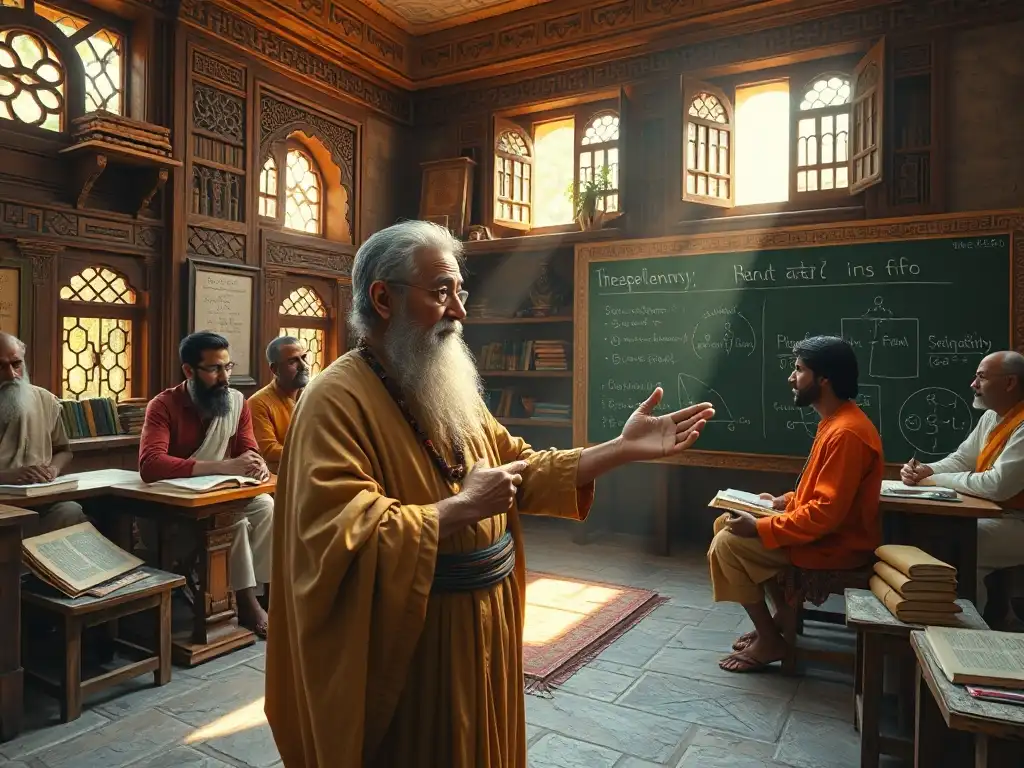
The Nyaya School of Thought, one of the six orthodox schools of Indian philosophy, places immense significance on perception and cognition. This school asserts that knowledge arises through various means, with perception (pratyakṣa) being the most fundamental. Nyaya philosophers argue that perception is not merely a passive reception of sensory data; rather, it is an active cognitive process that involves interpreting and conceptualizing the information gathered through the senses.
The Nyaya system classifies perception into two main types: external perception, which involves direct sensory experience, and internal perception, which relates to self-awareness and reflection. This duality highlights the intricate relationship between external stimuli and internal cognitive processes. According to Nyaya, correct cognition arises when these perceptions are processed correctly, leading to valid knowledge (jñāna).
Moreover, Nyaya emphasizes the role of inference (anumāna) as a complementary cognitive process. Inference builds on perceptual knowledge, allowing individuals to derive conclusions based on observed phenomena. For instance, if one perceives smoke rising from a hill, they can infer the presence of fire based on prior knowledge. This interplay between perception and cognition forms the bedrock of Nyaya epistemology, showcasing a sophisticated understanding of how humans acquire and validate knowledge.
Contributions of Nyaya to Epistemology
The Nyaya School has made substantial contributions to the field of epistemology, particularly regarding the nature and validity of knowledge. One of the most significant aspects of Nyaya epistemology is the framework it provides for understanding different sources of knowledge, which Nyaya categorizes into four pramāṇas (means of knowledge):
- Perception (Pratyakṣa): Direct sensory experience, considered the primary source of knowledge.
- Inference (Anumāna): Knowledge derived from reasoning based on perceived facts.
- Comparison (Upamāna): Knowledge gained through analogy, where one thing is understood based on its similarity to another.
- Testimony (Śabda): Knowledge acquired through authoritative sources, such as scriptures or trusted individuals.
The Nyaya philosophers meticulously analyzed each pramāṇa, establishing criteria for their validity. For instance, they argued that for perception to be valid, it must be free from error and should lead to a correct understanding of the object perceived. Such rigorous analysis laid the groundwork for later philosophical inquiries into the nature of knowledge and belief.
Nyaya also introduced the concept of fallacies (hetvabhasa), which are errors in reasoning that can lead to invalid conclusions. By identifying and categorizing these fallacies, Nyaya emphasized the importance of sound reasoning in the pursuit of knowledge, influencing both Indian and Western philosophical traditions.
Influence of Nyaya Views on Later Philosophical Thought
The insights of the Nyaya School regarding perception and cognition have profoundly influenced later philosophical thought, both within India and beyond. The emphasis on logical reasoning and the systematic approach to epistemology paved the way for subsequent schools of thought, including the Mimamsa and Vedanta traditions. These schools adopted and adapted Nyaya's rigorous methods of analysis, integrating them into their own philosophical frameworks.
Moreover, Nyaya's exploration of perception and inference has resonated with Western philosophers, particularly during the Enlightenment period. The ideas surrounding the nature of knowledge and the processes of cognition have parallels with the works of philosophers such as John Locke and David Hume, who also grappled with the empirical basis of knowledge.
In contemporary discussions, the Nyaya School's insights into the mechanisms of perception and cognition continue to be relevant, particularly in fields like cognitive science and epistemology. Researchers exploring the relationship between sensory experience and knowledge formation often find themselves engaging with concepts that trace their origins back to Nyaya philosophy.
The Nyaya School's views on perception and cognition not only enriched Indian philosophical discourse but also laid a foundation that continues to influence global philosophical thought. The systematic approach to understanding knowledge, grounded in perception and logical reasoning, remains a vital area of inquiry in both historical and modern contexts.
Conclusion

Summary of Key Points on Nyaya School Perception and Cognition
The Nyaya School of Thought, one of the six orthodox schools of Indian philosophy, offers profound insights into perception and cognition. Its exploration of epistemology is pivotal for understanding how knowledge is acquired and validated in ancient Indian thought. Here are the key points regarding the Nyaya School’s views on perception and cognition:
- Types of Perception: The Nyaya philosophers classified perception into two main types:
- Ordinary Perception (Pratyaksha): Direct sensory experience, which is deemed reliable and forms the basis of knowledge.
- Inference (Anumana): Knowledge derived from reasoning based on prior perceptions, highlighting the interconnectedness between sensory input and cognitive processes.
- Cognitive Processes: The Nyaya School emphasized the importance of the mind in processing sensory data. They proposed a structured approach to cognition that includes:
- Contact with Objects: Initial sensory engagement with the external world.
- Cognition Formation: The mental interpretation and understanding of sensory data.
- Validation: The assurance of knowledge through logical scrutiny and debate.
- Role of Logic: Logic (Nyaya) is fundamental in the validation of knowledge. The Nyaya philosophers developed rigorous methods for argumentation, ensuring that perceptions could be evaluated critically. This laid the groundwork for future philosophical discourse.
- Skepticism and Refutation: The Nyaya School also addressed skepticism regarding perception and cognition. They refuted various counterarguments, defending the reliability of sensory experience as a valid means of acquiring knowledge.
The Legacy of Nyaya Philosophy in Ancient Indian Thought
The legacy of Nyaya philosophy extends far beyond its immediate contributions to epistemology. Its influence permeates various aspects of ancient Indian thought, making it a cornerstone of philosophical discourse. Here are some notable legacies:
- Integration with Other Schools: Nyaya's emphasis on logic and epistemology significantly influenced other schools of Indian philosophy, including the Vaisheshika, which focused on metaphysics. The dialogues between these schools enriched the philosophical landscape of ancient India.
- Practical Applications: The principles of Nyaya have practical implications in fields such as ethics, jurisprudence, and education. By establishing a systematic approach to reasoning and knowledge assessment, the Nyaya School contributed to the development of legal systems and ethical frameworks in ancient Indian society.
- Influence on Modern Philosophy: The logical structures and epistemological inquiries initiated by the Nyaya philosophers have resonated with contemporary philosophical discussions. Scholars today continue to explore Nyaya's relevance in debates on perception, knowledge, and the nature of reality.
- Cultural Significance: The Nyaya School has played a crucial role in shaping the intellectual culture of ancient India. Its methodologies fostered a spirit of inquiry and debate, encouraging scholars to engage with complex philosophical questions.
The Nyaya School's views on perception and cognition not only provide a window into ancient Indian epistemology but also highlight the enduring legacy of its philosophical contributions in shaping the discourse of knowledge throughout history.
Frequently Asked Questions
What is the Nyaya School in ancient Indian philosophy?
The Nyaya School is one of the six orthodox philosophical systems in India, focusing on logic and epistemology, particularly the process of reasoning and acquiring knowledge.
How does the Nyaya School define perception?
In the Nyaya School, perception is considered one of the primary means of knowledge, defined as the direct and immediate experience of objects through the senses.
What are the key components of cognition according to the Nyaya School?
The Nyaya School identifies several components of cognition, including perception, inference, and comparison, which work together to form a comprehensive understanding of reality.
How does the Nyaya School differentiate between valid and invalid perception?
The Nyaya School posits that valid perception is based on accurate sensory experience, while invalid perception arises from errors or misinterpretations, emphasizing the importance of correct reasoning.
What influence did the Nyaya School have on other philosophical traditions?
The Nyaya School's emphasis on logic and epistemology significantly influenced various other Indian philosophical traditions, contributing to debates on knowledge and truth in both religious and secular contexts.
Final Reflection: The Enduring Wisdom of the Nyaya School on Perception and Cognition
The insights of the Nyaya School on perception and cognition remain profoundly relevant in today's world, where understanding the nature of knowledge and belief is more crucial than ever. As we navigate an era filled with information overload and diverse perspectives, the principles laid out by the Nyaya philosophers offer a timeless framework for discerning truth from illusion. Their emphasis on rigorous reasoning and empirical observation challenges us to cultivate a deeper awareness of how we perceive and interpret our experiences.
The teachings of the Nyaya School continue to resonate within our cultural and social landscapes, influencing not only philosophical discourse but also practical applications in fields such as psychology and cognitive science. The way we understand perception shapes our interactions and decisions, highlighting the importance of clarity and critical thought in our daily lives. The mind is not a vessel to be filled, but a fire to be kindled.
This quote encapsulates the essence of the Nyaya approach, urging us to actively engage with our cognitive processes rather than passively accept information.
As we reflect on the lessons from the Nyaya School, I invite you to consider how these ancient teachings can inform your own understanding of perception and cognition in the modern world. Take a moment to examine your beliefs and the sources of your knowledge. Are you engaging with the world around you with the critical eye that the Nyaya philosophers advocated? Embrace the challenge of questioning and exploring your perceptions, for it is through this journey that we can cultivate wisdom and insight that transcend time and culture.
Unlock the Secrets of Ancient Thought!
Thank you for diving into the fascinating world of the Nyaya School’s views on perception and cognition! By exploring these ancient perspectives, you’ve taken a valuable step toward understanding the complexities of Indian philosophy. Now, it’s time to put this knowledge into action!
Here’s how you can deepen your journey and share this wisdom with others:
- Engage with the community: Join online forums or social media groups focused on Indian philosophy to discuss your insights and learn from others.
- Dive deeper: Explore books or articles on contemporary applications of Nyaya philosophy to see how these ancient ideas resonate in today's context.
- Share your findings: Write a blog post or create a social media update summarizing your insights about the Nyaya School and its relevance in modern thought.
What aspect of the Nyaya School intrigues you the most, and how do you think it can influence your understanding of cognition today?