
The Legacy of Ancient Indian Astronomy in Modern Scientific Practices


Welcome to Ancient India History, where we embark on a fascinating journey through the rich tapestry of civilizations that shaped the Indian subcontinent. Dive into our featured article, “The Legacy of Ancient Indian Astronomy in Modern Scientific Practices,” and uncover how the astronomical insights of ancient Indian scholars not only illuminated the skies of their time but also laid the groundwork for contemporary scientific breakthroughs.
Prepare to be captivated as we unravel the threads of knowledge that connect our past to the present, inviting you to explore the profound contributions of ancient Indian astronomy. Your adventure through history begins here—let's set the stage for discovery!
- Introduction to Ancient Indian Astronomy Contributions
- Historical Context of Ancient Indian Astronomy
- Key Figures in Ancient Indian Astronomy
- Major Contributions of Ancient Indian Astronomy
- Influence of Ancient Indian Astronomy on Modern Scientific Practices
- Preservation and Rediscovery of Ancient Indian Astronomical Texts
- Conclusion: The Lasting Legacy of Ancient Indian Astronomy Contributions
- References and Further Reading on Ancient Indian Astronomy Contributions
- Frequently Asked Questions
- Final Reflection: Embracing the Wisdom of Ancient Indian Astronomy
- Embrace the Wisdom of the Stars Today!
Introduction to Ancient Indian Astronomy Contributions
The contributions of ancient Indian astronomy represent a profound chapter in the history of science, showcasing the remarkable advancements made by Indian scholars in understanding celestial phenomena. From the meticulous observations of the stars and planets to the development of sophisticated mathematical techniques, ancient Indian astronomy laid the groundwork for many modern scientific practices.
This article delves into the key contributions of ancient Indian astronomers, exploring how their work has influenced contemporary astronomy and mathematics. By examining the historical context and significance of these contributions, we can appreciate the rich tapestry of knowledge that ancient Indian civilizations have bequeathed to the world.
Overview of Ancient Indian Astronomy
Ancient Indian astronomy is characterized by its systematic approach to the study of celestial bodies and their movements. Key texts such as the Aryabhatiya by Aryabhata and the Surya Siddhanta are pivotal in this field. Aryabhata, who lived in the 5th century CE, introduced revolutionary concepts such as the rotation of the Earth on its axis and the calculation of eclipses. His work emphasized a mathematical framework that was ahead of its time.
The Surya Siddhanta, on the other hand, is a foundational text that provides comprehensive instructions on calculating planetary positions and understanding time cycles. Its methodologies illustrate the advanced level of astronomical knowledge possessed by scholars of that era.
Key contributions can be summarized as follows:
- Calculation of Time: Ancient Indian astronomers developed precise methods for measuring time, including the concept of shaka (era) and yuga (age).
- Ecliptic and Sidereal Systems: The establishment of two systems for measuring celestial movements, which still influence modern astronomy.
- Planetary Motion: Advanced theories on the motion of planets and their orbits, some of which align with contemporary understandings.
Importance of Astronomy in Ancient Indian Civilizations
Astronomy played a crucial role in the daily lives of ancient Indian civilizations, influencing agriculture, navigation, and religious practices. The seasonal changes dictated by celestial observations were essential for agricultural planning. Festivals and rituals were often aligned with celestial events, highlighting the cultural significance of astronomical knowledge.
Moreover, ancient Indian astronomers contributed to a broader scientific dialogue through their interactions with other cultures. The exchange of ideas with Greek, Persian, and Arab scholars facilitated the development of a more global understanding of astronomy.
The importance of astronomy in ancient India can be understood through several key aspects:
- Agricultural Planning: Accurate celestial observations ensured timely sowing and harvesting of crops.
- Navigation: Astronomical knowledge was essential for maritime navigation, especially for traders.
- Cultural Practices: Many religious festivals were determined by astronomical events, linking science with spirituality.
The legacy of ancient Indian astronomy is not merely a historical footnote; it is a vibrant part of the scientific heritage that continues to resonate in modern practices. As we explore these contributions further, we uncover the depth and brilliance of ancient Indian thought in the realm of science and mathematics.
Historical Context of Ancient Indian Astronomy

The Vedic Period and Astronomical Practices
The Vedic period, spanning from approximately 1500 BCE to 500 BCE, marks a significant chapter in the history of ancient Indian astronomy. During this time, astronomical knowledge was primarily intertwined with religious rituals and agricultural practices. The Vedas, especially the Atharva Veda and Rig Veda, contained hymns and verses that reflected an understanding of celestial phenomena.
Key features of Vedic astronomical practices include:
- Lunar Calendars: The Vedic people developed lunar calendars to determine auspicious dates for rituals and agricultural activities. They observed the phases of the moon and used this knowledge to create a systematic calendar.
- Constellations: The Vedic texts reference several constellations, indicating an awareness of the night sky. For instance, the Nakshatras are a group of 27 lunar mansions that were crucial for timing rituals.
- Cosmology: The concept of the universe in Vedic literature was deeply philosophical, with descriptions of the cosmos that hinted at a structured celestial framework. The Shatapatha Brahmana elaborates on the interrelations between celestial bodies and earthly events.
The Vedic period laid the foundations for future astronomical advancements, blending scientific inquiry with spiritual and agricultural practices.
Contributions from the Indus Valley Civilization
The Indus Valley Civilization (IVC), flourishing from approximately 3300 BCE to 1300 BCE, showcased advanced urban planning and social organization, which extended to their astronomical practices. Although direct textual evidence is limited, archaeological findings provide insights into their understanding of astronomy.
Significant contributions from the IVC include:
- Urban Layout and Orientation: Cities like Mohenjo-Daro and Harappa were meticulously planned with streets oriented in alignment with cardinal directions. This suggests an understanding of the sun's path and its significance in daily life.
- Weights and Measures: The standardized weights and measures used in trade may imply a systematic approach to timekeeping, possibly aligned with lunar cycles.
- Astronomical Tools: Artifacts such as the Great Bath in Mohenjo-Daro, which may have been used for ritual purification, indicate that water bodies were significant for astronomical observations and rituals linked to celestial events.
While the IVC's contributions are less documented than those of later civilizations, their societal structure and urban planning reflect an intrinsic connection to astronomy, influencing subsequent Indian civilizations.
The Golden Age of Astronomy during the Gupta Empire
The Gupta Empire, often referred to as the "Golden Age of India," thrived between the 4th and 6th centuries CE and is renowned for its remarkable advancements in various fields, including astronomy. Scholars during this period profoundly impacted the understanding of celestial phenomena, laying groundwork that resonates in modern scientific practices.
Prominent contributions during the Gupta period include:
- Aryabhata's Work: Aryabhata, one of the most notable astronomers of this era, authored the Aryabhatiya, a seminal text that introduced concepts such as the rotation of the earth on its axis and the calculation of the circumference of the earth. His work emphasized mathematical rigor in astronomical calculations.
- Key Concepts from Aryabhata:
- Place Value System: Aryabhata utilized a place value system, which was pivotal in developing algorithms for astronomical calculations.
- Sine Functions: He introduced the concept of sine in trigonometry, which has vast implications in modern mathematics and astronomy.
- Key Concepts from Aryabhata:
- Brahmagupta's Contributions: Following Aryabhata, Brahmagupta wrote the Brahmasphutasiddhanta, which elaborated on Aryabhata's work and introduced rules for calculating planetary positions and eclipses.
- Advancements in Predictive Astronomy: The Gupta period saw the refinement of tools such as the gola (spherical model) and the shakata (quadrant), enhancing observational accuracy and predictive capabilities regarding celestial events.
The Gupta Empire's legacy in astronomy not only reflects ancient Indian astronomy contributions but also anticipates many modern scientific practices, establishing a lasting influence on both Indian and global astronomical traditions.
Key Figures in Ancient Indian Astronomy

Aryabhata: The Pioneer of Indian Astronomy
Aryabhata, born in 476 CE, is often regarded as the first major mathematician and astronomer of ancient India. His seminal work, the Aryabhatiya, laid the groundwork for many astronomical concepts that significantly influenced later Indian and even global astronomy.
Aryabhata's contributions can be summarized as follows:
- Heliocentric Model: He proposed that the Earth rotates on its axis daily, which was revolutionary at the time. This concept was contrary to the geocentric models prevalent in many other cultures.
- Approximation of π (Pi): Aryabhata calculated the value of π to be approximately 3.1416, which is remarkably close to the exact value. This precision facilitated advancements in both mathematics and astronomy.
- Trigonometric Functions: He introduced sine and cosine functions, laying the groundwork for trigonometry as a mathematical discipline. His work on these functions helped in calculating the positions of celestial bodies.
- Eclipses and Planetary Positions: Aryabhata provided explanations for solar and lunar eclipses, emphasizing that they were caused by the shadows of celestial bodies rather than supernatural phenomena.
Through these contributions, Aryabhata's influence extended beyond his time and geography, serving as a foundation for later astronomers and mathematicians.
Brahmagupta and His Mathematical Innovations
Brahmagupta, who lived during the 7th century CE, made significant strides in mathematics and astronomy, particularly in the formulation of rules governing arithmetic and algebra. His major work, the Brahmasphutasiddhanta, is a seminal text that encompasses both astronomical observations and mathematical theories.
Key contributions of Brahmagupta include:
- Zero as a Number: He was one of the first to treat zero as a number with its own properties, which was a groundbreaking concept that transformed mathematics.
- Rules for Arithmetic: Brahmagupta established rules for operations involving positive and negative numbers, which were crucial for the development of algebra.
- Quadratic Equations: He provided methods for solving quadratic equations, laying the groundwork for future algebraic methods.
- Astronomical Calculations: His work included methods for calculating the positions of planets and the timing of eclipses, which were critical for both practical navigation and theoretical astronomy.
Brahmagupta’s innovations not only advanced mathematical thought in India but also influenced the development of mathematical concepts in the Islamic Golden Age and later in Europe.
Varahamihira: The Integrator of Astronomy and Astrology
Varahamihira, a 6th-century astronomer and astrologer, is best known for his comprehensive work, the Brihat Samhita. This text synthesizes various aspects of astronomy, astrology, and natural science, demonstrating the interconnectedness of these fields in ancient India.
Significant aspects of Varahamihira's contributions include:
- Astronomical Texts: He wrote extensively on planetary movements, eclipses, and the zodiac, integrating astronomy with astrological predictions.
- Meteorology: Varahamihira made early contributions to the study of weather patterns, correlating them with astronomical observations, which reflects an advanced understanding of climate.
- Influence of Astrology: He emphasized the importance of astrology in daily life, providing guidelines on how celestial phenomena could influence human affairs, which was a prevalent belief in ancient Indian culture.
- Cultural Integration: His work is a testament to the blend of science and spirituality in ancient India, showing how astronomical knowledge was applied within the context of daily life and rituals.
Varahamihira's integrative approach established a framework for understanding the universe that resonated deeply within Indian philosophy and continues to be appreciated for its holistic perspective.
Major Contributions of Ancient Indian Astronomy
The Concept of Zero and Its Impact on Mathematics
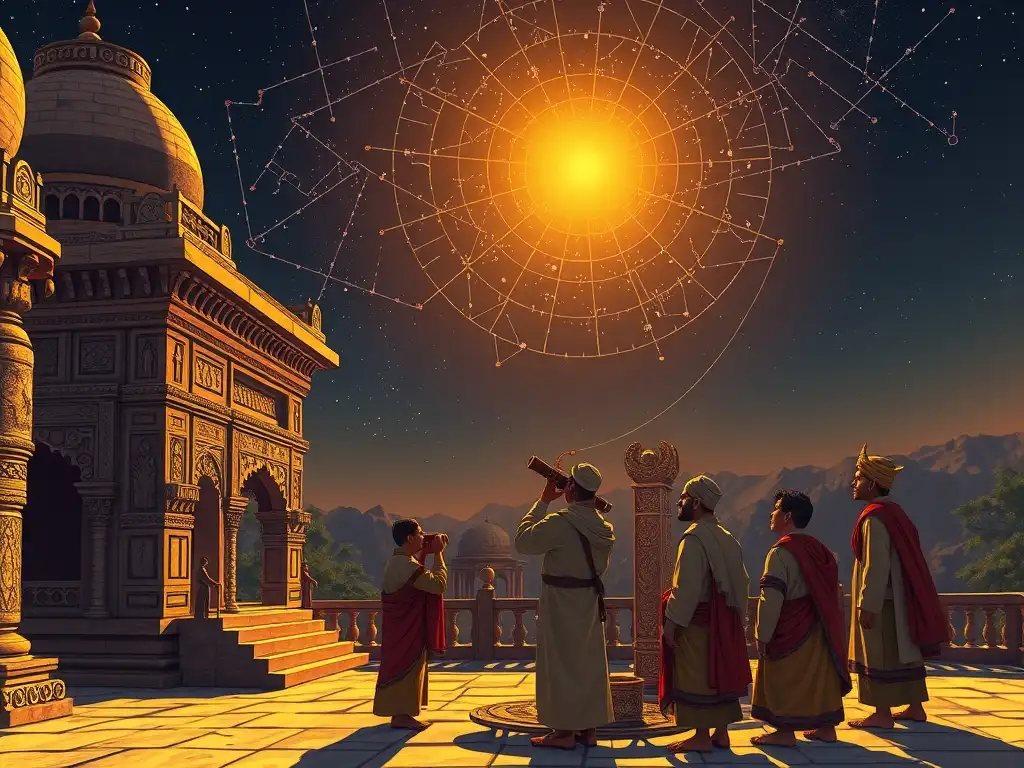
The concept of zero, a fundamental element in mathematics, has its roots in ancient Indian astronomy. The mathematician Brahmagupta, in his seminal work "Brahmasphutasiddhanta" (628 CE), elucidated the properties of zero and its operations. This revolutionary idea transformed mathematics from a mere counting system into a sophisticated, abstract discipline.
- Significance of Zero:
- Zero acts as a placeholder in the decimal system, enabling efficient computation and representation of large numbers.
- It facilitates the development of algebra, calculus, and complex number theory, laying the groundwork for modern mathematics.
The impact of zero extended beyond mathematics into astronomy, where it allowed ancient astronomers to compute celestial positions and timings with remarkable accuracy. The use of zero in astronomical calculations exemplifies how ancient Indian scholars integrated mathematics and astronomy seamlessly.
Astronomical Calculations and Calendar Systems
Ancient Indian astronomers developed advanced methods for astronomical calculations that were crucial for defining time and establishing calendar systems. The Siddhantic tradition, which includes texts like the "Surya Siddhanta," provided detailed algorithms for calculating planetary positions, eclipses, and other celestial events.
- Key Features of Ancient Calendars:
- Lunar and Solar Calendars: Ancient Indians created calendars based on both lunar phases and solar cycles, ensuring a comprehensive understanding of time.
- Equinox and Solstice Calculations: Astronomers meticulously calculated the timings of equinoxes and solstices, which had significant implications for agricultural practices and rituals.
| Calendar Type | Basis | Key Events |
|---|---|---|
| Lunar Calendar | Phases of the Moon | Festivals, agricultural cycles |
| Solar Calendar | Sun's position | Equinoxes, solstices |
The precision of these calculations reflects the sophistication of ancient Indian astronomical practices and their contributions to understanding celestial phenomena, which laid the groundwork for modern calendrical systems.
Ancient Indian astronomy also made remarkable strides in celestial navigation and timekeeping, crucial for trade, exploration, and agricultural planning. Techniques developed by astronomers allowed for accurate positional astronomy and the measurement of time based on celestial bodies.
- Celestial Navigation Techniques:
- Using Stars for Navigation: Sailors utilized the positions of stars and constellations, such as the Pole Star, for navigation across the seas. This was particularly significant for maritime trade.
- Astrolabes and Gnomons: Instruments like astrolabes facilitated the measurement of celestial angles, while gnomons were used to determine local solar time.
- Timekeeping Innovations:
- Water Clocks and Sundials: Ancient Indians invented water clocks (known as ghatikas) and sundials to measure time accurately throughout the day, which were essential for both daily activities and religious observances.
- Mathematical Formulations for Time: The computation of time intervals and the establishment of time zones based on astronomical observations were significant advancements.
The innovations in celestial navigation and timekeeping not only enhanced the maritime capabilities of ancient Indian civilizations but also contributed to the global understanding of astronomy. These contributions continue to influence modern scientific practices and reflect the rich legacy of ancient Indian astronomy.
Influence of Ancient Indian Astronomy on Modern Scientific Practices
The Adoption of Indian Astronomical Knowledge in the Islamic Golden Age
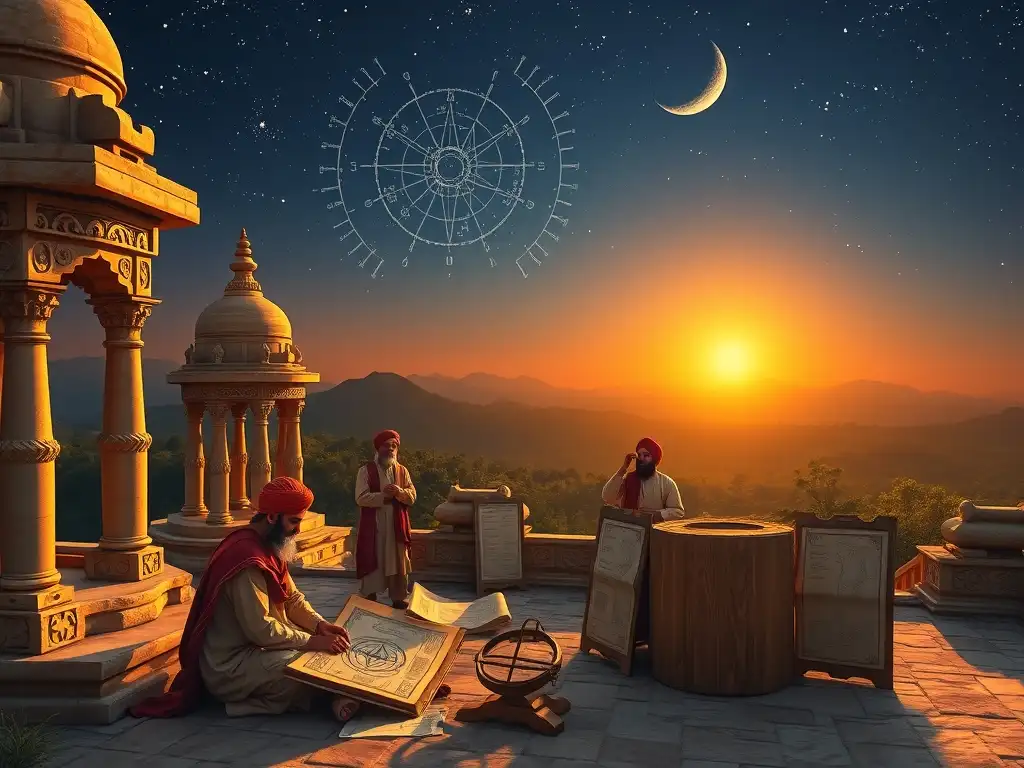
During the Islamic Golden Age, approximately from the 8th to the 14th century, scholars from the Islamic world made significant advancements in various fields, including astronomy. A crucial aspect of this development was the integration of ancient Indian astronomy contributions into the broader scientific discourse. Indian texts, particularly the Surya Siddhanta and Aryabhatiya, were translated into Arabic and became foundational references for Islamic astronomers.
The Indian numeral system, including the concept of zero, was particularly influential. This innovation allowed for more complex calculations and was pivotal in the development of trigonometry. Notably, the works of Indian astronomers like Brahmagupta and Varahamihira were cited extensively by scholars such as Al-Battani and Al-Khwarizmi. Their adoption of Indian techniques not only enriched Islamic astronomy but also laid the groundwork for further developments in Europe during the Renaissance.
Integration of Ancient Techniques in Contemporary Astronomy
Modern astronomy has seen a resurgence of interest in ancient methodologies, particularly those from Indian traditions. Techniques such as observational astronomy and the use of spherical trigonometry are being revisited for their precision and applicability.
- Celestial Navigation: Ancient Indian astronomers developed sophisticated methods for celestial navigation, which are being re-evaluated in the context of modern space exploration.
- Calendar System: The Indian lunar-solar calendar, derived from meticulous astronomical observations, is still relevant today for determining agricultural cycles and religious festivities.
- Astrolabes: The astrolabe, a device used for solving problems related to time and the position of the stars, has roots in Indian astronomy. Modern adaptations of this technology are being utilized in educational settings to teach principles of astronomy and mathematics.
By incorporating these ancient techniques, contemporary astronomers are not only preserving historical knowledge but also enhancing modern scientific practices.
Case Studies: Modern Applications of Ancient Indian Astronomical Methods
Several contemporary projects illustrate the enduring legacy of ancient Indian astronomical methods:
| Case Study | Description | Impact |
|---|---|---|
| Chandrayaan Missions | India's lunar exploration missions utilize ancient astronomical calculations. | Enhanced understanding of the Moon's surface and composition. |
| Astrology in Modern India | The resurgence of Vedic astrology employs ancient mathematical principles. | Influence on cultural practices and personal decision-making. |
| Heritage Conservation | Projects like the Jantar Mantar observatories are being restored and studied. | Promotes awareness of historical scientific achievements. |
These examples showcase how ancient Indian astronomy contributions are not only relevant but are actively shaping modern scientific pursuits. As researchers continue to explore these historical methods, they uncover new insights that bridge the gap between ancient wisdom and contemporary science.
The legacy of ancient Indian astronomy is a testament to its profound influence on modern scientific practices, demonstrating the timelessness of knowledge and the interconnectedness of cultures in the evolution of science.
Preservation and Rediscovery of Ancient Indian Astronomical Texts

Important Manuscripts and Their Significance
Ancient Indian astronomy contributions are well-documented in several key manuscripts, which have played a significant role in preserving the knowledge and practices of the time. These texts not only reflect the advanced understanding of celestial phenomena but also highlight the meticulous observations made by astronomers in ancient India.
- Surya Siddhanta: This foundational text, attributed to the legendary sage Aryabhata, provides insights into the movements of celestial bodies and offers methods for calculating eclipses and the positions of planets. Its astronomical principles influenced both Indian and Islamic scholars and laid the groundwork for future astronomical studies.
- Aryabhatiya: Written by Aryabhata in the 5th century CE, this work covers arithmetic, algebra, and astronomy. Aryabhata's innovative approach to zero and the decimal system is particularly noteworthy. The text includes detailed calculations regarding the Earth's rotation and the distances of celestial bodies.
- Brahmasphutasiddhanta: Authored by Brahmagupta in the 7th century, this text expanded upon Aryabhata's work and introduced rules for handling negative numbers and zero. It also addressed problems related to planetary motions, leading to advancements in mathematical astronomy.
- Padma Purana: While primarily a religious text, it incorporates astronomical concepts, particularly in its descriptions of the cosmos and celestial cycles. This manuscript illustrates the integration of astronomy into the spiritual and cultural fabric of ancient Indian society.
- Khandakhadyaka: Composed by Brahmagupta, this treatise focuses on the calculation of planetary positions and eclipses. It serves as a vital reference for understanding the methods used in ancient celestial observations.
Efforts in Archiving and Translating Ancient Texts
The preservation and rediscovery of ancient Indian astronomical texts have been critical in re-establishing their significance in modern scientific practices. Various efforts have been undertaken to archive, translate, and disseminate these valuable manuscripts.
- Institutional Initiatives: Many universities and research institutions in India have embarked on projects to digitize ancient manuscripts. Organizations like the National Mission for Manuscripts work diligently to catalog and preserve these texts, ensuring that they are accessible for future generations.
- Translation Projects: Scholars are actively translating key texts into modern languages, making the knowledge contained within them more accessible to a global audience. This effort not only aids in academic research but also promotes a broader understanding of ancient Indian astronomy contributions.
- Collaborations with International Scholars: Partnerships between Indian and international scholars have facilitated the exchange of knowledge and the joint study of ancient astronomical manuscripts. These collaborative efforts have led to a renewed interest in the contributions of ancient Indian astronomy to global scientific discourse.
- Publications and Conferences: Numerous publications and academic conferences dedicated to the study of ancient Indian science have emerged, providing platforms for scholars to share their findings and engage in discussions around the significance of these texts in the context of modern astronomy.
The ongoing efforts to preserve, translate, and study ancient Indian astronomical manuscripts highlight their enduring legacy. The contributions of ancient Indian astronomy not only shaped the scientific landscape of their time but continue to influence contemporary practices in astronomy and mathematics.
Conclusion: The Lasting Legacy of Ancient Indian Astronomy Contributions

Ancient Indian astronomy has left an indelible mark on modern scientific practices, showcasing a rich tapestry of contributions that have significantly influenced global scientific thought. The meticulous observations of celestial bodies, coupled with innovative methodologies, laid the foundation for various astronomical principles that resonate even today. This legacy is not merely historical; rather, it continues to inform contemporary scientific discourse and practices.
The contributions of ancient Indian astronomers like Aryabhata, Varahamihira, and Brahmagupta extended beyond the confines of their time, introducing concepts such as the heliocentric model, the calculation of planetary positions, and the mathematical underpinnings of celestial movements. Their works, particularly the Aryabhatiya and the Brahmasphutasiddhanta, exemplify rigorous scientific inquiry and provide insights into the advanced understanding of mathematics and geometry that underpinned their astronomical studies.
Impact on Global Scientific Thought
The impact of ancient Indian astronomy on global scientific thought is profound and multifaceted. The sophisticated methodologies developed by Indian astronomers contributed significantly to the evolution of astronomy as a discipline. Here are some key areas where ancient Indian contributions have influenced modern science:
- Mathematical Innovations: Ancient Indian astronomers were pioneers in the use of trigonometry and algebra. The sine function, for example, was extensively documented in texts such as the Surya Siddhanta, aiding in the calculations of celestial phenomena.
- Astronomical Calculations: The concepts of calculating eclipses and understanding the motions of celestial bodies were advanced by ancient Indian scholars. Their methods were adopted and adapted by scholars in the Islamic Golden Age and subsequently in Europe, forming a crucial bridge in the transmission of astronomical knowledge.
- Cultural Exchange: The translation of Indian astronomical texts into Arabic during the medieval period facilitated the spread of these ideas across the Islamic world and later into Europe, profoundly influencing the Renaissance. This cultural exchange highlights the interconnectedness of scientific thought across civilizations.
- Influence on Navigation: The precise calculations of celestial movements were essential for navigation. Ancient Indian astronomical knowledge contributed to advancements in maritime navigation, which were crucial for trade and exploration.
Future Directions for Research in Ancient Indian Astronomy
The study of ancient Indian astronomy is an evolving field, ripe with opportunities for further research and exploration. Here are some potential directions for future inquiry:
- Interdisciplinary Studies: Future research can benefit from interdisciplinary approaches that combine history, archaeology, and astronomy. This could lead to a more holistic understanding of how astronomical knowledge was applied in various aspects of ancient Indian life.
- Textual Analysis: The examination of lesser-known texts and manuscripts may uncover new insights into the astronomical practices of ancient India. This could lead to the rediscovery of lost knowledge and methodologies that have yet to be fully understood.
- Comparative Studies: Comparing ancient Indian astronomical contributions with those from other ancient civilizations, such as the Greeks and the Chinese, could provide a broader context for understanding the development of astronomical thought.
- Technological Applications: Modern technology, such as computational modeling and simulations, can be employed to analyze ancient astronomical methods and validate their accuracy compared to contemporary understanding.
- Public Engagement: Increasing public awareness and education regarding the contributions of ancient Indian astronomy can foster a greater appreciation for its significance in the history of science.
The legacy of ancient Indian astronomy contributions is not only a testament to the intellectual prowess of its scholars but also a vital part of the global scientific narrative. As research continues, the richness of this legacy promises to inspire new generations of scientists and historians alike.
References and Further Reading on Ancient Indian Astronomy Contributions
Recommended Books and Articles
-
A History of Indian Astronomy by C. V. Vaidya
This comprehensive book provides a detailed account of the evolution of astronomy in ancient India, covering significant contributions from the Vedic period through the Gupta Empire. Vaidya analyzes texts such as the Surya Siddhanta and their implications on later scientific developments.
-
Indian Astronomy: A Mathematical Approach by K. R. N. Rao
This work emphasizes the mathematical techniques developed by ancient Indian astronomers. It delves into the methodologies used for celestial calculations and their relevance in the context of modern scientific practices.
-
The Science of the Stars: Indian Astronomy and its Impact on Western Thought by Subhash Kak
Kak explores the philosophical and scientific aspects of Indian astronomy, focusing on its influence on Western astronomical thought. The book illustrates how ancient Indian contributions paved the way for future astronomical discoveries.
-
Astronomy in India: A Historical Perspective by Prabha Ghosh
Ghosh provides an insightful overview of the key astronomers and their contributions, such as Aryabhata and Brahmagupta. This book is essential for understanding the rich tapestry of astronomical thought in ancient India.
Online Resources for In-Depth Exploration
-
Indian Academy of Sciences - Astronomy
A treasure trove of resources, this site offers access to research papers, articles, and lectures focusing on the contributions of ancient Indian astronomy. It includes detailed analyses of ancient texts and their scientific significance.
-
Digital Library of India
This online repository contains a wealth of digitized texts, including ancient manuscripts related to astronomy. Researchers can access primary sources like the Aryabhatiya and Brahmasphutasiddhanta for firsthand insights into ancient Indian astronomical practices.
-
NASA's "Astronomy and Ancient Cultures" Portal
This section of NASA’s educational resources explores how ancient cultures, including India, contributed to our understanding of the cosmos. It offers articles and interactive content that highlights the intersection of ancient knowledge and modern astronomy.
-
The Asiatic Society - Publications on Indian Astronomy
This organization publishes various journals and papers that delve into the historical aspects of Indian science, including astronomy. Their archives provide valuable insights and scholarly articles on the contributions of ancient Indian astronomers.
By exploring these resources, readers can gain a deeper understanding of the significant contributions of ancient Indian astronomy and their lasting impact on modern scientific practices.
Frequently Asked Questions
What were the key contributions of ancient Indian astronomy?
Ancient Indian astronomy made significant contributions such as the development of the zero, the concept of decimal system, and detailed astronomical calculations that influenced later scientific practices.
How did ancient Indian astronomers measure time?
Ancient Indian astronomers used sundials and water clocks to accurately measure time, showcasing their advanced understanding of celestial movements and temporal measurement techniques.
What influence did ancient Indian astronomy have on modern science?
The principles and methods developed by ancient Indian astronomers laid the groundwork for modern scientific practices, particularly in the fields of mathematics and astrophysics.
Who were some notable figures in ancient Indian astronomy?
Key figures include Aryabhata, known for his work "Aryabhatiya," and Brahmagupta, who made advancements in algebra and provided rules for calculating planetary positions.
How did the cultural context shape ancient Indian astronomy?
The rich cultural context of ancient India, including religious beliefs and philosophical ideas, deeply influenced astronomical studies, leading to a unique blend of science and spirituality in their observations and theories.
Final Reflection: Embracing the Wisdom of Ancient Indian Astronomy
The contributions of ancient Indian astronomy are not just relics of the past; they are foundational pillars that continue to shape modern scientific practices. As we navigate through an era defined by rapid technological advancements, the insights and methodologies developed by ancient astronomers remind us of the profound interconnectedness between cultures and the universality of knowledge. Their legacy is a testament to the enduring power of human curiosity and intellect, urging us to honor and integrate these historical perspectives into our contemporary understanding of science.
The influence of ancient Indian astronomy extends far beyond its historical context; it serves as a beacon of inspiration in our current cultural and scientific landscape. From the precision of astronomical calculations to the philosophical inquiries about the cosmos, these contributions have enriched our understanding of the universe. As noted by the renowned astrophysicist Carl Sagan, We are made of star-stuff. We are a way for the universe to know itself.
This quote encapsulates the essence of our connection to the cosmos, a connection that ancient Indian astronomers profoundly understood and explored.
As we reflect on the lessons from ancient Indian astronomy, let us carry forward the spirit of inquiry and respect for knowledge that transcends time and culture. I invite you to explore how these ancient insights can inform your own understanding of the universe and inspire a deeper appreciation for the scientific practices we engage with today. By embracing this legacy, we not only honor the past but also cultivate a more inclusive and holistic approach to science that celebrates the contributions of diverse cultures.
Embrace the Wisdom of the Stars Today!
Thank you for diving into the intriguing world of ancient Indian astronomy with us! You've uncovered the remarkable ways this age-old knowledge has shaped modern scientific practices. Now, it’s time to translate that inspiration into action!
Here’s how you can deepen your engagement with this fascinating topic:
- Explore local astronomy clubs or online communities to connect with fellow enthusiasts and share insights on how ancient practices can be applied in today's world.
- Start a stargazing journal: document your observations of the night sky and reflect on their connections to the celestial wisdom of ancient India. You might uncover new patterns and meanings!
- Share your discoveries: engage friends or write a post on social media about the influence of ancient astronomy on our current understanding of the cosmos.
What aspect of ancient Indian astronomy surprised you the most, and how will you incorporate that wisdom into your everyday life?