
The Mathematical Breakthroughs of Ancient India: A Comprehensive Overview

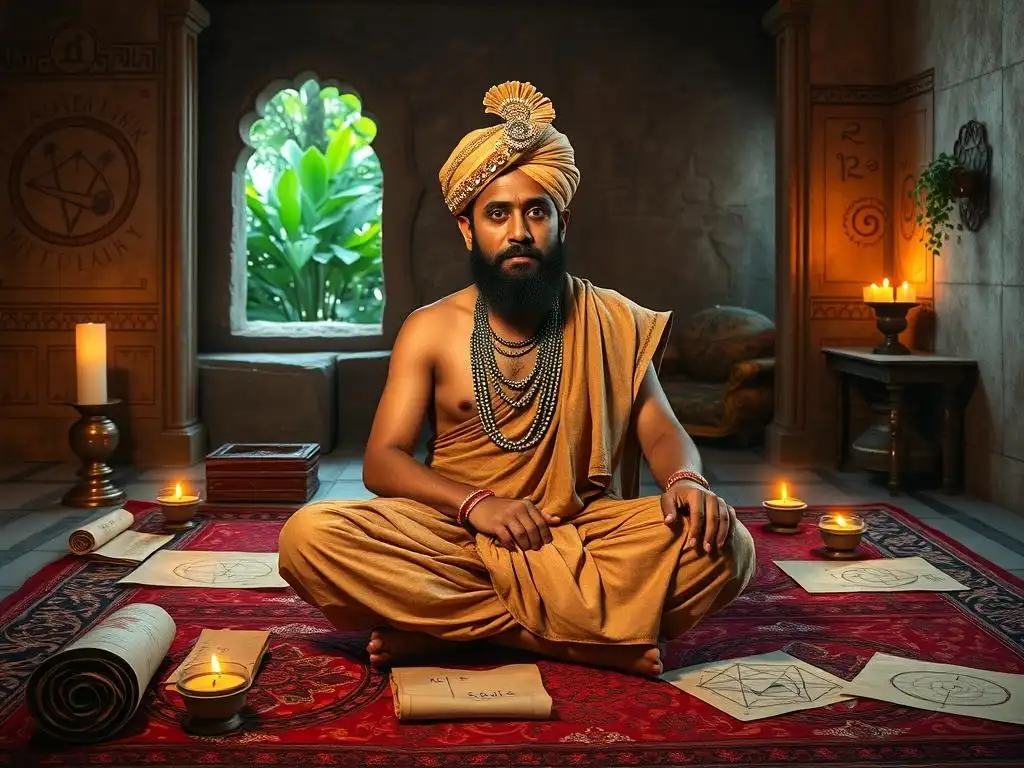
Welcome to Ancient India History, where we embark on a captivating journey through the rich tapestry of one of the world's oldest civilizations. Here, we delve deep into the mathematical contributions that laid the foundation for modern science and medicine. Did you know that ancient Indian scholars were pioneers in concepts such as zero and the decimal system?
In our main article, "The Mathematical Breakthroughs of Ancient India: A Comprehensive Overview," we will unravel these remarkable discoveries and their profound impact on the world. Prepare to be intrigued as we explore the brilliance of ancient minds and the legacy they left behind. Join us in uncovering the secrets of a civilization that shaped mathematical thought for centuries to come!

Introduction to Ancient Indian Mathematical Contributions
The history of mathematics is a rich tapestry woven with the contributions of various civilizations, and among them, ancient India stands out for its remarkable advancements. From the sophisticated numeral system that we use today to groundbreaking concepts in geometry and algebra, the mathematical contributions from ancient India have profoundly influenced not only the region but the entire world. This article explores the significant breakthroughs achieved by ancient Indian mathematicians, shedding light on their innovative methods and the philosophical underpinnings that guided their work.
In ancient India, mathematics was not merely a tool for commerce or trade but was deeply intertwined with the cultural and spiritual fabric of society. Scholars like Aryabhata, Brahmagupta, and Bhaskara made pivotal contributions that laid the groundwork for future mathematical theories. Understanding these contributions allows us to appreciate the profound legacy of ancient Indian mathematics and its enduring impact on modern mathematical thought.
Importance of Mathematics in Ancient Indian Civilization
Mathematics in ancient India was essential for various domains, including astronomy, architecture, and trade. The ancient Indians developed a unique approach to mathematics that emphasized practical applications and theoretical insights. Here are some key areas where mathematics played a crucial role:
- Astronomy: Ancient Indian mathematicians were instrumental in the development of astronomical calculations, including the determination of eclipses and planetary movements. The Aryabhatiya, authored by Aryabhata, is a seminal work that describes the computation of the circumference of the Earth and the calculation of time based on celestial movements.
- Architecture: Mathematics was vital in the construction of temples and cities. The use of geometric principles ensured structural integrity and aesthetic appeal. The famous temples of Khajuraho and the intricate designs of the Brihadeeswarar Temple showcase the application of mathematical concepts in architecture.
- Trade and Commerce: The growth of trade during ancient times necessitated advanced mathematical techniques for accounting and commerce. The development of the decimal system and zero facilitated complex calculations, enabling merchants to conduct business efficiently across vast distances.
Through these applications, ancient Indian mathematics not only enriched the civilization itself but also laid the groundwork for future advancements in the field. The legacy of these contributions continues to resonate today, highlighting the importance of preserving and studying this rich historical heritage.
- Introduction to Ancient Indian Mathematical Contributions
- Importance of Mathematics in Ancient Indian Civilization
- What were the main mathematical contributions of ancient India?
- How did ancient Indian mathematicians influence global mathematics?
- What role did the Indus Valley Civilization play in mathematics?
- Can you name some significant mathematical texts from ancient India?
- How did the Gupta Empire contribute to mathematical advancements?
Key Periods of Mathematical Development in Ancient India

The Vedic Period: Foundations of Mathematics
The Vedic period, spanning roughly from 1500 BCE to 500 BCE, marks the inception of mathematical thought in ancient India. During this era, the Vedas, particularly the Rigveda and Shulba Sutras, laid the groundwork for mathematical concepts that would evolve over centuries. The Shulba Sutras, texts that focus on geometry and ritualistic measurements, offer insights into the mathematical practices of the time.
- Geometric Principles: The Shulba Sutras introduced the concept of constructing altars using geometric principles. They provided rules for constructing various geometrical shapes, such as squares and circles, and emphasized the importance of precision in measurements. Notably, the Pythagorean theorem, which relates the lengths of the sides of a right triangle, was known in India long before Pythagoras himself.
- Decimal System: The Vedic texts also hinted at the early use of a decimal system, a significant advancement in mathematical notation. The concept of place value, which allows for efficient numerical representation, can be traced back to this period. This system laid the foundation for future developments in arithmetic.
- Astronomical Calculations: The Vedic scholars made significant contributions to astronomy, requiring advanced mathematical skills. They calculated the timing of rituals based on celestial movements, showcasing the intertwined nature of mathematics and astronomy in ancient Indian culture.
The Gupta Era: The Golden Age of Indian Mathematics
The Gupta Era, from approximately 320 CE to 550 CE, is often referred to as the Golden Age of Indian mathematics. This period was characterized by remarkable advancements in various fields, particularly mathematics, driven by scholars such as Aryabhata, Brahmagupta, and Bhaskara I.
- Aryabhata's Innovations: Aryabhata, one of the foremost mathematicians of this era, made groundbreaking contributions, including the approximation of π (pi) as 3.1416 and the introduction of algebraic concepts. His work, the Aryabhatiya, not only covered arithmetic but also addressed problems in trigonometry and astronomical calculations.
- Brahmagupta's Rules: Brahmagupta's Brahmasphutasiddhanta is a seminal work that formalized rules for arithmetic operations involving zero and negative numbers. He introduced the concept of zero as a number, which was revolutionary and laid the groundwork for modern mathematics. His methods for solving quadratic equations also contributed significantly to algebra.
- Advancements in Trigonometry: The Gupta period saw the development of sine and cosine functions, facilitating advancements in both mathematics and astronomy. The establishment of trigonometric tables allowed for more accurate calculations in celestial navigation.
Post-Gupta Period: Continuation and Evolution of Mathematical Concepts
Following the Gupta period, the mathematical contributions of ancient India continued to evolve, marked by innovations in various branches of mathematics.
- Influence of Islamic Scholars: The post-Gupta period saw the integration of Indian mathematical concepts with those from the Islamic world, particularly during the medieval era. Indian numerals, including the concept of zero, were transmitted to the Islamic scholars and later to Europe, significantly influencing the development of mathematics globally.
- Bhaskara II's Contributions: Bhaskara II, also known as Bhaskara the Great, emerged during the 12th century as a prominent mathematician. His work, Lilavati, is a comprehensive treatise on arithmetic, while Bijaganita focuses on algebra. He introduced new concepts in calculus, including the idea of infinitesimals and the mean value theorem, demonstrating a profound understanding of mathematical principles.
- Legacy of Ancient Indian Mathematics: The mathematical breakthroughs of ancient India laid the foundation for future generations. The concepts developed during these key periods not only advanced mathematical thought within India but also had a lasting impact on mathematics worldwide. The adoption of the decimal system and the understanding of zero revolutionized numerical systems globally, marking ancient Indian mathematical contributions as pivotal in the history of mathematics.
By exploring these key periods—Vedic, Gupta, and Post-Gupta—we gain a comprehensive understanding of the evolution of mathematics in ancient India. This rich history illustrates the monumental contributions that ancient Indian scholars made to the field of mathematics, influencing cultures and civilizations across the globe.
Notable Mathematicians in Ancient India

Aryabhata: The Pioneer of Indian Mathematics
Aryabhata, born in 476 CE, is often regarded as one of the first major mathematicians in ancient India. His work laid the foundation for numerous mathematical concepts that would influence not only Indian mathematics but also the world.
-
Key Contributions:
Aryabhata's seminal work, the Aryabhatiya, is a compendium of mathematics and astronomy. Within its pages, he introduced methods for solving linear and quadratic equations, as well as concepts of arithmetic and geometry.
-
Place Value System:
He is credited with the early use of the decimal place value system and the concept of zero, which revolutionized mathematics. His innovative notation made complex calculations simpler and more efficient.
-
Trigonometry:
Aryabhata's exploration of sine functions was groundbreaking. He provided sine tables and emphasized the importance of these functions in astronomical calculations, paving the way for future advancements in trigonometry.
Brahmagupta: Innovations in Algebra and Arithmetic
Brahmagupta, who lived during the 7th century CE, is celebrated for his significant contributions to algebra and arithmetic, which had a profound impact on later mathematicians.
-
Algebraic Methods:
His text, the Brahmasphutasiddhanta, introduced rules for arithmetic operations involving positive and negative numbers, establishing a systematic approach to solving quadratic equations.
-
Zero as a Number:
Brahmagupta was one of the first to treat zero as a number in its own right. He provided rules for arithmetic operations involving zero, marking a pivotal moment in the evolution of mathematics.
-
Practical Applications:
His work emphasized practical applications, including methods for calculating areas and volumes, which were crucial for land measurement and architecture.
Bhaskara I and II: Contributions to Calculus and Astronomy
Bhaskara I and II, who lived in the 7th and 12th centuries CE respectively, made remarkable strides in mathematics and astronomy, continuing the legacy of their predecessors.
-
Bhaskara I:
Known for his accurate calculations of sine values and his work on astronomical calculations, Bhaskara I contributed to the understanding of the motion of celestial bodies. His commentaries on Aryabhata's work further expanded upon the concepts introduced by Aryabhata.
-
Bhaskara II (Bhaskara Acharya):
Bhaskara II's most notable work, the Lilavati, is a treatise on arithmetic and geometry, presenting problems in a poetic format. His contributions to calculus, particularly his work on derivatives and infinite series, were centuries ahead of their time.
-
Astrolabe and Astronomy:
Bhaskara II also developed the concepts of the astrolabe for astronomical observations and made critical contributions to understanding planetary motion. His synthesis of mathematics and astronomy exemplified the interconnectedness of these fields in ancient India.
The mathematical breakthroughs of ancient Indian mathematicians like Aryabhata, Brahmagupta, and Bhaskara I and II not only advanced the field of mathematics but also laid the groundwork for future generations. Their contributions to algebra, arithmetic, trigonometry, and astronomy had a lasting impact, highlighting the rich heritage of ancient Indian mathematical contributions that continue to influence modern mathematics today.
Major Mathematical Concepts Originating from Ancient India
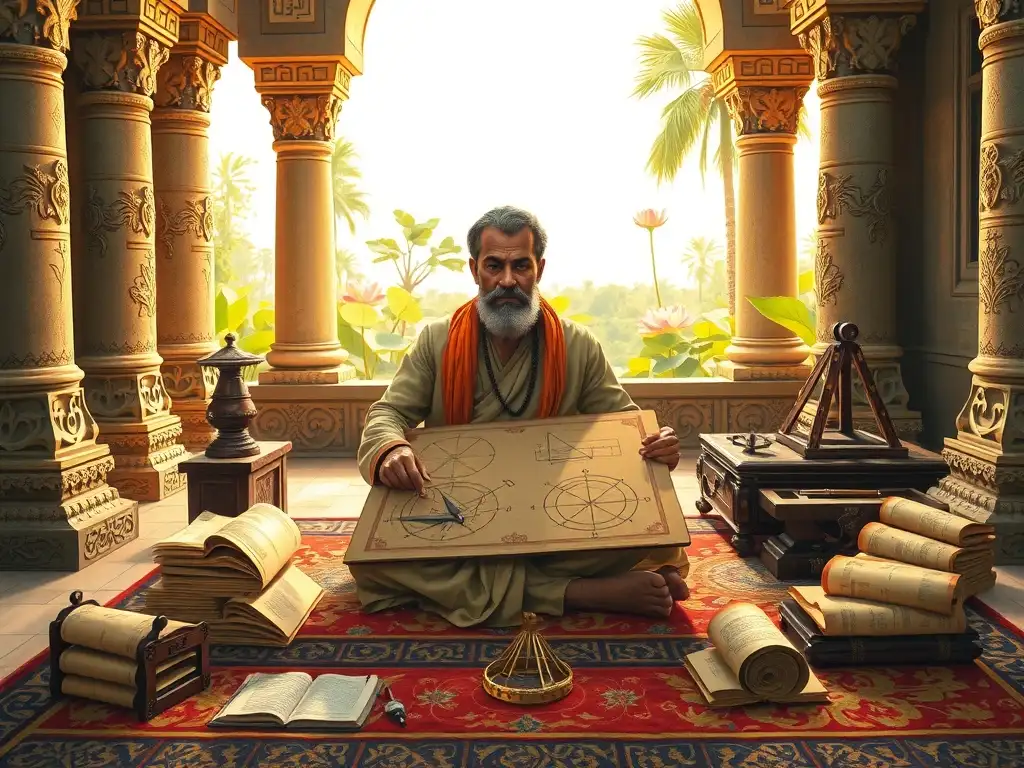
The Concept of Zero: A Revolutionary Idea
The invention of the concept of zero is one of the most significant mathematical breakthroughs attributed to ancient Indian mathematicians. This revolutionary idea is not merely the absence of a quantity but represents a fundamental shift in how numbers and mathematics were understood. The concept of zero as a numeral was first documented in the Bakhshali Manuscript, dating back to the 2nd century CE, although its use may have originated even earlier.
- Historical Context: The earliest recorded use of zero can be traced to the Indus Valley Civilization, where it was used in counting systems. However, it was during the Gupta period (circa 320-550 CE) that zero began to be recognized as a full-fledged number, thanks to mathematicians such as Brahmagupta. His seminal work, Brahmasphutasiddhanta, provided rules for arithmetic operations involving zero, emphasizing its importance in calculations.
- Mathematical Implications: The introduction of zero allowed for the formulation of new mathematical concepts, enabling the development of algebra and calculus. It also facilitated the representation of large numbers and complex mathematical problems, leading to advancements in various fields, including astronomy and engineering.
- Global Influence: The concept spread to the Islamic world and later to Europe through translations of Indian texts. By the 9th century, it was firmly established in the Arabic numeral system, laying the groundwork for modern mathematics.
Decimal System: The Influence on Global Mathematics
The ancient Indian decimal system, or the base-10 numeral system, is another monumental contribution that has had a lasting impact on mathematics worldwide. This system is characterized by its positional notation, where the position of a digit determines its value.
- Structure of the System: In the decimal system, each digit's value is ten times that of the digit to its immediate right. For instance, in the number 345, the '3' represents three hundred (3 x 100), the '4' represents forty (4 x 10), and the '5' represents five (5 x 1). This positional value system was a significant improvement over earlier numeral systems, which often lacked a systematic structure.
- Documentation and Spread: The decimal system was first documented in texts like Aryabhatiya by Aryabhata and later by Brahmagupta. These works not only popularized the system within India but also inspired mathematicians across the globe.
- Legacy and Adoption: The decimal system was adopted by Arab mathematicians and eventually made its way to Europe during the Renaissance. It became a cornerstone of modern mathematics, influencing everything from basic arithmetic to advanced computational methods. Today, the decimal system is universally recognized and remains integral to mathematics education worldwide.
Algebraic Techniques: Quadratic Equations and Beyond
Ancient Indian mathematicians made significant strides in algebra, particularly in the development of techniques for solving quadratic equations. These contributions laid the groundwork for future mathematical exploration.
- Quadratic Equations: The work of Brahmagupta in the 7th century CE is particularly noteworthy for its systematic approach to solving quadratic equations. In his text Brahmasphutasiddhanta, he outlined methods for solving equations of the form ax² + bx + c = 0, providing solutions that are still relevant today.
- Methods of Calculation: Brahmagupta introduced rules for manipulating positive and negative numbers, a concept that was revolutionary at the time. He specified methods for finding both positive and negative roots of quadratic equations, showcasing an understanding of the mathematical principles that govern these calculations.
- Further Developments: Following Brahmagupta, mathematicians like Bhaskara II expanded on these ideas in the 12th century, introducing more complex algebraic concepts. His work, Lilavati, not only addressed quadratic equations but also delved into permutations, combinations, and even the beginnings of calculus.
The algebraic techniques developed in ancient India have profoundly influenced the evolution of mathematics, contributing to the establishment of algebra as a foundational discipline. Today, these techniques are essential components of mathematical education around the world, illustrating the enduring legacy of ancient Indian mathematical contributions.
Ancient Indian Mathematical Texts and Their Influence

Mathematics in ancient India was not just a pursuit of numbers but a profound exploration of concepts that shaped the foundations of modern mathematics. The ancient Indian mathematical contributions can be traced through various texts that reflect the intellectual rigor and innovative spirit of the time. These texts not only encapsulated mathematical principles but also influenced later developments in mathematics across cultures. Below are key texts that illustrate the depth and breadth of ancient Indian mathematics.
The Aryabhatiya: A Comprehensive Study
The Aryabhatiya, written by the mathematician Aryabhata in 499 CE, is one of the earliest and most significant texts in Indian mathematics. This work is divided into four sections: Gitikapada, Ganitapada, Kalakriyapada, and Golapada, each addressing different aspects of mathematics and astronomy.
- Key Contributions:
- Place Value System: Aryabhata's work laid the groundwork for the decimal place value system, which is fundamental in modern mathematics.
- Zero: Although Aryabhata did not explicitly use the symbol for zero, he conceptualized the idea, which was crucial for subsequent mathematical advancements.
- Approximation of π: Aryabhata provided an approximation of π (pi) as 3.1416, showcasing remarkable precision for his time.
- Influence: The Aryabhatiya significantly influenced not only Indian mathematicians but also scholars in the Islamic world and Europe, leading to advancements in trigonometry and astronomy.
Brahmasphutasiddhanta: Algebraic Breakthroughs
The Brahmasphutasiddhanta, composed by Brahmagupta in 628 CE, represents a landmark in the development of algebra. This text is notable for its systematic approach to equations and rules for arithmetic operations involving zero and negative numbers.
- Key Contributions:
- Rules for Zero: Brahmagupta defined rules for arithmetic operations involving zero, establishing a framework that would later be pivotal in mathematics.
- Quadratic Equations: He provided methods for solving quadratic equations, introducing the idea of multiple roots.
- Indeterminate Equations: The text explored indeterminate equations, which later influenced Diophantine analysis.
- Influence: The Brahmasphutasiddhanta was essential in shaping algebraic thought, and its concepts were absorbed into Islamic mathematics, which later reached Europe during the Renaissance.
Lilavati: A Treatise on Arithmetic and Geometry
Lilavati, attributed to Bhaskara II in the 12th century, is a significant work focusing on arithmetic and geometry. It is presented in the form of a dialogue between a father and daughter, making it accessible and engaging.
- Key Contributions:
- Arithmetic and Word Problems: The text contains a wealth of problems related to everyday life, illustrating practical applications of mathematics.
- Geometric Concepts: Lilavati covers various geometric figures and their properties, providing insights into the understanding of shapes and measurements in ancient India.
- Innovative Methods: Bhaskara introduced unique methods for calculations, fostering a deeper comprehension of numbers and operations.
- Influence: Lilavati has been used as a textbook for teaching mathematics in India for centuries. Its practical approach and engaging narrative have made it a lasting legacy in the study of ancient Indian mathematics.
The exploration of these ancient texts reveals the sophistication of mathematical thought in India and its lasting influence on global mathematics. The contributions of ancient Indian mathematicians are a testament to their ingenuity and continue to inspire contemporary math enthusiasts and scholars alike.
The Impact of Ancient Indian Mathematics on Global Knowledge
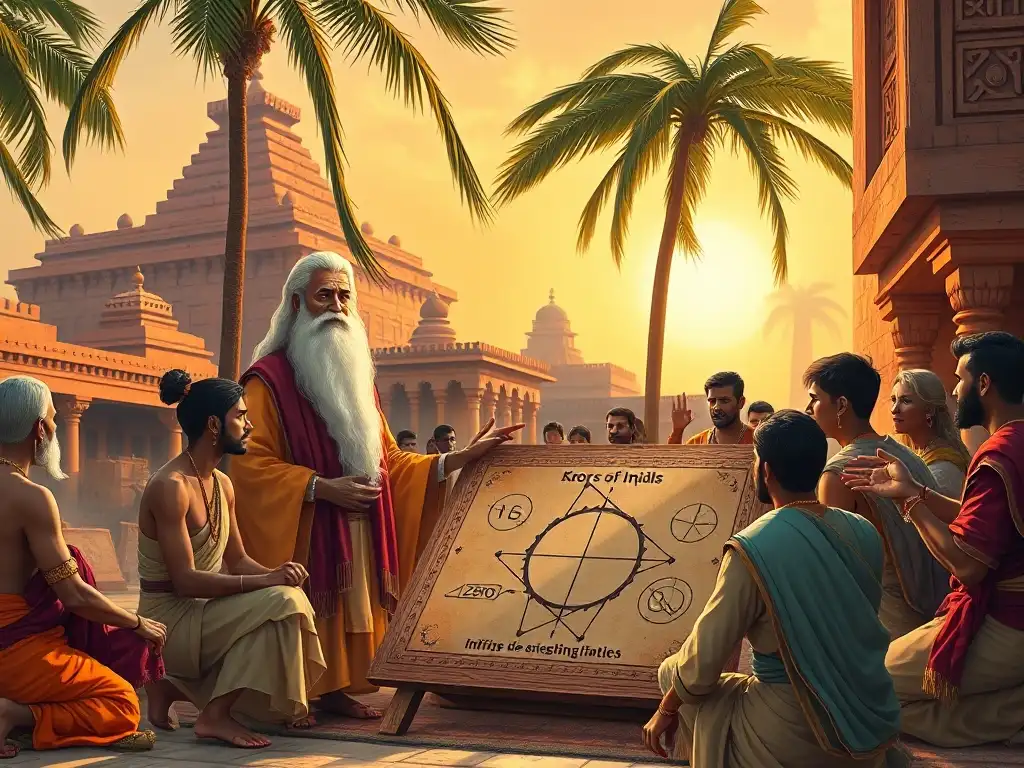
Ancient Indian mathematics has played a pivotal role in shaping global mathematical concepts and practices. The mathematical contributions of ancient India laid the groundwork for various branches of mathematics, including arithmetic, geometry, and algebra. These contributions not only influenced neighboring cultures but also permeated through time to impact modern mathematics.
The rich tradition of mathematical inquiry in ancient India is underscored by remarkable texts, such as the Bakhshali Manuscript, the Lilavati, and the Aryabhatiya, which reveal advanced calculations and concepts that were far ahead of their time. Scholars from various civilizations were inspired by these works, which facilitated the exchange of ideas and knowledge across borders.
Cultural Exchanges: Spread of Indian Mathematical Ideas
The spread of ancient Indian mathematical ideas can be attributed to several key factors, including trade, conquests, and the translation of texts.
- Trade Routes: Indian traders traveled extensively along the Silk Road and maritime trade routes, bringing mathematical knowledge with them. The exchange of goods often accompanied the transfer of ideas, including numeral systems and mathematical techniques.
- Cross-Cultural Interactions: The arrival of foreign scholars and travelers in India provided opportunities for cultural exchange. For instance, the Greek philosopher Pythagoras is believed to have been influenced by Indian mathematical concepts during his travels.
- Translation of Texts: The translation of key mathematical texts into Arabic during the medieval period significantly contributed to the dissemination of Indian mathematical knowledge. Scholars such as Al-Khwarizmi incorporated ideas from Indian mathematics, further embedding them into Islamic mathematical practices.
Through these channels, ancient Indian mathematics became integrated into various cultures, enriching global knowledge and practice.
Influence on Islamic Mathematics: Bridging Cultures
The relationship between ancient Indian mathematics and Islamic mathematics is particularly noteworthy. Indian mathematical concepts profoundly influenced Islamic scholars, who acted as conduits for this knowledge to reach Europe and beyond.
- Numeral System: One of the most significant contributions was the introduction of the decimal numeral system, including the concept of zero, which was pivotal in simplifying calculations. The Indian numeral system was adopted by Islamic mathematicians, who then introduced it to Europe.
- Algebraic Techniques: Ancient Indian works on algebra were foundational for later developments in Islamic mathematics. The Persian mathematician Al-Khwarizmi, often referred to as the "father of algebra," built upon Indian principles, leading to the establishment of systematic methods for solving equations.
- Astronomical Calculations: Indian advancements in astronomy, including calculations of planetary movements, were assimilated into Islamic scientific practices. This knowledge, in turn, influenced European astronomy during the Renaissance.
The bridge created by ancient Indian mathematics and its assimilation into Islamic mathematics showcases the interconnectedness of cultures and the cumulative nature of knowledge.
The Legacy of Ancient Indian Mathematics in Modern Education
The legacy of ancient Indian mathematical contributions continues to resonate in contemporary education systems worldwide. Here are several ways this legacy is preserved and celebrated:
- Curriculum Development: Many modern mathematics curricula incorporate foundational concepts rooted in ancient Indian mathematics, particularly in topics such as arithmetic and geometry.
- Recognition of Historical Contributions: Educational institutions are increasingly acknowledging the historical significance of ancient Indian mathematicians, such as Aryabhata and Brahmagupta, in textbooks and academic discussions.
- Mathematical Competitions: Various international mathematics competitions honor the legacy of ancient Indian mathematics by promoting problem-solving techniques and teachings derived from these ancient texts.
- Research and Publications: Ongoing research into ancient Indian mathematics continues to shed light on its innovative methods and theories, leading to new publications and scholarly discussions that keep this rich legacy alive.
The contributions of ancient Indian mathematics have left an indelible mark on the global mathematical landscape. As scholars and educators recognize and celebrate this legacy, the mathematical breakthroughs of ancient India continue to inspire future generations.
Conclusion: The Enduring Legacy of Ancient Indian Mathematical Contributions
The mathematical contributions of ancient India have had a profound and lasting impact on the development of mathematics as a whole. From the early innovations of the Indus Valley Civilization to the sophisticated theories of the Gupta Empire, Indian scholars laid the groundwork for a variety of mathematical concepts that continue to resonate in modern mathematics.
One of the most significant legacies is the concept of zero, which revolutionized numerical systems. This idea allowed for the development of a place-value system that facilitated complex calculations, enabling advancements in various fields such as astronomy, commerce, and engineering. The use of zero not only simplified arithmetic but also paved the way for more abstract mathematical thinking.
Additionally, ancient Indian mathematicians such as Aryabhata and Brahmagupta contributed to the understanding of algebra and geometry. Aryabhata's work on the approximation of pi and calculations of planetary positions showcased the application of mathematics in astronomy, while Brahmagupta's rules for solving quadratic equations laid foundational principles that would be expanded upon by mathematicians in other cultures.
Furthermore, the transmission of these mathematical ideas through trade routes and cultural exchanges significantly influenced mathematics in the Islamic Golden Age and later in Europe. The works of Indian mathematicians were translated into Arabic and Latin, introducing concepts like the decimal system and algorithms to a broader audience.
The mathematical breakthroughs of ancient India not only shaped the intellectual landscape of their time but also established a legacy that transcended geographical and temporal boundaries. The principles and ideas developed by these early mathematicians resonate in contemporary mathematics, reminding us of the rich tapestry of knowledge that has been woven throughout human history. As we continue to explore the contributions of ancient Indian scholars, we celebrate their enduring influence on global knowledge and the continued relevance of their discoveries in today's mathematical practices.
Frequently Asked Questions
What were the main mathematical contributions of ancient India?
Ancient India is renowned for its groundbreaking advancements in mathematics, including the invention of the decimal system and the concept of zero. These innovations laid the groundwork for modern mathematics.
How did ancient Indian mathematicians influence global mathematics?
Indian mathematicians like Aryabhata and Brahmagupta significantly influenced mathematics worldwide by introducing concepts like algebra and trigonometry, which were later adopted and expanded upon in the Islamic Golden Age.
What role did the Indus Valley Civilization play in mathematics?
The Indus Valley Civilization showcased early mathematical practices, particularly in measuring land and urban planning, indicating that mathematics was integral to their society and commerce.
Can you name some significant mathematical texts from ancient India?
Key texts include Aryabhata's Aryabhatiya, which covers arithmetic and astronomy, and Brahmagupta's Brahmasphutasiddhanta, which discusses rules for arithmetic and algebra. These works are foundational in the study of ancient mathematics.
How did the Gupta Empire contribute to mathematical advancements?
The Gupta Empire is often referred to as the Golden Age of Indian Mathematics, where scholars made remarkable progress in fields like geometry and calculus, significantly impacting future mathematical thought.
Final Reflection: The Enduring Legacy of Ancient Indian Mathematical Contributions
The mathematical breakthroughs of ancient India are not merely historical footnotes; they are the foundation upon which modern mathematics stands. Today, as we navigate an increasingly complex world driven by technology and data, the principles and innovations pioneered by ancient Indian mathematicians resonate more than ever. Their contributions, from the concept of zero to sophisticated algorithms, continue to shape our understanding of mathematics and its applications in everyday life.
The influence of ancient Indian mathematics extends far beyond the classroom; it has woven itself into the very fabric of global culture and scientific inquiry. The exploration of these contributions reveals not only the brilliance of ancient scholars but also their profound impact on various fields, including astronomy, engineering, and economics. As the mathematician and philosopher Bhaskara II once stated, “Mathematics is the language of the universe.” This sentiment underscores the timeless relevance of the mathematical principles developed in ancient India, which continue to inspire and inform contemporary thought.
As we reflect on the significance of these ancient contributions, let us consider how we can integrate this rich mathematical heritage into our own lives. I invite you to explore the beauty of mathematics through the lens of ancient Indian innovations, allowing their wisdom to guide your understanding and appreciation of the subject. Whether you are a student, educator, or simply a curious mind, embracing these lessons can empower you to see mathematics not just as a series of equations, but as a vibrant and dynamic language that connects us all.
Unlock the Secrets of Ancient Indian Mathematics!
Thank you for diving into the exciting world of ancient Indian mathematical breakthroughs! By exploring the remarkable developments from this rich history, you've uncovered insights that continue to influence modern mathematics. Now, it’s time to take the next step and engage more deeply with this fascinating subject.
Here are some ways you can immerse yourself further:
- Explore Ancient Texts: Investigate original works such as the “Aryabhatiya” or “Brahmasphutasiddhanta” to witness the brilliance of ancient scholars firsthand.
- Join a Discussion Group: Connect with fellow enthusiasts by participating in online forums or local study groups dedicated to the mathematical achievements of ancient civilizations.
- Share Your Insights: Write a brief post or highlight your favorite mathematical concept from ancient India on social media to inspire others to discover this incredible history.
What aspect of ancient Indian mathematics intrigues you the most, and how do you believe it can inspire modern innovations?