
Vedic Cosmology: Understanding the Universe through Ancient Texts

Welcome to Ancient India History, where we embark on a journey through the rich and diverse tapestry of ancient Indian civilizations. In this exploration, we delve into the profound realms of Vedic cosmology, uncovering insights that reveal how our ancestors understood the universe. Are you ready to unlock the mysteries of ancient texts and discover the wisdom that shaped a civilization? Join us as we dive deeper into the Vedic cosmology and its impact on both spirituality and science, paving the way for a broader understanding of our world. Your adventure in ancient knowledge begins here!
Introduction to Vedic Cosmology
Vedic cosmology, a profound aspect of ancient Indian thought, offers a unique lens through which to understand the universe and our place within it. Rooted in the sacred texts of the Vedas and Upanishads, this ancient framework provides insights into the nature of existence, the cosmos, and the divine.
By examining the intricate relationships between the material and spiritual realms, Vedic cosmology reveals a sophisticated understanding of time, space, and the cycles of creation. The texts articulate a vision of the universe that is not just physical but also metaphysical, reflecting the beliefs and practices of a civilization that revered knowledge and wisdom.
At its core, Vedic cosmology emphasizes the interconnectedness of all beings and the importance of harmony within the cosmos. It presents a universe governed by natural laws, where cosmic cycles of creation (Srishti) and dissolution (Pralaya) occur in a rhythmic dance. This cosmological perspective is not merely theoretical; it shapes the spiritual practices and philosophical inquiries of ancient Indian civilization, influencing various aspects of life, including art, architecture, and rituals.
As we delve into the intricacies of Vedic cosmology, we will explore how these ancient insights continue to resonate in contemporary discussions about existence and our relationship with the universe.
Importance of Ancient Indian Vedic Cosmology Insights
The insights derived from ancient Indian Vedic cosmology hold significant importance for several reasons. First and foremost, they provide a comprehensive framework for understanding the universe that transcends mere scientific inquiry. Unlike modern cosmology, which often focuses on empirical evidence and mathematical models, Vedic cosmology integrates spiritual wisdom and philosophical contemplation. This holistic approach encourages individuals to seek not only knowledge but also a deeper connection to the cosmos and their surroundings.
Moreover, Vedic cosmology offers profound insights into the nature of time and existence. The concept of Yugas—cyclical ages of the universe—illustrates an understanding of time that is both linear and cyclical, suggesting that events in human history are part of larger cosmic patterns. This perspective invites a reflection on the transient nature of life and the importance of living in harmony with universal laws.
Additionally, the teachings found in the Vedas and Upanishads highlight the significance of Dharma (righteousness) and Karma (action), emphasizing that our actions have consequences that ripple through the fabric of the cosmos. This ethical framework encourages individuals to live mindfully, recognizing their role in the greater cosmic order.
In essence, the insights from ancient Indian Vedic cosmology not only enrich our understanding of the universe but also offer timeless wisdom that can guide contemporary spiritual and philosophical explorations. By engaging with these ancient texts, we can uncover layers of meaning that resonate with the human experience across cultures and eras.
The Foundations of Vedic Cosmology
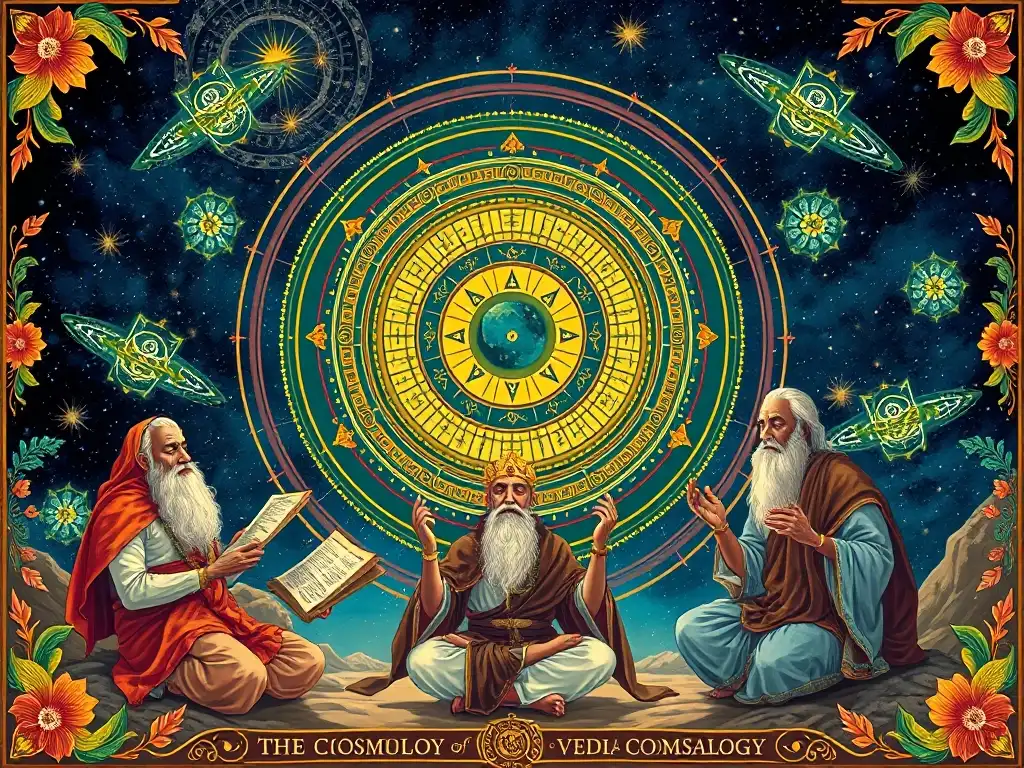
Overview of Ancient Indian Scriptures
Ancient Indian Vedic cosmology is deeply rooted in the sacred texts known as the Vedas, which consist of four primary collections: the Rigveda, Samaveda, Yajurveda, and Atharvaveda. These texts, composed between 1500 and 500 BCE, not only serve as religious scriptures but also provide profound insights into the cosmological views of ancient Indian civilization.
The Vedas encompass a range of content, from hymns and rituals to philosophical inquiries, and they collectively form the bedrock of Hindu thought. The Rigveda, for instance, is notable for its hymns that invoke the cosmic order (Rta) and the creation of the universe. It introduces several deities, each representing various aspects of existence and nature, which reveals the interconnectedness of the cosmos.
The Upanishads, which are philosophical texts that emerged later, further elaborate on these concepts. They delve into the nature of reality (Brahman) and the individual self (Atman), proposing that understanding the self is essential to grasping the universe. This duality between the macrocosm (the universe) and microcosm (the individual) is a recurring theme in Vedic cosmology, illustrating the belief that the human experience is intrinsically linked to cosmic principles.
Key Concepts and Themes in Vedic Cosmology
Vedic cosmology presents several key concepts that are crucial to understanding ancient Indian perspectives on the universe. Notable among these are:
- Creation Myths: The Vedic texts contain various creation narratives, with the most famous being found in the Nasadiya Sukta of the Rigveda. This hymn poses profound questions about creation, suggesting that the universe emerged from a state of non-being into being, highlighting the mystery surrounding existence.
- Cosmic Order (Rta): Central to Vedic thought, Rta signifies the natural order that governs the universe. It embodies the principles of truth and righteousness, underscoring the belief that all phenomena operate within a structured, harmonious system. The maintenance of Rta through rituals and moral conduct is essential for cosmic stability.
- Three Realms of Existence: Vedic cosmology articulates a tripartite division of the universe into three realms: Svarga (heaven), Madhya (the earth), and Patala (the underworld). This structure reflects a layered understanding of existence, where each realm plays a distinct role in the cosmic narrative.
- Time Cycles (Yugas): The concept of time in Vedic cosmology is cyclical, encompassing vast epochs known as Yugas. The four Yugas—Satya, Treta, Dvapara, and Kali—depict a gradual decline in virtue and righteousness over time, shaping the moral and spiritual landscape of humanity.
- Influence of Deities: The Vedic pantheon consists of numerous deities that symbolize various cosmic forces. For instance, Indra represents strength and rain, while Agni embodies fire and transformation. These deities are not merely worshipped; they are seen as integral aspects of the cosmic order, influencing both the physical and spiritual realms.
Through these concepts, ancient Indian Vedic cosmology offers a multi-dimensional view of the universe, underscoring the intricate relationships between the divine, the cosmos, and humanity. The insights derived from these ancient texts continue to resonate, providing a rich framework for understanding existence and our place within it.
The Structure of the Universe in Vedic Texts
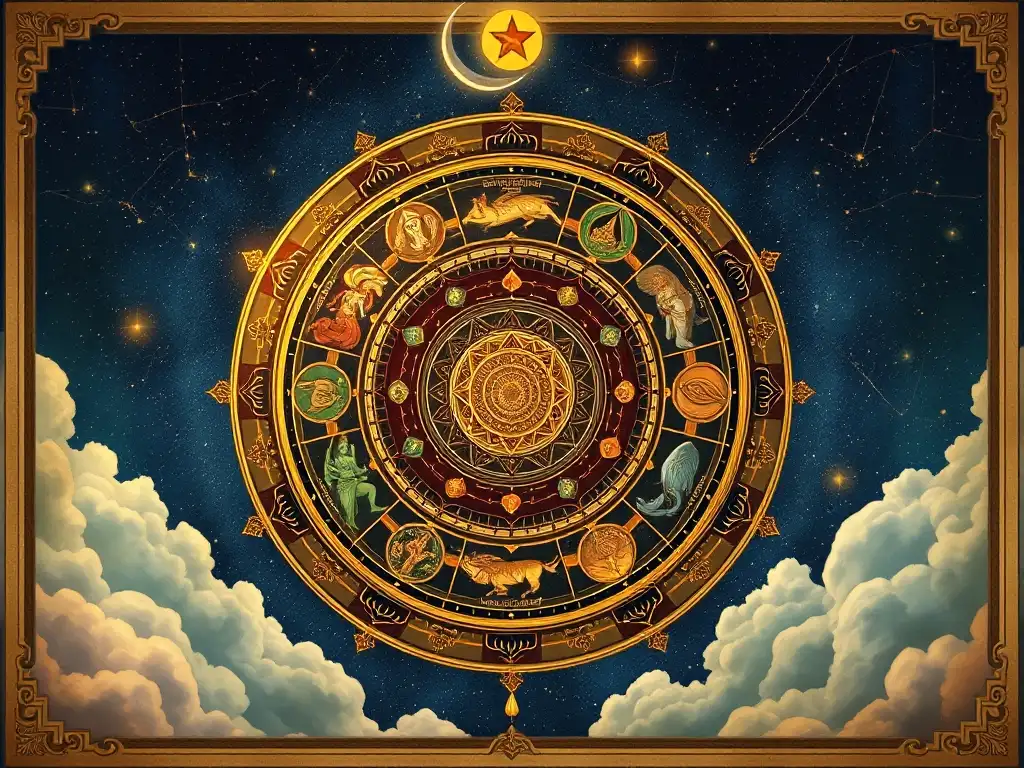
The Cosmic Egg (Hiranyagarbha) Concept
In Vedic cosmology, the concept of Hiranyagarbha, often referred to as the "Cosmic Egg," symbolizes the universe's origin and structure. This metaphorical egg encapsulates the entirety of existence and represents the primordial source from which all creation emerges. The term "Hiranyagarbha" translates to "golden womb" or "golden egg" and is mentioned prominently in texts like the Rig Veda and the Upanishads.
The Hiranyagarbha is not merely a physical entity but embodies the idea of potentiality. It signifies a state where all elements of the universe are contained in a latent form. From this cosmic egg, the universe is birthed, leading to the emergence of the physical world as well as the spiritual dimensions. This duality reflects the Vedic belief that the material and spiritual realms are interconnected and stem from a singular source.
For instance, the Rig Veda (10.121) describes the creation of the universe as arising from this cosmic principle, emphasizing the unity underlying the diversity of existence. The idea of Hiranyagarbha also introduces the concept of Brahman, the ultimate reality, wherein Hiranyagarbha is often seen as a manifestation of Brahman in the physical cosmos.
The Three Worlds: Upper, Middle, and Lower
Vedic cosmology delineates the universe into three distinct realms, often referred to as the three worlds: Svarga (Heaven), Madhya (Earth), and Patala (Underworld). This tripartite structure illustrates the complexity of existence and the interconnectedness of various planes of being.
- Svarga (Upper World):
- This realm is associated with the heavens and is the abode of gods, celestial beings, and the righteous souls who achieve liberation (moksha). It is a place of bliss and divine joy, often described as a paradise filled with light and spiritual fulfillment.
- Madhya (Middle World):
- The Earth or the human realm forms the middle layer of the universe. It is the domain of human beings and other living creatures, where individuals experience the dualities of existence, such as pleasure and pain, success and failure. The Middle World serves as a battleground for karma, where actions determine the soul's journey and future incarnations.
- Patala (Lower World):
- This realm represents the underworld, inhabited by various beings, including serpents and demons. It is often depicted as a dark and mysterious place, yet it is also associated with the transformative aspects of existence. The Lower World reflects the cycle of death and rebirth (samsara) and the necessity of confronting one’s past karmas.
The interaction between these three realms highlights the Vedic understanding of cosmology as a dynamic interplay of forces and entities, emphasizing that all three worlds are essential parts of the cosmic order.
The Role of Elements in Vedic Cosmology
In Vedic cosmology, the physical universe is understood through the lens of five primary elements, known as Pancha Mahabhuta: Earth (Prithvi), Water (Apas), Fire (Agni), Air (Vayu), and Space (Akasha). Each of these elements plays a vital role in the structure and functioning of the cosmos.
- Earth (Prithvi): Represents stability and materiality, forming the physical foundation of existence. It is associated with the senses and the tangible aspects of life.
- Water (Apas): Symbolizes fluidity and adaptability. Water is essential for life and is often linked to emotions and intuition in Vedic texts.
- Fire (Agni): Represents transformation and energy. Fire is considered a purifying force and is integral to rituals, symbolizing the divine presence and the transformative power of knowledge.
- Air (Vayu): Signifies movement and life force (prana). Air is crucial for respiration and is associated with communication, thought, and consciousness.
- Space (Akasha): The most subtle of the elements, space embodies the void and is the medium through which all elements interact. It represents the infinite potential and the underlying fabric of the cosmos.
The interplay of these elements is fundamental to understanding the Vedic perspective on the universe. They are seen not merely as physical substances but as principles that govern the processes of creation, preservation, and dissolution. This holistic view underscores the belief that the universe is a living organism, with each element contributing to the balance and harmony essential for existence.
Time in Vedic Cosmology
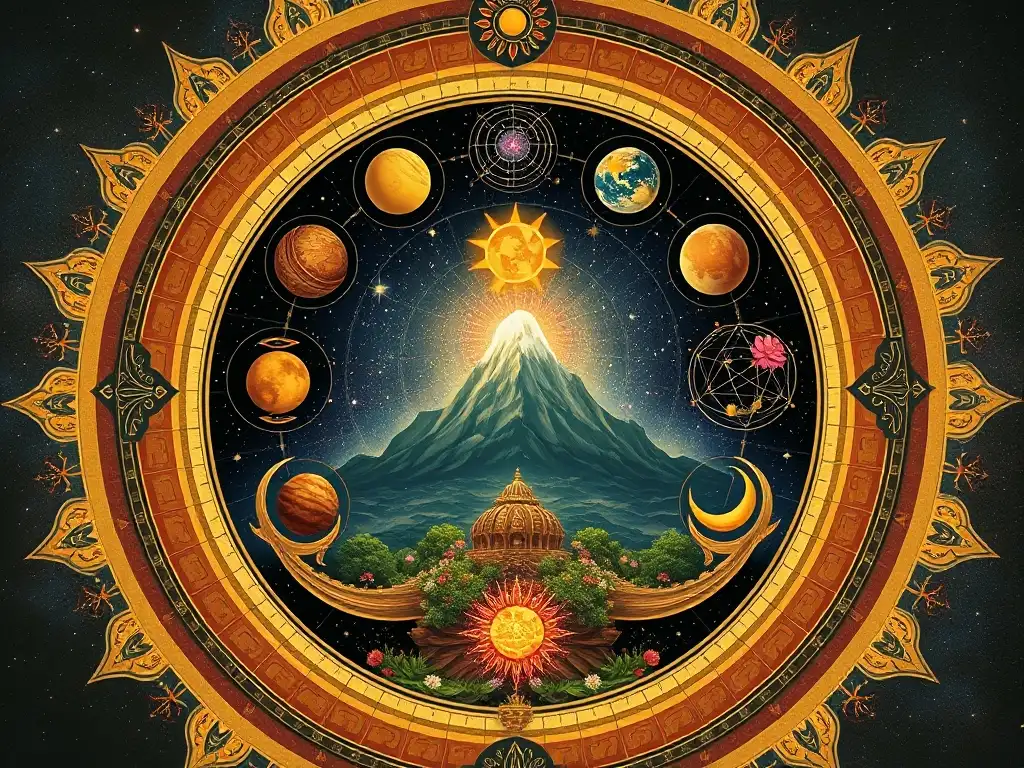
Cycles of Time: Yugas and Kalpas
In Vedic cosmology, the concept of time is not linear but cyclical, characterized by the intricate interplay of Yugas and Kalpas. The Yugas represent vast epochs that signify the moral and spiritual evolution of humanity, while Kalpas denote the greater cycles of creation and dissolution.
The Four Yugas
The Yugas are divided into four distinct ages, each characterized by a gradual decline in righteousness (Dharma) and spiritual knowledge:
- Satya Yuga (Golden Age):
- Duration: 1,728,000 years
- Characteristics: This age is marked by truth, virtue, and righteousness. Humanity experiences a direct connection with the divine, and spiritual practices are profound and effective.
- Treta Yuga (Silver Age):
- Duration: 1,296,000 years
- Characteristics: The decline of virtue begins, and the knowledge of Dharma fades. However, righteous kings and heroes still emerge, and spiritual practices remain effective.
- Dvapara Yuga (Bronze Age):
- Duration: 864,000 years
- Characteristics: This age sees a significant decline in spirituality and moral standards. The epic tales of the Mahabharata and Ramayana are set during this period, illustrating the moral struggles of humanity.
- Kali Yuga (Iron Age):
- Duration: 432,000 years
- Characteristics: As the current age, Kali Yuga represents a time of darkness and moral decay. The connection to the divine is tenuous, and spirituality is often overshadowed by materialism.
Kalpas and the Cycle of Creation
A Kalpa is a day in the life of Brahma, the creator god, lasting 4.32 billion years. Each Kalpa consists of 1,000 cycles of the four Yugas, followed by a period of dissolution where creation ceases. This cyclical process of creation and dissolution is fundamental to Vedic cosmology, illustrating the eternal nature of the universe:
- Day of Brahma: Represents creation; spans one Kalpa.
- Night of Brahma: Represents dissolution; also spans one Kalpa.
This framework emphasizes the idea that time is infinite, with cycles of creation and destruction repeating endlessly.
The Concept of Cosmic Time in the Vedas
The Vedas provide profound insights into the nature of time and the universe, revealing a complex understanding of cosmic rhythms and cycles. The concept of Kalachakra, or the wheel of time, signifies that time operates in a cyclical manner, governed by cosmic laws.
The Role of Time in Creation
In Vedic texts, time is portrayed as a divine force that orchestrates the rhythm of the cosmos. The Rigveda and Yajurveda detail the interplay between time and the divine, suggesting that:
- Time is not merely a measure but a principle of the universe, influencing creation, preservation, and dissolution.
- The Samsara, or cycle of birth and rebirth, is intricately linked to the concept of time, as souls traverse through the Yugas in their quest for liberation (Moksha).
Astronomical Insights
The Vedic texts also exhibit advanced astronomical knowledge, highlighting the significance of celestial bodies in temporal measurements. For example, the Lunar Calendar and Solar Calendar were essential for determining agricultural cycles, festivals, and rituals, reflecting the deep connection between time and nature.
| Aspect | Description |
|---|---|
| Kalpa | 4.32 billion years; day of Brahma |
| Yugas | Four ages with specific durations |
| Samsara | Cycle of birth and rebirth linked to time |
This intricate understanding of time in Vedic cosmology emphasizes the interdependence of time, divinity, and the universe, showcasing the profound insights that ancient Indian Vedic cosmology offers into the workings of existence.
Vedic Cosmology and Creation Myths
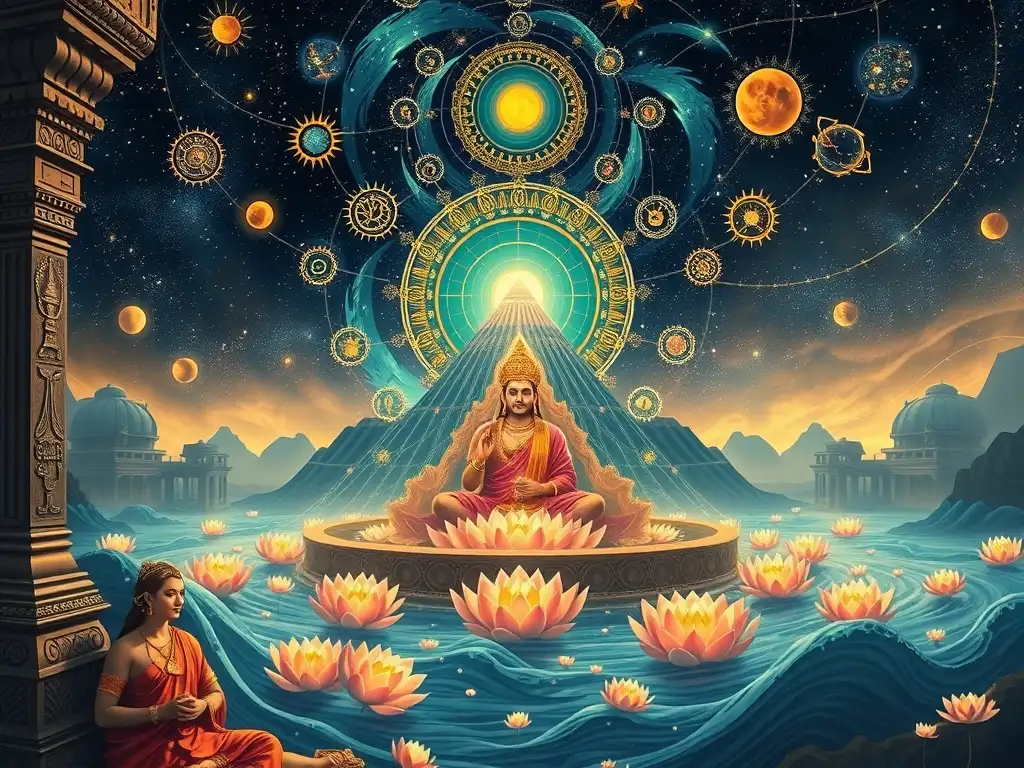
Vedic cosmology presents a fascinating framework for understanding the universe, deeply rooted in the ancient texts of India. This system offers insights into the nature of existence, the cosmos, and the relationship between the divine and the material world. Central to Vedic cosmology is the idea that the universe is not merely a physical entity but a complex interplay of consciousness, time, and space governed by cosmic laws.
The Creation Hymn (Nasadiya Sukta)
One of the most significant texts in Vedic cosmology is the Nasadiya Sukta, found in the Rigveda (10.129). This hymn is renowned for its profound and philosophical approach to creation. It begins with the famous lines:
"In the beginning, there was neither existence nor non-existence; there was neither the realm of space nor the sky above."
This opening sets a tone of ambiguity and wonder, reflecting the complexity of creation. The hymn goes on to express the uncertainty and mystery surrounding the origins of the universe, questioning the nature of the creator and the process of creation itself.
Key Themes in the Nasadiya Sukta
- Ambiguity of Creation: The hymn emphasizes the ambiguity surrounding the creation process. It suggests that the creator, if one exists, may be beyond human comprehension.
- Interconnectedness: It implies a deep interconnectedness of all elements in the cosmos, hinting at the idea that the universe is a unified whole.
- Role of Inquiry: The text encourages philosophical inquiry and skepticism, inviting listeners to ponder the origins and nature of existence rather than accepting dogma.
This hymn is a remarkable example of ancient Indian philosophical thought, as it does not provide clear answers but instead prompts reflection and contemplation on the nature of reality.
Comparative Analysis with Other Ancient Creation Myths
When examining Vedic cosmology in the context of global creation myths, several intriguing similarities and differences emerge.
Similarities
- Chaos and Order: Many creation myths, including those from Mesopotamia (e.g., the Enuma Elish) and ancient Egypt (e.g., the Heliopolitan creation myth), begin with a state of chaos or nothingness, which then gives rise to order and creation. The Nasadiya Sukta mirrors this theme of moving from non-existence to existence.
- Divine Intervention: In numerous ancient cultures, a divine being or beings play a crucial role in the act of creation. Similarly, the Nasadiya Sukta leaves open the possibility of a creator, albeit one that remains inscrutable.
- Philosophical Inquiry: Much like the questioning nature of the Nasadiya Sukta, other cultures, such as the ancient Greeks, also explored the concept of creation through philosophical dialogues, emphasizing the importance of understanding the cosmos.
Differences
- Nature of the Creator: While many ancient myths depict a clear creator deity (e.g., Marduk in Babylonian mythology), the Vedic text raises uncertainties about the creator's identity and role, suggesting a more abstract and philosophical approach.
- Focus on Cosmic Order: Vedic cosmology places significant emphasis on the idea of Rta (cosmic order), which governs the universe's functioning, a concept less prominent in many other creation narratives.
- Existential Questions: The Nasadiya Sukta is distinctive in its focus on existential questions and the limits of human understanding, contrasting sharply with more definitive narratives found in other cultures.
Through this comparative lens, it becomes evident that Ancient Indian Vedic cosmology insights offer a unique perspective that encourages reflection on the cosmos and existence while fostering a profound appreciation for the complexities of creation narratives across different cultures.
The Influence of Vedic Cosmology on Ancient Indian Thought
Impact on Philosophy and Spiritual Practices
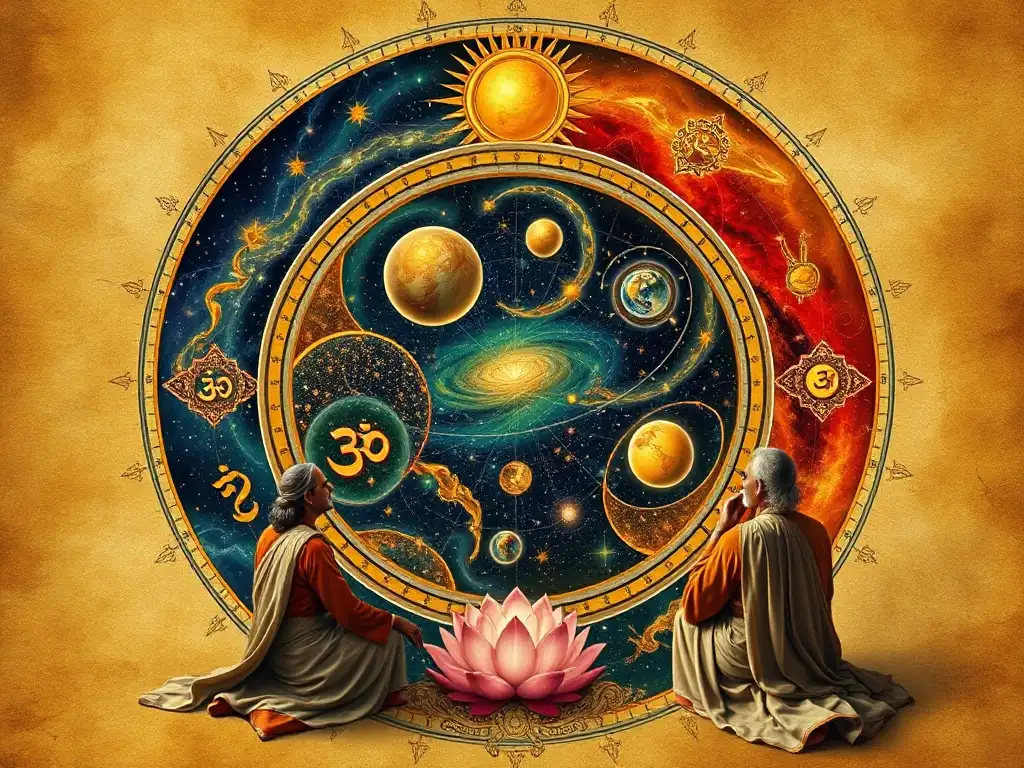
Vedic cosmology has profoundly shaped the philosophical and spiritual landscape of ancient India. The intricate understanding of the cosmos as depicted in Vedic texts has been instrumental in formulating the foundational concepts of Hindu philosophy and spiritual practice.
- Interconnectedness of All Beings: Vedic cosmology emphasizes the interdependence of all entities in the universe. This principle is articulated in the concept of Brahman, the ultimate reality that underlies and connects all existence. Such a perspective encourages a holistic understanding of life and promotes harmony between humans and the cosmos.
- Cycles of Creation and Destruction: The Vedas describe the universe as undergoing endless cycles of creation ( Srishti) and dissolution ( Pralaya). This cyclical view of time and existence has influenced various philosophical schools, particularly Sankhya and Yoga, which advocate for the understanding of life as a series of transformations rather than a linear progression.
- Meditation and Rituals: The intricate cosmological frameworks found in texts such as the Rigveda and the Upanishads have shaped the ritualistic practices in Hinduism. The alignment of rituals with cosmic events reflects the belief that human actions can influence the universe. The practice of meditation is also rooted in these cosmological insights, aiming to achieve a state of unity with the cosmos and transcend the illusion of separateness.
- Ethical and Moral Framework: Vedic cosmology has laid the groundwork for ethical teachings in Hinduism. The understanding of Dharma (cosmic law and order) underscores the importance of living in accordance with the universal principles, guiding individuals towards righteousness and social responsibility.
- Philosophical Schools: Various philosophical systems such as Vedanta and Mimamsa draw heavily on Vedic cosmology. These schools explore the nature of reality, consciousness, and the relationship between the individual soul ( Atman) and the ultimate reality ( Brahman), emphasizing the importance of understanding the cosmos for spiritual liberation.
Vedic Cosmology in Hinduism and Beyond
Vedic cosmology is not only a cornerstone of Hindu thought but also extends its influence to various aspects of culture, science, and spirituality beyond ancient India.
- Integration into Hindu Scriptures: The insights from Vedic cosmology are woven throughout critical Hindu texts, including the Upanishads, Mahabharata, and Puranas. These texts elaborate on cosmological themes, explaining the nature of creation, the role of deities, and the workings of time and space.
- Influence on Other Religions: Elements of Vedic cosmology have permeated other spiritual traditions in India, such as Buddhism and Jainism. The shared understanding of the cyclical nature of existence and the importance of ethical living reflects a broader spiritual dialogue that transcends individual religious boundaries.
- Scientific Perspectives: Modern interpretations of Vedic cosmology have garnered interest from various scientific fields, particularly in astrophysics and quantum physics. Scholars have drawn parallels between ancient cosmological insights and contemporary theories about the universe, such as the concept of a multi-dimensional reality.
- Cultural Expressions: Vedic cosmology has influenced art, literature, and architecture across ancient Indian civilizations. The depiction of cosmic themes in temple architecture, sculptures, and classical literature showcases how deeply embedded these ideas are within Indian culture.
- Global Impact: The principles derived from Vedic cosmology are increasingly recognized in global discussions on spirituality and philosophy. The emphasis on interconnectedness and the cyclical nature of life resonates with contemporary ecological movements, advocating for a sustainable approach to living in harmony with nature.
Ancient Indian Vedic cosmology insights have not only shaped the spiritual and philosophical discourse within Hinduism but have also reached beyond its borders, influencing other traditions and modern thought. The enduring legacy of these cosmological concepts continues to inspire individuals seeking a deeper understanding of the universe and their place within it.
Modern Interpretations of Vedic Cosmology
Relevance of Ancient Indian Cosmology in Contemporary Science
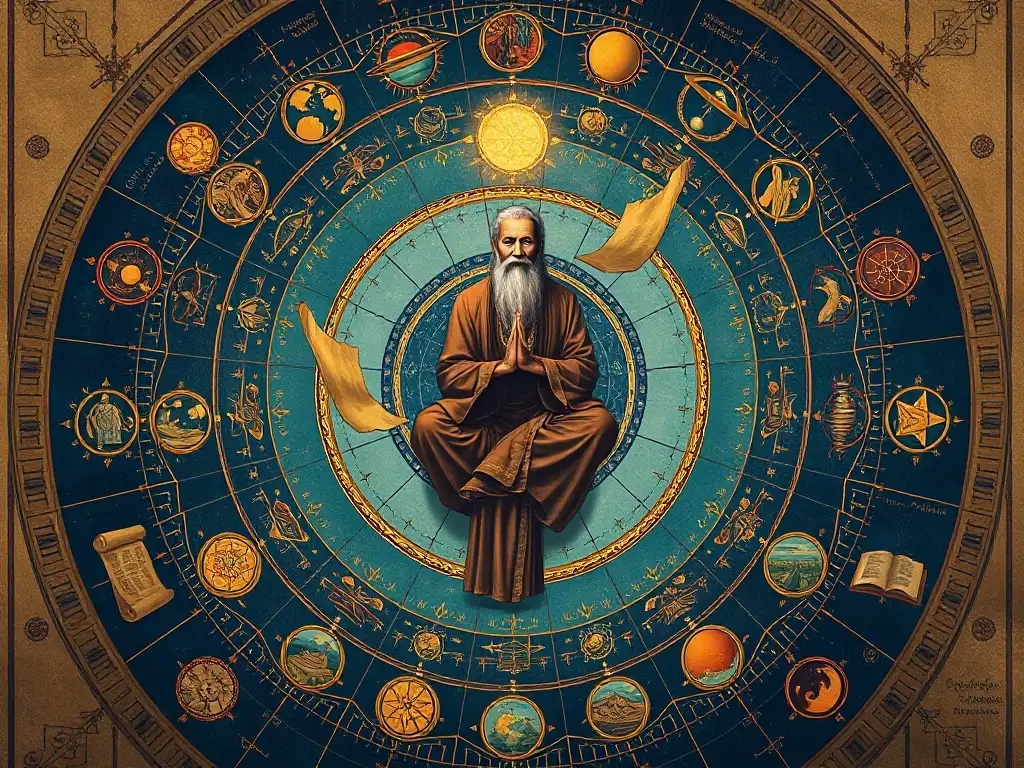
Ancient Indian Vedic cosmology offers profound insights that resonate with contemporary scientific paradigms. The intricate concepts found in texts like the Rigveda and the Upanishads showcase a holistic understanding of the universe that predates modern scientific thought. Several aspects of Vedic cosmology, such as the cyclic nature of time and the concept of a unified cosmos, align with current scientific theories, particularly in cosmology and quantum physics.
- Cyclic Time: Vedic texts propose a cyclical view of time, where the universe undergoes endless cycles of creation, preservation, and dissolution. This perspective mirrors modern theories of the universe, such as the oscillating universe model and the cyclical universe theory proposed by physicists like Paul Steinhardt. These theories suggest that the universe may expand and contract indefinitely, similar to the Vedic cycle of Yugas.
- Unity of Existence: The Vedic assertion that all beings are interconnected reflects contemporary ideas in quantum entanglement, where particles can become intertwined irrespective of distance. This principle of interconnectedness underscores the Vedic view that the universe is a singular entity, an idea that is gaining traction in modern physics.
- Microcosm and Macrocosm: The Vedic concept of "Yajna" (sacred sacrifice) symbolizes the interrelation between the microcosm (individuals) and the macrocosm (the universe). This idea finds parallels in systems theory and ecology, which emphasize that individual actions impact the greater system, promoting a holistic view of existence.
Vedic Insights into Modern Cosmological Questions
Vedic cosmology provides unique insights that address several fundamental questions in modern cosmology. These insights often stem from the philosophical and metaphysical inquiries presented in ancient texts.
- Origin of the Universe: The Vedic texts articulate the idea of "Brahman" as the ultimate reality or source of existence. This notion can be likened to the Big Bang theory, which posits that the universe emerged from a singular point. The metaphor of "Srishti" (creation) in the Vedas aligns with the scientific exploration of the universe's beginnings.
- Nature of Reality: The Vedic distinction between "Maya" (illusion) and "Brahman" (truth) prompts questions about the nature of reality itself. This philosophical inquiry parallels modern discussions in physics regarding the nature of space-time and reality as perceived through human consciousness. The exploration of alternate dimensions and the fabric of reality in contemporary science echoes the Vedic quest for understanding the essence of existence.
- Consciousness and the Universe: The Vedic texts suggest that consciousness is a fundamental aspect of the universe, proposing that awareness shapes reality. This idea resonates with the principles of quantum mechanics, where the observer's effect plays a crucial role in determining the state of particles. The intersection of consciousness and the cosmos is a burgeoning field of study, with Vedic insights offering valuable perspectives.
The ancient Indian Vedic cosmology provides a rich framework that not only enhances our understanding of the universe but also serves as a bridge to contemporary scientific explorations. By integrating these ancient insights, modern scientists can potentially unlock deeper understandings of the cosmos and our place within it.
Conclusion: The Legacy of Vedic Cosmology
The legacy of Vedic cosmology is profound and multifaceted, reflecting not only the ancient Indian understanding of the universe but also its lasting impact on various fields such as philosophy, science, and spirituality. Vedic texts, particularly the Rigveda and the Upanishads, provide a rich tapestry of insights into the nature of existence, the cosmos, and humanity's place within it. This ancient framework of understanding encourages a holistic view that integrates both the material and spiritual aspects of reality, revealing a worldview that is as relevant today as it was thousands of years ago.
Summary of Ancient Indian Vedic Cosmology Insights
Vedic cosmology presents a complex and intricate understanding of the universe, which can be summarized through several key insights:
- Cyclical Time: Vedic texts introduce the concept of cyclical time, which contrasts sharply with the linear perspective prevalent in many Western philosophies. The universe is depicted as undergoing endless cycles of creation, preservation, and dissolution (the cycles of Yugas), a process that emphasizes the impermanence and dynamism of existence.
- Cosmic Structure: The Vedas describe a multilevel cosmos, consisting of various realms and dimensions beyond the physical world. These include the terrestrial realm ( Bhuloka), the celestial realm ( Swarga), and higher spiritual realms (such as Maharloka and Janarloka). Each level of this cosmological hierarchy is inhabited by different beings, from humans to celestial deities, highlighting the interconnectedness of all forms of life.
- Sacred Sound (Nada): The concept of Nada, or sacred sound, is pivotal in Vedic cosmology. It suggests that the universe is created through sound vibrations, echoing modern scientific theories about the fundamental nature of matter and energy. This idea underscores the significance of mantras and rituals in connecting individuals with the cosmic order.
- Unity of Existence: A central tenet of Vedic thought is the idea of Brahman, the ultimate reality that pervades the universe. The relationship between Atman (the individual soul) and Brahman encapsulates the notion that every being is a microcosm of the greater cosmos, emphasizing a profound unity underlying all existence.
These insights not only provide a foundation for spiritual practices within Hinduism but also resonate with contemporary scientific inquiries into the nature of the universe, making Vedic cosmology a timeless source of wisdom.
The Continued Relevance of Vedic Texts in Understanding the Universe
The relevance of Vedic texts in contemporary discourse about the universe cannot be overstated. As modern science grapples with questions about the origins of the universe, the nature of consciousness, and the fundamental structure of reality, insights from Vedic cosmology offer a complementary perspective.
- Interdisciplinary Dialogue: Researchers in fields such as physics, consciousness studies, and even quantum mechanics are increasingly exploring parallels between ancient cosmological ideas and current scientific theories. Vedic concepts of non-dualism and interconnectedness resonate with findings in quantum physics that suggest a deeper unity of the cosmos.
- Spiritual Practices: The continued practice of yoga, meditation, and chanting of mantras, rooted in Vedic traditions, fosters a deeper understanding of consciousness and the self, encouraging individuals to explore their place within the cosmos. These practices not only enhance personal well-being but also align with the holistic perspective of Vedic cosmology.
- Philosophical Inquiry: The philosophical discussions initiated by Vedic texts continue to stimulate dialogue on existential questions, ethics, and the nature of reality. Modern thinkers draw upon these ancient insights to address contemporary issues, from environmental ethics to the significance of human consciousness.
The ancient Indian Vedic cosmology offers rich insights that inform our understanding of the universe. Its teachings remain relevant, providing a bridge between ancient wisdom and modern scientific exploration, ultimately enriching our comprehension of existence itself.
Frequently Asked Questions
What is Vedic cosmology?
Vedic cosmology refers to the ancient Indian understanding of the universe, derived from sacred texts like the Vedas and Upanishads. It explores concepts of space, time, and the structure of the cosmos.
How did ancient Indians view the universe?
Ancient Indians believed the universe is cyclical, comprising cycles of creation and destruction. These ideas are reflected in their texts, which describe the interconnectedness of all existence.
What are the main texts that provide insights into Vedic cosmology?
The primary texts include the Vedas, Upanishads, and Puranas. These texts offer profound insights into the nature of reality, consciousness, and the universal order.
How do ancient Indian cosmological concepts relate to modern science?
Many ideas in Vedic cosmology, such as the interconnectedness of the universe and concepts of time, resonate with modern theories in physics and cosmology, showcasing the depth of ancient Indian thought.
What contributions did ancient Indian civilizations make to cosmological knowledge?
Ancient Indian civilizations contributed significantly by developing advanced mathematical concepts, such as the decimal system, and philosophical ideas about the nature of the universe, influencing both Eastern and Western thought.
Final Reflection: Embracing Ancient Indian Vedic Cosmology Insights for a Modern Understanding
In our fast-paced, technology-driven world, the insights of ancient Indian Vedic cosmology offer a profound lens through which to understand the universe and our place within it. As we grapple with existential questions and the mysteries of existence, these ancient texts remind us that the quest for knowledge is timeless. They challenge us to look beyond the surface of our reality and explore the interconnectedness of all things, urging us to consider the cosmos not just as a physical space, but as a living, breathing entity that we are intrinsically part of.
The influence of Vedic cosmology extends far beyond its historical context; it continues to shape cultural and spiritual landscapes today. By integrating these ancient insights into our modern lives, we can cultivate a deeper appreciation for the universe's complexity and our role within it. As the renowned philosopher Alan Watts once said, You are the universe experiencing itself.
This perspective invites us to reflect on our existence and encourages a harmonious relationship with the cosmos, fostering a sense of unity and purpose that transcends the individual.
As we conclude this exploration of Vedic cosmology, I invite you to take a moment to reflect on how these ancient teachings can enrich your own understanding of the universe. Consider how you can incorporate these insights into your daily life, fostering a sense of connection with the world around you.
Whether through meditation, study, or simply observing the beauty of nature, let the wisdom of the Vedas inspire you to seek deeper truths and embrace the mysteries that lie ahead. The journey of understanding is ongoing, and each step taken with intention brings us closer to the cosmos and to ourselves.
Unveil the Secrets of the Universe Today!
Thank you for taking the time to explore the fascinating world of Vedic cosmology with us! We hope this journey through ancient texts has ignited your curiosity and deepened your understanding of the universe's intricate design. Now, it’s time to take action and further enrich your knowledge!
Here are some steps you can take right now:
- Dive deeper! Read our recommended books and resources on Vedic literature to expand your insights and experience these ancient teachings firsthand.
- Join the conversation! Share your thoughts about Vedic cosmology in the comments below or connect with fellow enthusiasts in our community forums.
- Explore more! Check out our related articles on the history of Ancient India to uncover other enlightening aspects of Indian philosophy and science.
What new insights about the universe have you discovered through Vedic perspectives, and how do they resonate with your own beliefs?