
The Impact of Hellenistic Culture on Indian Society After Alexander's Invasion


Welcome to Ancient India History, where we embark on a captivating journey through time to uncover the rich tapestry of India's past. In this exploration, we delve into the profound Hellenistic influence on Indian culture, a fascinating narrative that emerged following Alexander's invasion. How did the convergence of these two great civilizations shape the very fabric of Indian society? Join us as we unveil the intricate cultural exchanges that defined an era and continue to influence contemporary India. Prepare to be intrigued and inspired as you navigate through the pages of history!

Introduction to Hellenistic Influence on Indian Culture
The interaction between cultures has always played a pivotal role in shaping the course of history, and the Hellenistic influence on Indian culture stands out as a significant chapter in this narrative. Following Alexander the Great's incursion into India in the 4th century BCE, a rich tapestry of cultural exchange unfolded, leading to profound transformations in various aspects of Indian society.
This article delves into the multifaceted impact of Hellenistic culture on Indian civilization, exploring how art, philosophy, governance, and trade were enriched by this dynamic interaction. Understanding this historical confluence not only highlights the adaptability and resilience of Indian culture but also showcases the broader implications of cultural exchanges between neighboring civilizations.
Overview of Hellenistic Culture
The Hellenistic period, which began after the death of Alexander in 323 BCE, is characterized by the spread of Greek culture across a vast expanse of territory, from the Mediterranean to the edges of India. This era brought forth advancements in various fields, including:
- Art and Architecture: A shift towards realism and emotional expression in sculpture and architecture.
- Philosophy: The emergence of schools such as Stoicism and Epicureanism that influenced thought patterns.
- Science and Mathematics: Innovations in fields like astronomy and geometry, with figures like Euclid and Archimedes leading the way.
These elements of Hellenistic culture not only defined the era but also laid the groundwork for future interactions with distant cultures, including that of India.
Context of Alexander's Invasion of India
Alexander's invasion in 326 BCE marked a critical juncture in Indo-Greek relations. The Macedonian king aimed to expand his empire and encountered the Indian kingdoms, notably the Porus Kingdom. The battles fought, such as the Battle of the Hydaspes, were not merely military confrontations; they served as a bridge for cultural exchanges. Following his conquest, Alexander's establishment of cities, like Alexandria on the Indus, facilitated the influx of Greek ideas into Indian society.
This invasion not only paved the way for the dissemination of Hellenistic culture but also led to the establishment of trade routes that would further enhance the exchange of goods and ideas.
Importance of Cultural Exchanges in Ancient Civilizations
Cultural exchanges have historically been catalysts for growth and innovation. They fostered an environment where ideas, technologies, and artistic expressions could flourish. In the context of ancient civilizations, such interactions played a crucial role in:
- Economic Development: Trade routes expanded, allowing for the exchange of commodities and ideas.
- Social Integration: Diverse populations began to interact, leading to the blending of customs and traditions.
- Intellectual Growth: Cross-cultural dialogues spurred advancements in philosophy, science, and the arts.
The Hellenistic influence on Indian culture epitomizes how such exchanges can transform societies, enriching their heritage while fostering a spirit of collaboration and mutual respect.
Historical Background of Hellenistic Influence in India
The Arrival of Hellenistic Ideas in India
The arrival of Hellenistic ideas in India was not an isolated incident but a gradual process facilitated by trade, diplomacy, and military encounters. Following Alexander’s campaign, Greek settlers, traders, and scholars began to migrate into Indian territories, bringing with them their customs, language, and philosophies.
This influx led to the establishment of Bactria, which became a melting pot of Greek and Indian cultures. The Greco-Buddhist art that emerged during this time is a testament to this cultural synergy, characterized by unique stylistic elements that combined Hellenistic realism with Indian spiritual themes.
Key Historical Figures and Events
Several key figures and events played pivotal roles in the propagation of Hellenistic influence in India:
- Menander I: The Indo-Greek king who embraced Buddhism, his reign marked significant cultural integration.
- The spread of Buddhism: Hellenistic art and philosophy deeply influenced the development of Buddhist teachings and practices.
- Trade Agreements: The establishment of trade routes such as the Silk Road further facilitated the exchange of ideas and culture.
These interactions were instrumental in shaping the socio-political landscape of ancient India, leading to a rich blending of Hellenistic and indigenous traditions.
Regions Affected by Hellenistic Influence
The Hellenistic influence permeated various regions of India, especially:
- Northwest India: Areas like Gandhara became central to the fusion of Greek and Indian artistic and philosophical traditions.
- Punjab: This region saw the establishment of several Hellenistic cities, which acted as cultural hubs.
- Central Asia: The influence extended beyond India, impacting neighboring regions and facilitating a broader exchange of ideas.
The impact of Hellenistic culture on Indian society post-Alexander's invasion was profound and transformative, marking a significant chapter in the history of cultural exchanges between civilizations. Through this exploration, we can appreciate the depth and richness of ancient India's interactions with neighboring cultures.
Hellenistic Contributions to Indian Art and Architecture
The Hellenistic period, marked by the spread of Greek culture following Alexander the Great's conquests, significantly influenced Indian art and architecture. This cultural exchange was a result of direct interactions between the Greeks and the Indian subcontinent, leading to a fusion of styles and ideas. The merging of Hellenistic and Indian aesthetics not only enriched local art forms but also laid the groundwork for future artistic developments.
Artistic Styles and Techniques Introduced
One of the most notable contributions of Hellenistic culture to Indian art was the introduction of realistic human figures and naturalistic representations. Techniques such as chiaroscuro, which involves the use of strong contrasts between light and dark, were adopted to enhance the three-dimensionality of sculptures. The Greeks emphasized human anatomy and expression, which inspired Indian artists to explore more lifelike representations in their sculptures and paintings.
Additionally, the use of drapery to depict movement and fluidity in sculptures became prevalent during this period. The intricate detailing in garments and the portrayal of emotions in facial expressions were hallmarks of Hellenistic art that Indian craftsmen began to emulate. This intersection of styles resulted in a unique blend that characterized the art of the Mauryan period and beyond.
Notable Examples of Hellenistic Art in India
Several significant sites showcase the influence of Hellenistic artistry in India. The Sanchi Stupa, a UNESCO World Heritage Site, features intricate carvings and reliefs that reflect Greek artistic techniques, particularly in the depiction of human figures and narrative scenes. The Gandhara school of art, which flourished in the northwest regions of India, is another exemplary case. It combined Indian themes with Hellenistic styles, creating sculptures of the Buddha that exhibit Greek realism.
Another notable example is the Taxila archaeological site, where artifacts such as coins and sculptures reveal a strong Hellenistic influence. The coins often depicted Greek gods alongside Indian deities, symbolizing the syncretism of cultures that occurred during this period. These artistic representations not only served religious purposes but also acted as a medium for cultural exchange.
Influence on Indian Architecture and Urban Planning
The architectural landscape of ancient India underwent significant changes post-Alexander's invasion, influenced by Hellenistic principles. The Greeks introduced concepts such as urban planning with grid layouts and the incorporation of monumental structures. The city of Pataliputra, for instance, showcased an organized urban design, which can be attributed to this Hellenistic influence.
Moreover, the construction of large stone stupas and the use of columns in architecture can be traced back to the Hellenistic style. This is evident in the Ashoka Pillars, which combined Indian motifs with Greek techniques of stone-carving and inscription. The introduction of porticos and colonnades in Indian architecture reflected the aesthetic preferences of Hellenistic designs, leading to a more sophisticated architectural form that persists in various regions of India.
Impact on Indian Philosophy and Religion
The encounter between Hellenistic and Indian civilizations led to a profound transformation in philosophical thought and religious practices. The exchange of ideas fostered a dialogue between different schools of thought, enabling the synthesis of diverse philosophical systems.
Introduction of Greek Philosophical Concepts
Greek philosophy, particularly the works of Plato and Aristotle, began to permeate Indian intellectual circles, introducing concepts such as ethics, metaphysics, and epistemology. The emphasis on rational thought and empirical observation resonated with Indian philosophers, who began to integrate these ideas into their own frameworks. Schools such as Nyaya and Vaisheshika reflected this syncretism, as they incorporated logical reasoning and analytical methods inspired by Greek philosophy.
Additionally, the concept of the soul and discussions surrounding its nature and immortality found parallels in both traditions, leading to enriched dialogues on existential questions. This cross-pollination of philosophical ideas laid the groundwork for more complex metaphysical explorations in later Indian philosophical texts.
Interaction Between Hellenistic and Indian Religions
The interaction between Hellenistic and Indian religions also marked a significant cultural exchange. Greek religious practices and beliefs, such as the reverence for gods and rituals, began to blend with Indian spiritual traditions. This resulted in the emergence of new religious sects that incorporated elements from both cultures.
For example, the worship of Heracles found resonance in certain Indian deities, illustrating the syncretic nature of religious practices. The introduction of Greek deities alongside indigenous gods in temples and iconography is a testament to this fusion. It allowed for a broader religious landscape in which individuals could embrace multiple belief systems.
Case Studies of Philosophical Syncretism
Several case studies highlight the richness of philosophical syncretism resulting from Hellenistic influence. The Buddhist texts, particularly those produced during the Kushan Empire, reflect the incorporation of Hellenistic philosophical ideas. The synthesis of Buddhist thought with Stoicism is evident in themes of ethics and the nature of suffering.
Another significant case is the Jain philosophy, which began to incorporate Greek notions of logic and reasoning into its discourse, enhancing its argumentative frameworks. The philosophical dialogues between Indian and Greek thinkers contributed to a more nuanced understanding of ethics, metaphysics, and the nature of existence, paving the way for future philosophical developments in the Indian subcontinent.
The impact of Hellenistic culture on Indian society post-Alexander's invasion was profound, affecting art, architecture, philosophy, and religion in ways that shaped the trajectory of Indian civilization for centuries to come.
The Fusion of Hellenistic and Indian Trade Practices
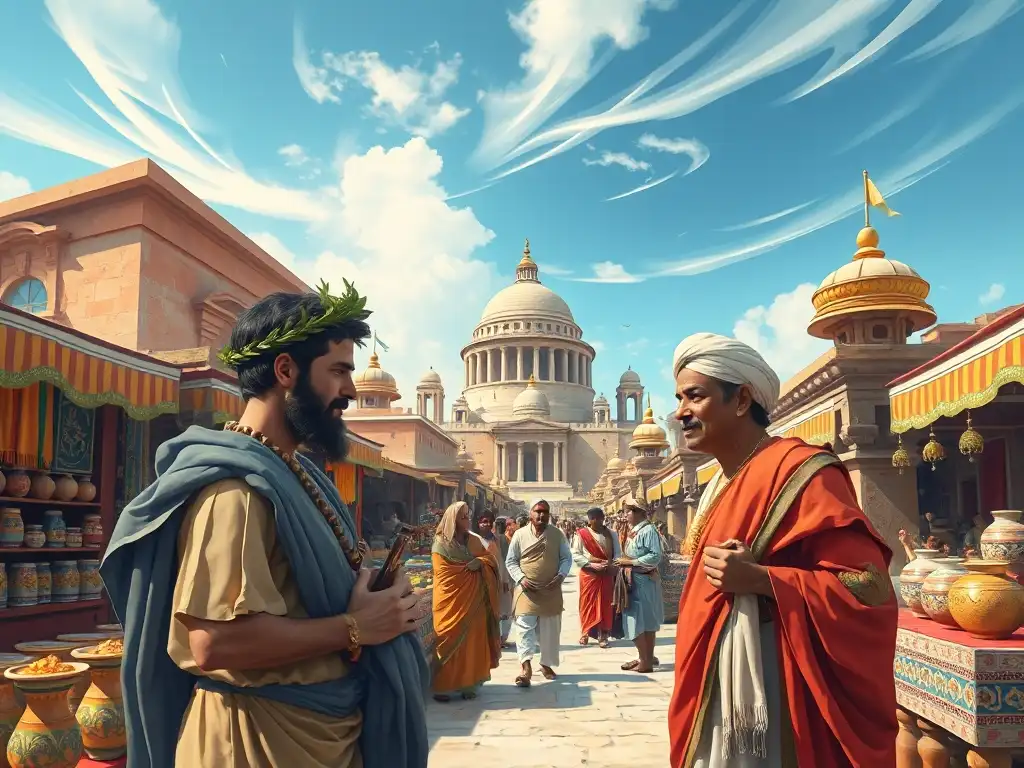
The arrival of Hellenistic culture in India, particularly after Alexander the Great’s invasion in 326 BCE, significantly transformed Indian trade practices. The Hellenistic influence introduced new methodologies, commodities, and networks that enhanced existing trade routes. Merchants from both cultures began to exchange not only goods but also ideas, leading to a fusion of practices that benefited both societies.
Indian traders, already well-versed in maritime and overland routes, found that Hellenistic merchants brought with them advanced techniques in navigation and logistics. The introduction of Greek coins, which offered a standardized medium of exchange, facilitated smoother transactions and fostered trade confidence. This new economic environment allowed for a broader range of goods to be traded, including luxury items like silk and spices, which became highly sought after in the Mediterranean world.
Trade Routes Established Through Hellenistic Influence
The Hellenistic period saw the expansion of trade routes that connected India with the Mediterranean and beyond. Notably, the establishment of the Silk Road and maritime routes through the Arabian Sea enabled a flow of goods, ideas, and cultural influences. These routes not only facilitated trade between India and Hellenistic kingdoms, such as those in modern-day Iran and Iraq, but also opened connections to Africa and Europe.
The integration of Indian ports like Bharukachchha (modern Bharuch) and Tamralipti (in present-day West Bengal) into the Hellenistic trade network allowed Indian merchants to engage more dynamically with Hellenistic markets. The use of Greek ships and navigation techniques further enhanced trade efficiency, making the exchange of goods more profitable and extensive.
Economic Impacts on Indian Society
The economic impact of Hellenistic influence on Indian society was profound. The influx of Hellenistic goods, such as olive oil, wine, and glassware, enriched local markets and diversified consumer choices. This not only increased the wealth of merchants but also stimulated local economies, leading to urban growth in trading hubs.
Moreover, the introduction of more sophisticated banking practices and credit systems, influenced by Hellenistic approaches, transformed economic interactions. Joint ventures and partnerships became more common, allowing for larger scale trading operations. This economic dynamism contributed to the rise of a merchant class in Indian society, which played a crucial role in the cultural and political landscapes of the time.
Cultural Exchange Through Trade
Cultural exchange through trade was a significant outcome of the Hellenistic influence on Indian society. As merchants traveled along newly established trade routes, they not only exchanged goods but also shared knowledge, customs, and artistic expressions. This interaction led to a blending of Hellenistic artistic styles with Indian forms, evident in sculptures and architecture.
The trade networks also facilitated the spread of Hellenistic philosophies and scientific knowledge into India. Concepts such as Stoicism and mathematics found their way into Indian intellectual circles, influencing local thought and education. This cultural intermingling fostered a more cosmopolitan society in major Indian cities, where diverse cultures coexisted and thrived.
Language and Literature: A Cross-Cultural Dialogue
The impact of Hellenistic culture on Indian society extended into the realm of language and literature, creating a unique cross-cultural dialogue. The interactions between Greek and Indian scholars led to significant linguistic exchanges that enriched both cultures.
Influence of Greek Language on Indian Languages
The Greek language had a palpable influence on several Indian languages, particularly in the regions that were part of Alexander’s empire and subsequent Hellenistic kingdoms. Loanwords, especially in areas like administration, philosophy, and science, began to infiltrate local dialects. For instance, terms relating to governance and military organization were adopted from Greek, showcasing the practical implications of Hellenistic governance practices.
Furthermore, the use of Greek script for certain Indian languages, especially during the early centuries of the Common Era, facilitated the documentation of ideas and administrative practices, promoting literacy and scholarship.
Literary Works Reflecting Hellenistic Themes
The literary landscape of ancient India experienced transformation with the incorporation of Hellenistic themes. Works produced during this period began to reflect Greek narrative styles and character development. For example, Sanskrit plays and poetry began to exhibit elements of Greek drama, including complex plots and moral dilemmas.
The Mahabharata and Ramayana, while rooted in Indian tradition, showed influences of Greek storytelling techniques, including the use of dialogue and character arcs that mirrored Greek tragedies. This synthesis of literary forms enriched Indian literature and contributed to the development of a more nuanced narrative tradition.
The Role of Bilingualism in Cultural Exchange
Bilingualism played a pivotal role in facilitating cultural exchange between the Hellenistic and Indian worlds. Many Indian scholars and merchants became proficient in Greek, allowing for direct communication and exchange of ideas. This bilingualism was particularly evident in the northwest regions of India, where Greek influence was strongest.
The ability to navigate both cultures led to a rich discourse in philosophy, science, and art, as scholars translated works and engaged in philosophical debates. The cross-pollination of ideas not only advanced knowledge in various fields but also fostered a spirit of inquiry and innovation that characterized this vibrant period in Indian history.
The arrival of Hellenistic culture in India, primarily following Alexander the Great's invasion in the 4th century BCE, had profound social and political implications. This cultural exchange reshaped various aspects of Indian society, facilitating new governance structures, altering social hierarchies, and fostering unique political alliances. Understanding these implications allows us to appreciate the intricate dynamics between Hellenistic influences and indigenous Indian traditions.
Changes in Governance and Political Structures
The Hellenistic period introduced new administrative practices and governance models that influenced local Indian rulers. Following Alexander’s campaigns, a number of Greek satraps (governors) were established in various regions, particularly in the northwestern territories. These satraps often adopted a blend of Greek and Indian administrative practices, leading to:
- Incorporation of Hellenistic Bureaucratic Techniques: The use of systematic record-keeping, taxation, and regional governance was emphasized, which streamlined administrative processes and improved local governance.
- Cultural Syncretism in Leadership: Indian rulers began to adopt Hellenistic titles and philosophies, reflecting a fusion of leadership styles. For instance, the adoption of the title raja by Hellenistic rulers illustrated their attempt to integrate into the local socio-political fabric.
- Diplomatic Relations: The establishment of diplomatic ties and treaties with Hellenistic states, such as the Seleucid Empire, facilitated political alliances that often merged Hellenistic and Indian interests, leading to a more interconnected geopolitical landscape.
Social Hierarchies and Hellenistic Influence
The Hellenistic influence also significantly impacted social hierarchies within Indian society. The interaction between Greek and Indian cultures led to the emergence of new social dynamics, which included:
- Increased Mobility and Interaction: The migration of Greek settlers and merchants into Indian territories introduced new social classes and facilitated interactions between diverse groups. This led to a greater blending of cultural practices.
- Cultural Exchange and Class Structure: Hellenistic culture introduced new artistic, philosophical, and religious ideas that resonated with Indian elites, resulting in a shift in class structures where knowledge and culture began to play a more prominent role than traditional lineage.
- Religious Syncretism: The introduction of Hellenistic philosophies, particularly Stoicism and Epicureanism, influenced Indian religious thought. This led to the development of syncretic religious movements that integrated Greek ideas with indigenous beliefs, impacting social norms and practices.
Case Studies of Political Alliances and Conflicts
Several case studies illustrate the political alliances and conflicts that arose as a result of Hellenistic influence on Indian society:
- The Maurya Empire: Chandragupta Maurya's alliance with the Seleucid Empire is a prime example. After Alexander's death, Chandragupta negotiated a peace treaty with Seleucus I Nicator, which included marriage alliances and territorial agreements, showcasing how Hellenistic influence shaped large-scale political strategies in India.
- Bactrian Greeks in India: The establishment of the Greco-Bactrian Kingdom in the northwest further exemplifies the blending of cultures. Bactrian rulers, who had adopted Hellenistic customs, often engaged in conflicts with Indian kingdoms, leading to exchanges that reshaped regional politics.
- Cultural Diplomacy: The interactions between Hellenistic and Indian kingdoms often involved diplomatic marriages, as seen in the alliances formed between Indo-Greek rulers and local dynasties. These alliances not only brought stability but also facilitated cultural exchanges, enriching both societies.
Conclusion: Lasting Legacy of Hellenistic Influence on Indian Culture
The Hellenistic influence on Indian culture, initiated by Alexander's invasion, left an indelible mark on Indian society, shaping its political landscape and social structures. This legacy continues to be explored and understood in contemporary scholarship.
Summary of Key Cultural Exchanges
The exchanges between Hellenistic and Indian cultures were multifaceted, involving trade, art, philosophy, and governance. Key cultural exchanges included:
- Artistic Influences: The introduction of Hellenistic art forms, such as sculpture and architecture, which were adapted into Indian styles, most notably seen in the Gandhara art movement.
- Philosophical Dialogues: The cross-pollination of ideas, particularly in ethics and metaphysics, enriched Indian philosophical traditions, incorporating elements of Hellenistic thought.
- Trade Networks: The establishment of trade routes facilitated the exchange of goods and ideas, deepening the integration of Hellenistic elements into Indian life.
Reflection on the Enduring Impact of Hellenistic Ideas
The enduring impact of Hellenistic ideas in India can be seen in various aspects of culture, governance, and social organization. Concepts of democracy, political philosophy, and even scientific inquiry were influenced by Hellenistic thought, contributing to the evolution of Indian intellectual traditions.
Future Research Directions on Hellenistic and Indian Interactions
Future research into Hellenistic and Indian interactions could focus on:
- Archaeological Evidence: Ongoing excavations in northwestern India and the discovery of Hellenistic artifacts can shed light on the extent and nature of cultural exchanges.
- Comparative Studies: Analyses that compare Hellenistic influences in India with other regions, such as the Middle East or Central Asia, could provide broader insights into the nature of cultural interactions during this period.
- Interdisciplinary Approaches: Integrating perspectives from history, anthropology, and art history could enrich our understanding of how Hellenistic culture was assimilated and transformed within Indian society.
Exploring the nuances of Hellenistic influence on Indian culture not only enhances our understanding of ancient societies but also underscores the complexity of cultural exchanges that have shaped civilizations throughout history.
- Introduction to Hellenistic Influence on Indian Culture
- Historical Background of Hellenistic Influence in India
- Hellenistic Contributions to Indian Art and Architecture
- Impact on Indian Philosophy and Religion
- The Fusion of Hellenistic and Indian Trade Practices
- Language and Literature: A Cross-Cultural Dialogue
- Social and Political Implications of Hellenistic Influence
- Conclusion: Lasting Legacy of Hellenistic Influence on Indian Culture
- What was the Hellenistic influence on Indian culture?
- How did Alexander's invasion affect Indian society?
- What were the main contributions of Hellenistic culture to India?
- How did the Mauryan Empire interact with Hellenistic culture?
- Are there specific examples of Hellenistic influence in Indian art?
Frequently Asked Questions
What was the Hellenistic influence on Indian culture?
The Hellenistic influence on Indian culture refers to the blending of Greek and Indian traditions following Alexander the Great's invasion, which introduced new ideas in art, architecture, and philosophy.
How did Alexander's invasion affect Indian society?
Alexander's invasion led to cultural exchanges that enriched Indian society, introducing Hellenistic elements in various fields, including politics, governance, and trade practices.
What were the main contributions of Hellenistic culture to India?
Key contributions included advancements in artistic styles, such as the Gandhara art, which combined Greek and Indian motifs, and the introduction of new scientific ideas and philosophical thought.
How did the Mauryan Empire interact with Hellenistic culture?
The Mauryan Empire embraced elements of Hellenistic culture through trade and diplomacy, which resulted in significant cultural synthesis and the spread of Buddhism to the West.
Are there specific examples of Hellenistic influence in Indian art?
Yes, notable examples include sculptures and reliefs from the Gandhara region, which exhibit Greek techniques and themes, illustrating the fusion of Hellenistic and Indian artistic traditions.
Final Reflection: The Enduring Legacy of Hellenistic Influence on Indian Culture
The Hellenistic influence on Indian culture is not just a historical footnote; it is a testament to the profound interconnectedness of civilizations. As we explore the intricate tapestry woven by Alexander's invasion, we uncover a rich exchange of ideas, art, and philosophy that continues to resonate in contemporary society. The fusion of Hellenistic and Indian elements has shaped not only the cultural landscape of ancient India but also laid the groundwork for future interactions between diverse cultures. This legacy reminds us that the boundaries we perceive are often more porous than we think.
The impact of Hellenistic culture on Indian society has been profound and multifaceted, influencing everything from art to governance. The blending of these two rich traditions has fostered a unique cultural milieu that continues to inspire and inform modern thought. As we reflect on this historical convergence, we recognize the importance of embracing diverse influences in our own lives. Cultures are not isolated; they are in constant dialogue with one another, shaping and reshaping identities.
This ongoing dialogue is a reminder that our identities are not static but rather dynamic, influenced by the myriad interactions we experience.
As we conclude this exploration of Hellenistic influence on Indian culture, I invite you to reflect on your own life and the cultural exchanges that shape your identity. Consider how the blending of ideas and traditions can enrich your understanding of the world. Let this reflection inspire you to seek out diverse perspectives, engage in meaningful dialogues, and appreciate the beauty of cultural interconnectedness. In doing so, we honor the legacy of those who came before us and pave the way for a more inclusive and enriched future.
Unveil the Magic of Cultural Exchange!
Thank you for diving into the fascinating world of Hellenistic culture and its influence on Indian society following Alexander's invasion! Your curiosity opens up a wondrous exploration of how cultures intertwine and shape our historical narrative.
Now, it’s your turn to engage with this rich tapestry of history. Here are some steps you can take to deepen your understanding and share this journey with others:
- Delve into the past: Explore further by reading books or articles that focus on Hellenistic influences in various regions. You might uncover surprising connections that enhance your understanding!
- Join the conversation: Share your thoughts on this cultural exchange in the comments section. What aspects of the Hellenistic influence on India do you find most intriguing?
- Connect with like-minded history enthusiasts: Follow our website for ongoing discussions, articles, and community insights about the impact of diverse cultures in ancient history.
How do you think the blending of Hellenistic ideas with Indian traditions continues to influence cultural exchanges in our modern world?