

Philosophical Schools (Nyaya, Vaisheshika, Sankhya)
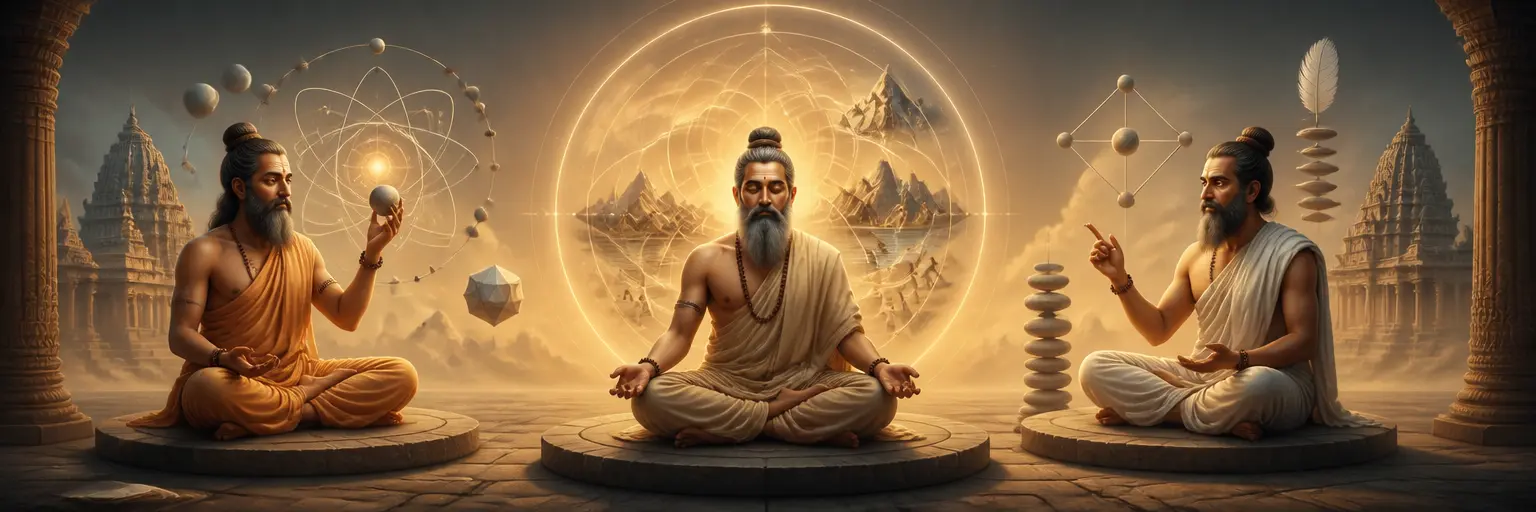

Philosophical Schools (Nyaya, Vaisheshika, Sankhya)
61 articles in this topic
Start here
- Philosophical Schools (Nyaya, Vaisheshika, Sankhya)The Historical Development of Vaisheshika: From Ancient Texts to Contemporary Relevance
- Philosophical Schools (Nyaya, Vaisheshika, Sankhya)The Interplay of Nyaya and Vaisheshika: A Synergistic Approach to Philosophy
- Philosophical Schools (Nyaya, Vaisheshika, Sankhya)The Sankhya System of Knowledge: Integrating Philosophy and Science
Read more about this topic
Explore the intellectual foundations of ancient India through Nyaya, Vaisheshika, and Sankhya—influential philosophical traditions that shaped Indian logic, metaphysics, epistemology, and theories of reality. Discover how these schools examined knowledge, matter, consciousness, causation, and liberation, offering profound insights into the development of ancient Indian philosophy and its enduring influence on art, culture, religion, and scholarly thought.
More in Philosophical Schools (Nyaya, Vaisheshika, Sankhya)
Philosophical Schools (Nyaya, Vaisheshika, Sankhya)
The Interplay of Philosophy and Art in Ancient India: Nyaya, Vaisheshika, and Sankhya
Philosophical Schools (Nyaya, Vaisheshika, Sankhya)
The Nyaya Approach to Science: Logic, Evidence, and Inquiry
Philosophical Schools (Nyaya, Vaisheshika, Sankhya)
The Nyaya School: Unraveling the Logic Behind Ancient Indian Philosophy

Philosophical Schools (Nyaya, Vaisheshika, Sankhya)
The Role of Pramanas in Nyaya: Valid Means of Knowledge in Ancient Philosophy
Philosophical Schools (Nyaya, Vaisheshika, Sankhya)
The Role of Perception in Nyaya: Exploring the Different Ways We Know

Philosophical Schools (Nyaya, Vaisheshika, Sankhya)
Vaisheshika vs. Nyaya: Understanding the Distinct Philosophical Pathways

Philosophical Schools (Nyaya, Vaisheshika, Sankhya)
Vaisheshika’s Contribution to Science: The Birth of Atomism in Ancient India
Philosophical Schools (Nyaya, Vaisheshika, Sankhya)
The Relevance of Ancient Indian Logic in Contemporary Philosophy
🕉️ Philosophical Schools of Ancient India: Nyaya, Vaisheshika, and Sankhya
Explore the intellectual traditions of ancient India through this focused collection on Nyaya, Vaisheshika, and Sankhya philosophy. As an important subcategory within Art, Architecture, and Philosophy on Ancient India History, it examines the ideas, texts, teachers, and debates that shaped Indian thought from the early classical period onward. Readers can discover how these philosophical schools investigated knowledge, reality, matter, consciousness, logic, causation, and liberation, while also understanding their relationship with wider Indian culture and civilization.
🧠 Nyaya Philosophy: Logic, Reasoning, and Valid Knowledge
Learn how the Nyaya school of ancient Indian philosophy developed a systematic method for reasoning and debate. Articles in this section explore Nyaya logic, inference, perception, comparison, testimony, and the concept of reliable knowledge, known as pramana. Readers will encounter the contributions of thinkers such as Gautama, also known as Akshapada, and discover why Nyaya became one of India’s most influential traditions of philosophical analysis.
This section also explains how Nyaya addressed questions about the self, the external world, God, error, language, and liberation. Whether you are studying Indian logic, researching ancient philosophical systems, or comparing Eastern and Western traditions of reasoning, these resources offer clear historical context and accessible explanations of Nyaya terminology and arguments.
🔬 Vaisheshika Philosophy: Atoms, Categories, and the Nature of Reality
Discover the distinctive approach of Vaisheshika philosophy, an ancient Indian school known for its detailed classification of reality. This subcategory explores the school’s categories, or padarthas, including substance, quality, motion, universality, particularity, and inherence. It also examines the work traditionally associated with Kanada, whose ideas about atoms and material composition represent a significant development in the history of Indian philosophical thought.
Readers can expect discussions of Vaisheshika metaphysics, natural philosophy, cosmology, causation, and the relationship between physical matter and spiritual liberation. By placing Vaisheshika within the wider history of ancient Indian science and philosophy, this section shows how early thinkers analyzed the structure of the universe through observation, classification, logical argument, and metaphysical inquiry.
🌌 Sankhya Philosophy: Purusha, Prakriti, and Cosmic Evolution
Explore Sankhya philosophy, one of the most influential dualistic systems of ancient India. Sankhya explains existence through the interaction of Purusha, or pure consciousness, and Prakriti, or primordial material nature. Articles in this section introduce the Sankhya theory of evolution, the three gunas—sattva, rajas, and tamas—and the twenty-five principles used to describe the development of mind, matter, senses, and the cosmos.
This collection also examines the historical importance of Kapila, the relationship between Sankhya and Yoga philosophy, and the school’s understanding of suffering, bondage, knowledge, and liberation. Readers interested in Indian metaphysics, Hindu philosophy, spiritual traditions, and the origins of Yoga will find helpful explanations of how Sankhya influenced later religious, philosophical, and cultural practices.
📚 Ancient Indian Texts, Teachers, and Intellectual Traditions
Study the foundational texts and teachers connected with Nyaya, Vaisheshika, and Sankhya. This section may include discussions of the Nyaya Sutra, Vaisheshika Sutra, Sankhya teachings, commentaries, and later developments that helped preserve and reinterpret these systems. It also considers the role of philosophical teachers, debate traditions, monasteries, courts, and centers of learning in transmitting knowledge across generations.
Readers will gain a broader understanding of how Indian philosophy developed through dialogue, commentary, debate, and intellectual exchange. These resources connect philosophical texts with the history of ancient India, showing how abstract ideas about knowledge and reality influenced education, religion, ethics, medicine, literature, and public life.
⚖️ Comparing Nyaya, Vaisheshika, and Sankhya
Compare the central principles of these three major ancient Indian philosophical schools. Nyaya emphasizes valid reasoning and methods of knowledge, Vaisheshika focuses on categories and the structure of reality, while Sankhya presents a dualistic account of consciousness and nature. Exploring their similarities and differences makes it easier to understand the diversity of Indian philosophy beyond simplified descriptions.
Readers can expect accessible comparisons of concepts such as the self, matter, causation, perception, inference, God, suffering, and liberation. This approach is useful for students, history enthusiasts, researchers, and anyone searching for reliable information about Nyaya versus Vaisheshika, Sankhya metaphysics, and the development of classical Indian thought.
🏛️ Philosophy in the Cultural History of Ancient India
Place these philosophical schools within the larger story of ancient Indian civilization, from early cultural developments to the intellectual achievements of the classical and Gupta periods. Philosophy was not isolated from society; it interacted with religion, art, architecture, literature, education, political thought, and scientific traditions. Studying Nyaya, Vaisheshika, and Sankhya therefore provides insight into the values and questions that shaped Indian culture.
This section highlights the continuing legacy of ancient Indian philosophy in modern scholarship, Yoga studies, comparative philosophy, logic, spirituality, and cultural history. With historically informed articles and clear explanations, Ancient India History helps readers understand how these schools contributed to India’s enduring intellectual heritage.
❓ Frequently Asked Questions About Ancient Indian Philosophical Schools
What are Nyaya, Vaisheshika, and Sankhya?
Nyaya, Vaisheshika, and Sankhya are major philosophical schools of ancient India. Nyaya focuses on logic and valid knowledge, Vaisheshika analyzes the categories and structure of reality, and Sankhya explains existence through the distinction between consciousness and material nature.
Who founded the Nyaya school?
Nyaya is traditionally associated with Gautama, also called Akshapada, who is credited with composing the Nyaya Sutra. The school became especially important for its study of inference, debate, perception, testimony, and methods for establishing reliable knowledge.
What is Vaisheshika philosophy known for?
Vaisheshika is best known for its system of classifying reality into fundamental categories and for its theory that material objects are composed of extremely small particles or atoms. The school is traditionally linked with Kanada and the Vaisheshika Sutra.
What are Purusha and Prakriti in Sankhya philosophy?
In Sankhya philosophy, Purusha refers to pure, witnessing consciousness, while Prakriti means primordial material nature. Sankhya teaches that spiritual freedom comes from recognizing the difference between these two principles and overcoming mistaken identification with material experience.
Why are these philosophical schools important today?
Nyaya, Vaisheshika, and Sankhya remain important for understanding Indian intellectual history, logic, metaphysics, Yoga, spirituality, and comparative philosophy. Their ideas continue to influence academic research and provide valuable perspectives on knowledge, reality, consciousness, and human liberation.