
From Brahmi to Devanagari: The Evolution of Ancient Indian Scripts

Welcome to Ancient India History, where we embark on a fascinating journey through the rich tapestry of ancient Indian civilizations. Here, we delve into the evolution of ancient Indian scripts, exploring how these intricate writing systems shaped the culture and communication of the time.
In our featured article, "From Brahmi to Devanagari: The Evolution of Ancient Indian Scripts," you’ll uncover the remarkable transformations that took place over centuries, revealing not just the scripts themselves but also the stories and innovations that accompanied them. Prepare to ignite your curiosity as we unlock the secrets of a language that has withstood the test of time!
- Introduction to the Evolution of Ancient Indian Scripts
- The Origins of Brahmi Script
- Transition from Brahmi to Other Scripts
- The Development of Devanagari Script
- Comparing Brahmi and Devanagari Scripts
- The Impact of Religion and Culture on Script Evolution
- Conclusion: The Legacy of Ancient Indian Scripts
- Further Reading on the Evolution of Ancient Indian Scripts
- Frequently Asked Questions
- Final Reflection: The Enduring Legacy of Ancient Indian Scripts
- Unveil the Secrets of Ancient Scripts!
Introduction to the Evolution of Ancient Indian Scripts
The evolution of ancient Indian scripts is a fascinating journey that reflects the rich tapestry of India's linguistic heritage, cultural exchanges, and historical developments. This article delves into the intricate transformations of writing systems from the early Brahmi script to the more contemporary Devanagari, showcasing how these scripts not only served as a medium of communication but also played a pivotal role in shaping the cultural and intellectual landscape of ancient India.
Understanding this evolution is crucial for grasping the historical context of Indian literature, philosophy, and administration, while also appreciating the contributions of various civilizations that flourished in the Indian subcontinent.
Understanding the Importance of Ancient Indian Scripts
Ancient Indian scripts are significant for several reasons:
- Cultural Identity: Scripts like Brahmi and Devanagari are not merely tools of communication; they are emblematic of the cultural and philosophical traditions of their time. They encapsulate the essence of the societies that used them, reflecting their values, thoughts, and beliefs.
- Historical Documentation: The inscriptions and manuscripts written in these scripts provide invaluable insights into the social, political, and economic conditions of ancient India. They serve as primary sources for historians studying the evolution of Indian civilization.
- Linguistic Development: The evolution of scripts is closely tied to the development of languages in India. Understanding these scripts helps in tracing the origins and transformations of languages such as Sanskrit, Prakrit, and later vernaculars.
- Art and Aesthetics: The scripts are not only functional but also artistic. The calligraphy and design of ancient inscriptions showcase the artistic sensibilities of their creators, contributing to the rich artistic legacy of India.
Overview of Brahmi and Devanagari
The journey of ancient Indian scripts begins with Brahmi, one of the earliest writing systems in India, which emerged around the 3rd century BCE. Characterized by its phonetic nature, Brahmi laid the foundation for many subsequent scripts in the Indian subcontinent. Its influence can be seen in a variety of scripts, including those used in Southeast Asia.
- Characteristics of Brahmi:
- Phonetic Script: Each character represents a specific sound, making it easier to read and write.
- Direction: Written from left to right, Brahmi's layout established the norm for many later scripts.
On the other hand, Devanagari emerged as a prominent script around the 7th century CE and is widely used today for languages such as Hindi, Sanskrit, and Marathi. Its name literally means "city of the gods," reflecting its sacred associations.
- Characteristics of Devanagari:
- Complex Structure: Devanagari is known for its unique combination of letters and diacritical marks, allowing for the representation of a wide range of sounds.
- Horizontal Line: The distinctive horizontal line running along the top of the letters is a hallmark of Devanagari, giving it a visually appealing and cohesive appearance.
Both Brahmi and Devanagari symbolize the remarkable evolution of written expression in ancient India, serving as critical links in the continuum of India's linguistic and cultural history.
The Origins of Brahmi Script
Historical Context of Brahmi in Ancient India
Brahmi script is considered one of the oldest writing systems in India, dating back to approximately the 3rd century BCE. It emerged during a pivotal era in Indian history marked by the rise of the Maurya Empire under Emperor Ashoka. The historical context of Brahmi is intricately linked to the spread of Buddhism, as Ashoka's edicts, inscribed in Brahmi, were crucial in disseminating Buddhist teachings across the Indian subcontinent.
During this period, the subcontinent witnessed significant socio-political changes, with trade routes expanding and cultural exchanges flourishing. The use of Brahmi script allowed for better communication and record-keeping, facilitating administrative functions and promoting literacy among the populace. Its development can be traced to earlier writing systems, such as the Indus script, although the exact relationship remains a topic of scholarly debate.
Brahmi inscriptions have been found in various regions, including the famous Ashoka Pillars and rock edicts, which not only highlight the script's geographical spread but also its role in unifying diverse cultures under a common written language. The inscriptions reveal a blend of local dialects and the formalized language of administration, showcasing Brahmi's adaptability and significance in early Indian history.
Characteristics and Features of Brahmi Script
Brahmi is a distinctive abugida script, meaning that it is primarily syllabic, with consonants carrying an inherent vowel sound that can be modified with diacritics. Some key characteristics and features of the Brahmi script include:
- Structure: Brahmi consists of 41 consonants and 12 vowels, allowing for a wide range of phonetic expressions. Each character in the script can be combined to form syllables, making it versatile for various languages.
- Directionality: The script is written from left to right, which is a hallmark of many later Indian scripts, including Devanagari.
- Stylization: Brahmi characters are characterized by their rounded shapes, which evolved over time into more angular forms in later scripts. This evolution reflects the influence of writing materials and techniques used by scribes.
- Inscriptions: The use of Brahmi in stone inscriptions demonstrates its durability and significance. These inscriptions often served as public declarations, commemorating events or edicts issued by rulers.
- Regional Variants: As Brahmi spread across the Indian subcontinent, regional variants began to emerge. These adaptations influenced the development of other scripts, such as Kharosthi in the northwest and later scripts like Gupta and Tamil.
The Role of Brahmi in Early Indian Literature
Brahmi's contribution to early Indian literature is profound, as it served as a vehicle for expression in various literary forms. The script was instrumental in documenting religious texts, philosophical treatises, and administrative records, thus playing a vital role in preserving India's cultural heritage.
- Religious Texts: Brahmi inscriptions are found in numerous Buddhist texts, including the Tripitaka, which laid the foundation for Buddhist philosophy. Additionally, Jain texts also utilized Brahmi, highlighting its importance in religious discourse.
- Philosophical Works: The script enabled scholars to articulate complex ideas and philosophies, contributing to the intellectual landscape of ancient India. Works in Brahmi explored themes of ethics, metaphysics, and society, influencing generations of thinkers.
- Administrative Records: Brahmi was employed for various administrative purposes, including tax records, land grants, and legal documents. This practical application underscores the script's significance in governance and societal organization.
Brahmi script not only facilitated communication and administration in ancient India but also enriched the literary landscape, shaping the cultural narrative of the time. Its evolution set the stage for the development of subsequent scripts, marking a crucial phase in the evolution of ancient Indian scripts.
Transition from Brahmi to Other Scripts
The transition from Brahmi to other scripts marks a significant chapter in the history of ancient Indian writing systems. Brahmi, believed to have originated around the 3rd century BCE, served as the foundation for many scripts that followed. Its simplicity, adaptability, and phonetic nature allowed it to spread across the Indian subcontinent and evolve into various regional scripts. This transformation played a crucial role in the dissemination of language, culture, and administration in ancient India.
The evolution of ancient Indian scripts is not a linear progression but rather a complex interplay of cultural exchanges, trade routes, and political dynamics. As different regions adapted Brahmi to their linguistic needs, distinct scripts emerged, each reflecting the unique characteristics of the languages they represented.
Influence of Brahmi on Regional Scripts
Brahmi's influence is evident in numerous regional scripts that emerged throughout ancient India. The script's structure and phonetic principles laid the groundwork for an array of writing systems, each tailored to local languages and dialects. Below are some of the notable scripts that evolved from Brahmi:
- Devanagari: Used for Sanskrit and several modern Indian languages, Devanagari retains many features of Brahmi, including its cursive style.
- Bengali: Evolving in the eastern regions, Bengali script showcases Brahmi's influence through its rounded shapes and distinctive character set.
- Gurmukhi: Developed for the Punjabi language, Gurmukhi incorporates elements from Brahmi while also possessing unique characteristics suitable for its phonetic requirements.
Kharosthi: A Contemporary of Brahmi
Kharosthi, contemporary to Brahmi, emerged in the northwestern regions of ancient India, primarily in what is now Pakistan and Afghanistan. This script was predominantly used for writing Gandhari, a Prakrit language.
Kharosthi exhibits several key features:
- Directionality: Unlike Brahmi, which is written from left to right, Kharosthi is written from right to left.
- Character Design: Kharosthi characters are more angular and less rounded compared to Brahmi, reflecting a different aesthetic and practical approach to writing.
The decline of Kharosthi began around the 4th century CE as Brahmi and its derivatives gained prominence. The script's rarity in surviving inscriptions highlights the shifting linguistic landscape of ancient India.
Tamil and Other South Indian Scripts
In South India, Brahmi profoundly influenced the development of Tamil and other regional scripts. The Tamil script, which began to take shape around the 5th century BCE, shows clear connections to Brahmi's phonetic principles.
Key characteristics of Tamil script include:
- Adaptation for Phonetics: The script was designed to accurately represent the sounds of the Tamil language, showcasing Brahmi's legacy in phonetic writing.
- Distinctive Features: Although rooted in Brahmi, Tamil script incorporates unique symbols and ligatures that reflect the language's specific phonology.
Other South Indian scripts, such as Kannada and Telugu, also evolved from Brahmi, each adapting the script to their linguistic and cultural contexts.
Evolution of Brahmi Variants Across Regions
The evolution of Brahmi variants across different regions illustrates the adaptability and resilience of ancient Indian scripts. As languages diversified and regional identities strengthened, Brahmi gave rise to several variants tailored to local needs.
The following table summarizes key Brahmi variants and their characteristics:
| Script | Region | Key Characteristics |
|---|---|---|
| Devanagari | Northern India | Used for Hindi, Sanskrit; distinctive horizontal line atop letters. |
| Bengali | Eastern India | Rounded shapes; cursive style; used for Bengali and Assamese. |
| Gurmukhi | Punjab | Used for Punjabi; features a unique set of characters. |
| Tamil | Southern India | Phonetic adaptation; distinct symbols for Tamil phonemes. |
| Kannada | Karnataka | Incorporates curves and loops for phonetic accuracy. |
| Telugu | Andhra Pradesh | Characteristic rounded letters, designed for Telugu language. |
The rich tapestry of scripts that emerged from Brahmi not only showcases the linguistic diversity of ancient India but also highlights the cultural exchanges that shaped the subcontinent's history. As scholars continue to study these scripts, they uncover insights into the evolution of language, administration, and societal structures in ancient Indian civilizations.
The Development of Devanagari Script
The Devanagari script, a prominent writing system used for several languages, has a rich history that traces back to ancient Indian scripts. It is widely recognized for its unique and structured form, and its development is a significant chapter in the evolution of ancient Indian scripts.
Historical Background of Devanagari
The origins of Devanagari can be traced to the Brahmi script, which is considered one of the earliest scripts in India, dating back to the 3rd century BCE. The Brahmi script itself evolved from the Phoenician alphabet and significantly influenced subsequent Indian scripts.
By the 7th century CE, Devanagari began to emerge as a distinct script, primarily used for writing Sanskrit. It developed from the earlier Nagari script, which was a derivative of the Gupta script—a script that flourished during the Gupta Empire (circa 240-550 CE). The term "Devanagari" translates to "divine city" (Deva = divine; Nagari = city), reflecting its sacred association with Hindu literature.
The script was first codified in inscriptions, and its use expanded significantly during the medieval period, especially with the rise of literature in Sanskrit and later in vernacular languages. By the 11th century, Devanagari had become the primary script for Sanskrit, and its use spread to various regional languages, paving the way for its widespread adoption in modern times.
Key Features and Distinctive Characteristics of Devanagari
Devanagari possesses several distinctive characteristics that set it apart from other scripts:
- Phonetic Nature: It is a phonetic script, meaning that each character corresponds to a specific sound. This feature allows for precise pronunciation of words and contributes to its effectiveness in representing the rich phonetics of Sanskrit and Hindi.
- Vowel Diacritics: Devanagari employs a system of vowel diacritics that modifies consonants to indicate different vowel sounds. For instance:
- क (ka)
- की (ki)
- कु (ku)
- के (ke)
- Conjunct Consonants: The script allows for the formation of conjunct consonants, where two or more consonants are combined into a single character. This is particularly useful in Sanskrit, where consonant clusters are common.
- Top Line: A distinctive horizontal line runs along the top of the letters in Devanagari, connecting them. This feature enhances the script's visual appeal and aids in the reading process.
- Directionality: Devanagari is written from left to right, similar to many modern scripts.
This combination of features allows for a rich and nuanced representation of the sounds and meanings inherent in the languages it serves.
The Role of Devanagari in Sanskrit and Hindi Literature
Devanagari plays a crucial role in the preservation and dissemination of Sanskrit and Hindi literature. As the script of choice for Sanskrit, it has facilitated the transmission of ancient texts, including sacred scriptures like the Vedas, Upanishads, and epic poetry such as the Mahabharata and Ramayana.
In the realm of Hindi literature, Devanagari has enabled the expression of diverse cultural and literary traditions. Renowned poets like Tulsidas and Mirza Ghalib used this script to create works that continue to resonate with readers today. The script's adaptability has allowed it to evolve alongside the languages it represents, ensuring that it remains relevant in contemporary literature and education.
The evolution of ancient Indian scripts is embodied in the development of Devanagari, which has played an instrumental role in shaping the linguistic landscape of India. Its historical significance and distinctive features make it a vital component of India's cultural heritage.
Comparing Brahmi and Devanagari Scripts
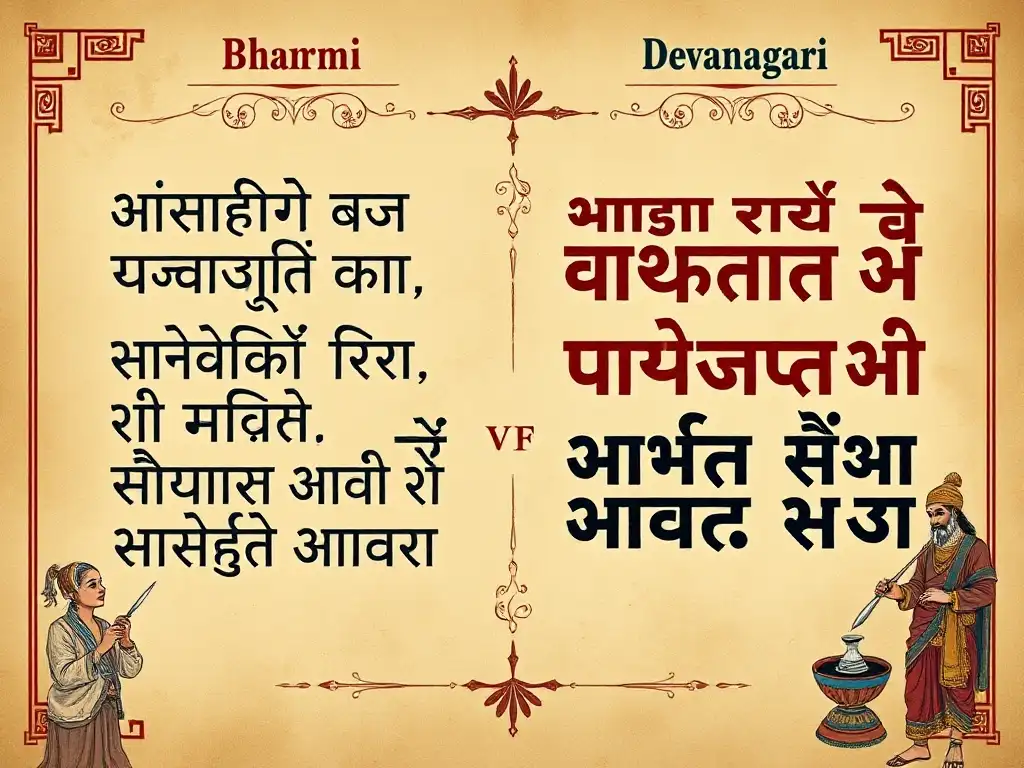
The evolution of ancient Indian scripts is marked by various transformations that reflect the linguistic and cultural shifts over centuries. Among these scripts, Brahmi and Devanagari stand out as pivotal in the history of Indian writing. Understanding their characteristics and differences provides insight into how the written word has developed in this region.
Structural Differences Between Brahmi and Devanagari
Brahmi, believed to have originated around the 3rd century BCE, is considered one of the earliest scripts in India. It features a distinct set of structural characteristics:
- Consonantal Basis: Brahmi is an abugida, meaning it primarily represents consonants with inherent vowel sounds that can be modified with diacritics.
- Curvilinear Forms: The characters are primarily formed with rounded shapes, making them aesthetically unique.
- Linear and Incised: Brahmi was often incised on stone and other materials, leading to a more linear appearance.
In contrast, Devanagari, which emerged around the 7th century CE, exhibits different structural features:
- Syllabic Structure: Devanagari is also an abugida, but it places more emphasis on the representation of syllables as units, allowing for a composite structure.
- Rectilinear Forms: The script is characterized by its straight lines and angular shapes, giving it a more geometric appearance.
- Horizontal Line: A distinctive horizontal line runs across the top of the letters, uniting them visually and functionally.
| Feature | Brahmi | Devanagari |
|---|---|---|
| Script Type | Abugida (Consonantal) | Abugida (Syllabic) |
| Character Shape | Curvilinear | Rectilinear |
| Visual Connection | No horizontal line | Horizontal line unites characters |
Phonetic Elements: How Sounds are Represented
The phonetic representation in Brahmi and Devanagari scripts also varies significantly, showcasing their adaptation to the phonological needs of the languages they represent.
- Brahmi:
- Limited in representing vowel sounds distinctly; most vowels were indicated through diacritics.
- Consonants could be modified to express different vowel sounds, which required a deeper understanding from the reader.
- Devanagari:
- Each consonant has an inherent vowel sound ('a') which can be modified.
- Additional diacritical marks are used to denote other vowel sounds clearly, making it more accessible for phonetic understanding.
- The script incorporates conjunct consonants effectively, allowing for a more fluid representation of sounds.
For example, the consonant 'क' (ka) can be modified to represent different sounds, while Brahmi would require a change in diacritic marks to achieve the same clarity.
Usage in Different Languages and Regions
The geographical and linguistic diversity of India has influenced the usage of Brahmi and Devanagari scripts significantly.
- Brahmi:
- Used predominantly in ancient inscriptions across various regions, including the inscriptions of Ashoka, which spread the script from the northwest to the southern parts of India.
- Brahmi served as the progenitor for many regional scripts, including Tamil, Kannada, and Tibetan, showcasing its extensive reach in ancient times.
- Devanagari:
- Predominantly used for languages such as Hindi, Sanskrit, Marathi, and Nepali.
- Its current use is widespread across northern and central India, reflecting its adaptability and continued relevance in modern contexts.
- Devanagari is also recognized internationally due to the global spread of Hindi and other languages written in this script.
The evolution of ancient Indian scripts highlights a fascinating journey through time, where Brahmi laid the groundwork for many future scripts, including Devanagari, which continues to thrive today. This progression not only reflects linguistic development but also the rich cultural tapestry of ancient India.
The Impact of Religion and Culture on Script Evolution
The evolution of ancient Indian scripts is deeply intertwined with the region's religious and cultural dynamics. From the early inscriptions of the Indus Valley civilization to the standardized forms of scripts like Devanagari, various religious movements and cultural practices played a pivotal role in shaping the trajectory of these scripts. This section explores how Buddhism, Jainism, and Hinduism influenced the development and spread of ancient Indian scripts.
Influence of Buddhism and Jainism on Script Development
Buddhism and Jainism emerged as significant religious movements in ancient India around the 6th century BCE, both advocating for the dissemination of their teachings through written texts. This led to the establishment of several scripts, most notably Brahmi and Kharoṣṭhī.
- Brahmi Script:
- Used extensively for writing the Buddhist texts, Brahmi is one of the oldest scripts in India. It was employed to transcribe the teachings of the Buddha, making them accessible to a broader audience.
- The script's adaptations can be seen in various regions, reflecting local languages and dialects.
- Kharoṣṭhī Script:
- Originating in the northwest regions of India, Kharoṣṭhī was primarily used for writing in the Gandhari language, which was spoken by many Buddhists.
- This script's use in Buddhist texts signifies the importance of scriptural preservation in these religions, demonstrating a direct correlation between religious practices and script development.
Jainism also contributed significantly to the preservation of ancient Indian scripts, particularly through the writing of philosophical texts in Jain Agamas. This religious emphasis on textual authority and clarity helped refine scripts, ensuring that they were legible and accessible for followers.
The Role of Hinduism in Promoting Devanagari
As Hinduism evolved, so did the scripts used to convey its vast array of texts, rituals, and philosophies. The Devanagari script, which emerged around the 7th century CE, became the dominant script for Sanskrit and many modern Indo-Aryan languages.
- Standardization of Devanagari:
- Devanagari's standardized form facilitated the preservation and dissemination of Hindu scriptures, including the Vedas, Upanishads, and Puranas.
- The script's structure, with its distinct horizontal line and syllabic organization, allowed for a clear representation of the phonetics of Sanskrit.
- Cultural Integration:
- The adoption of Devanagari across various regions highlighted its cultural significance. It became a unifying script for Hindu texts and practices, promoting shared religious and cultural identity among diverse communities.
- Devanagari was not only a tool for religious expression but also for literature, poetry, and administrative documentation, marking a pivotal moment in the evolution of ancient Indian scripts.
Cultural Significance of Scripts in Ancient Indian Society
The scripts of ancient India were not merely means of communication; they held profound cultural significance that shaped societal norms, values, and identities.
- Symbol of Identity:
- Each script represented linguistic and regional identities, serving as a marker of community belonging. For instance, the use of Brahmi in Buddhist regions and Devanagari in Hindu contexts illustrated the intersection of language, religion, and identity.
- Preservation of Knowledge:
- Scripts played a critical role in the preservation of knowledge across generations. Ancient Indian scholars meticulously recorded scientific, philosophical, and literary works, ensuring that wisdom was not lost to time.
- Ritual and Tradition:
- Many scripts were used in rituals and religious ceremonies, reinforcing their cultural significance. The act of writing in a sacred script often imbued the text with spiritual importance, further emphasizing the connection between script and culture.
The evolution of ancient Indian scripts cannot be understood in isolation from the religious and cultural contexts in which they developed. The interplay between Buddhism, Jainism, and Hinduism significantly shaped the scripts' forms, usage, and cultural relevance, marking a rich tapestry of linguistic heritage that continues to influence modern Indian society.
Conclusion: The Legacy of Ancient Indian Scripts
The legacy of ancient Indian scripts is a testament to the rich linguistic history and cultural diversity of the Indian subcontinent. From the early inscriptions of the Indus Valley Civilization to the sophisticated forms of Brahmi and Devanagari, these scripts not only served as a means of communication but also acted as vessels of cultural expression and intellectual thought. The evolution of ancient Indian scripts reflects the dynamic interplay of various cultures, languages, and philosophies that have shaped India's history.
The significance of these scripts extends beyond their historical context; they have laid the groundwork for many modern languages in India. The adaptability and continuity of these writing systems illustrate how ancient practices influence contemporary society. As we delve into the specifics, we can see that the legacy of ancient Indian scripts is not merely a relic of the past but an ongoing narrative that continues to evolve.
The Continuing Influence of Brahmi and Devanagari Today
Brahmi, one of the earliest scripts developed in India, marks a crucial point in the evolution of writing in the region. Its influence persists in numerous modern scripts, including Devanagari, which is used for several languages such as Hindi, Sanskrit, and Marathi.
- Characteristics of Brahmi:
- Phonetic Nature: Brahmi was one of the first scripts to represent sounds rather than just ideas, paving the way for phonetic alphabets.
- Influence on Other Scripts: The script has given rise to numerous derivatives, including various Brahmic scripts across Southeast Asia.
- Devanagari's Role:
- Standardization: Devanagari has become a standardized script for many languages, enhancing communication across diverse linguistic groups.
- Cultural Significance: It is used in religious texts, literature, and administrative documents, making it integral to cultural identity.
In the modern context, both Brahmi and Devanagari serve as symbols of India's linguistic heritage, showcasing the evolution of ancient Indian scripts and their relevance today. The ability to adapt and thrive in new contexts is a testament to their enduring legacy.
Reflections on the Evolution of Ancient Indian Scripts in Modern Context
The evolution of ancient Indian scripts is not just a historical narrative but a reflection of the socio-cultural transformations that have taken place over millennia. In today's increasingly globalized world, the scripts continue to play a vital role in preserving identity and tradition.
- Revival Efforts:
- Educational Programs: There has been a resurgence of interest in ancient scripts through educational initiatives aimed at teaching Brahmi and Devanagari.
- Digitalization: The digital age has led to the preservation and dissemination of ancient texts, making them accessible to a broader audience.
- Cultural Resilience:
- Literature and Arts: Modern literature often draws inspiration from these ancient scripts, infusing contemporary works with historical depth.
- Identity and Heritage: For many communities, these scripts are a source of pride, serving as a connection to their ancestral past.
The evolution of ancient Indian scripts like Brahmi and Devanagari is a rich tapestry that illustrates the complexities of language development, cultural exchange, and identity formation in the Indian subcontinent. Their continuing influence in both educational and cultural contexts underscores the importance of understanding and preserving this legacy for future generations.
Further Reading on the Evolution of Ancient Indian Scripts
Recommended Books and Articles
To delve deeper into the evolution of ancient Indian scripts, consider exploring the following recommended books and scholarly articles:
-
"The Scripts of Ancient India" by Richard Salomon
This comprehensive book examines the various scripts used in ancient India, detailing their development, usage, and significance in historical contexts.
-
"Brahmi and the History of Writing in India" by Michael Witzel
Witzel provides an insightful analysis of the Brahmi script, its origins, and its profound influence on subsequent Indian scripts.
-
"The Indian Epigraphical Tradition" by K. R. Narayanan
A detailed exploration of inscriptions found across India, this book highlights how ancient scripts were utilized in documenting history and culture.
-
"Language and Literature in Ancient India" by M. H. S. Raghavan
This article discusses the interrelationship between language evolution and the development of scripts, providing a broader understanding of their cultural implications.
-
"From Brahmi to Devanagari: The Journey of Indian Scripts" (Journal of Ancient Indian History)
This journal article tracks the transition from Brahmi to Devanagari, illustrating key milestones in the historical evolution of these scripts.
Online Resources for Exploring Ancient Indian Scripts
For those interested in digital exploration of the evolution of ancient Indian scripts, there are numerous online resources available:
-
Digital South Asia Library
A treasure trove of resources related to South Asian studies, including digital collections of manuscripts and inscriptions that showcase various ancient scripts.
-
The Indian Manuscript Resource
This website offers a wide array of manuscripts, many of which feature ancient Indian scripts, providing virtual access to historical documents with detailed descriptions.
-
Ancient Indian Scripts Database
A comprehensive database that catalogs inscriptions and scripts from various regions and periods, allowing users to explore the evolution of writing styles over time.
-
YouTube Channels
Channels like "Ancient History Encyclopedia" and "History with Hilbert" often feature detailed videos on ancient Indian history, including discussions about scripts and their significance.
-
Online Courses on Ancient Indian History
Platforms like Coursera and edX frequently offer courses that include modules on ancient scripts, providing structured learning paths about their development and usage.
By utilizing these resources, readers can gain a richer understanding of the evolution of ancient Indian scripts and their enduring legacy in the cultural fabric of India.
Frequently Asked Questions
What are the main scripts discussed in the article?
The article focuses on the Brahmi and Devanagari scripts, highlighting their significance in the evolution of ancient Indian scripts.
How did the Brahmi script influence other scripts?
The Brahmi script is considered a precursor to many Indian scripts, including Devanagari, and it laid the foundational structure for writing systems across the subcontinent.
What is the historical significance of Devanagari?
Devanagari is crucial as it serves as the script for several Indian languages, including Hindi and Sanskrit, showcasing the cultural diversity of ancient India.
How did ancient Indian scripts evolve over time?
The article details the gradual evolution of scripts, influenced by regional dialects, cultural exchanges, and the need for more standardized writing systems.
Why is it important to study ancient Indian scripts?
Studying the evolution of ancient Indian scripts helps us understand the cultural heritage, literary traditions, and historical developments of ancient Indian civilizations.
Final Reflection: The Enduring Legacy of Ancient Indian Scripts
The evolution of ancient Indian scripts is not merely a historical account; it is a testament to the resilience and adaptability of human communication. As we navigate through the complexities of our modern world, understanding how these scripts have transformed over centuries provides invaluable insights into our cultural heritage and identity. The journey from Brahmi to Devanagari illustrates a profound narrative of linguistic evolution that continues to resonate in contemporary society, reminding us of the power of written language in shaping civilizations.
The influence of ancient Indian scripts extends far beyond their historical context; they are woven into the very fabric of our cultural and social landscape. As we engage with these scripts today, we are not just reading characters; we are connecting with the thoughts and philosophies of our ancestors.
The ability to communicate ideas through written language has fostered a sense of unity and continuity among diverse communities. As Mahatma Gandhi once said, “The best way to find yourself is to lose yourself in the service of others.” This sentiment reflects the enduring impact of our linguistic heritage, as it encourages us to serve and uplift one another through the power of words.
As we reflect on the evolution of ancient Indian scripts, let us embrace the lessons they impart about communication, culture, and connection. I invite you to explore the richness of your own linguistic heritage and consider how it shapes your identity and interactions with others. By appreciating the journey of these scripts, we can cultivate a deeper understanding of our shared history and inspire future generations to honor and preserve the art of written expression. Together, let us celebrate the legacy of our ancestors and commit to nurturing the evolution of language in our lives today.
Unveil the Secrets of Ancient Scripts!
Thank you for exploring the fascinating journey of ancient Indian scripts, from Brahmi to Devanagari, with us! We hope you’ve gained valuable insights into how these scripts not only communicate language but also narrate the rich tapestry of history and culture. Now, let’s take the next steps to deepen your understanding and engagement with this captivating subject.
- Dive deeper into the world of ancient languages by enrolling in an online course focused on Indian ancient scripts.
- Join our community by sharing your thoughts and insights on social media or in the comments below, and connect with fellow enthusiasts.
- Explore local archives or museums that showcase ancient manuscripts, allowing you to experience the beauty and artistry of these scripts firsthand.
What aspect of ancient scripts inspires you the most, and how do you think they influence modern languages today? We would love to hear your thoughts!