
The Role of Geometry in Ancient Indian Temple Architecture


Welcome to Ancient India History, where we embark on a fascinating journey through the rich tapestry of India’s past. Dive into our latest exploration, “The Role of Geometry in Ancient Indian Temple Architecture,” and discover how the intricate designs and mathematical precision of ancient temples reflect the genius of Indian civilization. What secrets do these structures hold about the technological innovations of their time? Join us as we unravel the mysteries of geometry that shaped the spiritual and artistic landscapes of ancient India. Your adventure into history awaits!

Introduction to Geometry in Ancient Indian Temples
The intricate designs of ancient Indian temples are not merely artistic expressions; they embody a profound understanding of geometry that played a crucial role in their construction and functionality. Geometry in Ancient Indian Temples served as a guiding principle, influencing not only the aesthetic appeal of these structures but also their spiritual significance.
The alignment, proportion, and spatial organization of temples were meticulously planned, reflecting the advanced mathematical knowledge of the time. This article delves into the role of geometry, exploring its significance in the design and construction of ancient Indian temples, and highlights how these principles are rooted in the broader context of Indian architectural heritage.
Understanding the Importance of Geometry in Architecture
Geometry has always been a cornerstone of architecture, providing the framework for creating harmonious and functional spaces. In ancient India, architects and builders employed geometric principles to achieve balance and symmetry, which were essential for the spiritual and cultural meanings embedded within temple structures. Key aspects include:
- Proportion and Scale: The use of ratios and proportions ensured that each part of the temple complemented the whole, contributing to a visually appealing structure.
- Spatial Organization: Geometric layouts dictated the arrangement of sanctums, halls, and corridors, enhancing the flow of movement and the overall experience of worshippers.
- Symbolism: Many geometric shapes hold symbolic meanings in Hindu philosophy, representing cosmic principles and divine order, which were integral to the design of temples.
By employing geometry, ancient architects not only created enduring structures but also conveyed complex philosophical ideas through their designs.
Overview of Ancient Indian Temple Architecture
Ancient Indian temple architecture varies significantly across regions and time periods, reflecting the diversity of cultural influences and local traditions. Key architectural styles include:
- Nagara: Predominantly found in northern India, characterized by curvilinear shikhara (tower) and intricate stone carvings.
- Dravidian: Common in southern India, marked by towering gopurams (gateway towers) and a more horizontal layout.
- Vesara: A hybrid style combining features of Nagara and Dravidian architecture, seen in parts of central India.
Each style incorporates geometric principles in its design, emphasizing the cultural and religious significance of the structures. The temples not only served as places of worship but also as centers of community life, reflecting the socio-political dynamics of their time.
Historical Context of Geometry in Temple Design
The application of geometry in temple architecture is deeply rooted in the historical and cultural context of ancient India. Various factors influenced how geometry was integrated into architectural practices, particularly through religious texts and mathematical advancements.
Influence of Vedic Texts on Architectural Principles
The Vedic texts, especially the Vastu Shastra, laid down the foundational principles for architecture and urban planning in ancient India. These texts emphasized the importance of geometry in creating spaces that are harmonious with nature and conducive to spiritual practices. Key concepts include:
- Mandala: A geometric diagram representing the cosmos, often used as a blueprint for temple layouts, symbolizing the universe's order.
- Sutra Architecture: Guidelines found in ancient texts that detail measurements, proportions, and alignments, ensuring that structures adhere to cosmic and spiritual laws.
The influence of these texts can be seen in the meticulous planning of temple sites, where geometry was used not just for aesthetics but also for aligning structures with celestial bodies.
Ancient Indian Mathematicians and Their Contributions
The advancements in mathematics during ancient India significantly contributed to the understanding and application of geometry in temple architecture. Notable mathematicians include:
- Aryabhata: His works laid the groundwork for mathematical principles, including geometry, that would influence architectural design.
- Brahmagupta: Known for his contributions to geometry, including formulas for calculating areas and volumes, which were essential for constructing temples.
- Bhaskara II: His treatises further advanced the understanding of geometric principles, particularly in relation to astronomical calculations, which were vital for temple orientation.
These mathematicians not only shaped the mathematical landscape of their time but also provided the tools necessary for architects to create enduring structures that continue to inspire awe today.
Incorporating these geometric principles into temple architecture not only facilitated the construction of magnificent structures but also connected the physical realm with the spiritual, creating spaces that resonate with deep cultural significance.
Key Geometric Principles in Ancient Indian Temples
The role of geometry in ancient Indian temple architecture cannot be overstated. It served as a guiding principle not only in the structural integrity of the buildings but also in their aesthetic and spiritual dimensions. The ancient architects applied advanced geometric concepts to create spaces that were harmonious and conducive to spiritual practices. Key geometric principles included symmetry, proportion, and the use of specific shapes, all of which contributed to the holistic design of the temples. These principles were not merely artistic choices; they reflected a deep understanding of mathematics, cosmology, and philosophy, linking the physical and the divine.
Symmetry and Proportion in Temple Layouts
Symmetry is a vital aspect of ancient Indian temple design, symbolizing balance and harmony. Temples were often designed with a central axis, with all elements radiating outwards in a symmetrical manner. This layout not only facilitated the movement of devotees but also resonated with the concept of cosmic order.
Proportional relationships were meticulously calculated, often adhering to the principles laid out in ancient texts like the Manasara and Vishwakarma Vastu Shastra. These texts emphasized that the dimensions of each part of the temple should relate harmoniously to the whole, creating a sense of unity and balance that enhances both the spiritual experience and the visual impact.
Geometric Shapes: Circles, Squares, and Rectangles
Geometric shapes play a crucial role in temple architecture, with circles, squares, and rectangles being the most prominent. The square, often symbolizing stability and the earth, is commonly used in the temple sanctum (garbhagriha) and the temple's overall layout, creating a solid foundation. Circles, representing the infinite and the cosmos, are typically found in the design of domes and mandapas (pillared halls), contributing to the temple's verticality and grandeur.
Rectangles are frequently used in the temple’s cross-section, providing a sense of depth and perspective. The thoughtful integration of these shapes not only enhances the aesthetic appeal but also embodies philosophical concepts, connecting the earthly to the celestial.
The Use of Mandalas in Temple Architecture
Mandalas, intricate geometric patterns that represent the universe, are integral to ancient Indian temple architecture. These designs often serve as blueprints, guiding the overall layout of the temple complex. Each mandala is a microcosm of the cosmos, embodying spiritual significance and serving as a tool for meditation and contemplation.
The layout of many temples aligns with these mandalic designs, ensuring that the structure is not only a physical space but also a sacred one. The incorporation of mandalas reflects a profound understanding of geometry, where each line and angle is imbued with meaning, reinforcing the connection between the temple and the cosmos.
Regional Variations in Geometric Applications

The application of geometric principles in temple architecture exhibits significant regional variations across ancient India. These differences arise from local traditions, materials, and cultural influences, leading to unique expressions of geometry in temple designs. Each region adapted these principles to reflect its environment and the cosmological beliefs of its people, resulting in a diverse architectural landscape that remains a testament to the ingenuity of ancient Indian craftsmen.
Northern Indian Temples: A Study of Shape and Form
In Northern India, temples often showcase intricate carvings and a pronounced verticality, with geometric shapes playing a pivotal role in their design. The Nagara style, prevalent in this region, employs curvilinear shikhara (spire) forms that rise elegantly, often adorned with detailed ornamental patterns. The use of squares and rectangles in the temple's base is common, facilitating a solid and stable foundation. The symmetry evident in the layout of these temples enhances their grandeur, creating a striking visual impact that reflects the mathematical precision of their design.
Southern Indian Temples: Unique Geometric Features
Southern Indian temples, particularly those built in the Dravidian style, exhibit unique geometric characteristics that set them apart. The gopurams (gateway towers) are often grand and intricately designed, featuring a multitude of geometric forms that create a dramatic visual effect. The emphasis on rectangular layouts and the use of large stone blocks allow for expansive temple complexes that invite exploration. Additionally, the elaborate use of mandalas can be seen in the layout of the temple precincts, which often include multiple shrines and courtyards, arranged in a geometrically harmonious manner, reflecting the spiritual cosmology of the region.
The Impact of Local Materials on Geometric Design
The availability and characteristics of local materials significantly influenced the geometric designs of temples across ancient India. In regions with abundant granite, for instance, architects could achieve precise cuts and intricate carvings, leading to temples with fine detailing and complex geometries. Conversely, in areas where softer stones were prevalent, simpler geometric forms were more common, resulting in a different aesthetic.
The choice of materials also affected structural techniques, leading to variations in the application of geometric principles. Thus, local resources not only shaped the physical appearance of the temples but also dictated how geometrical concepts were expressed within the architectural framework.
Notable Examples of Geometry in Ancient Indian Temples
Ancient Indian temples are renowned for their intricate designs and geometrical precision, which not only served aesthetic purposes but also conveyed deeper philosophical meanings. The use of geometry in temple architecture reflects a sophisticated understanding of space and form, often embodying spiritual and cosmic principles. Here are some notable examples of geometry in ancient Indian temples:
The Brihadeeswarar Temple: A Geometric Marvel
The Brihadeeswarar Temple in Thanjavur, constructed during the Chola dynasty in the 11th century, stands as a monumental example of geometric excellence. The temple's design incorporates a vast array of geometric shapes, prominently featuring the square, which symbolizes the earth. The sanctum sanctorum, or garbhagriha, is perfectly square, representing stability and permanence. Additionally, the temple's towering vimana (tower) tapers elegantly, demonstrating the principles of proportion and symmetry in its design. The precise alignment of the temple with cardinal directions further exemplifies the architectural mastery and the significance of geometry in creating a sacred space.
The Sun Temple at Konark: Symbolism and Geometry
The Sun Temple at Konark, built in the 13th century, is another illustrious example where geometry plays a crucial role. Designed as a chariot for the sun god Surya, the temple showcases a grand circular plan, symbolizing the cyclical nature of time and the universe. The use of intricate stone carvings and geometric motifs, such as mandalas, reflects the temple's connection to the cosmos.
The alignment of the temple with the sun's movements demonstrates an advanced understanding of astronomy and geometry, as it captures the sun's rays at the equinoxes, illuminating the sanctum. This interplay of geometry and symbolism reinforces the temple's purpose as a cosmic gateway.
The Kandariya Mahadeva Temple: Complexity in Design
The Kandariya Mahadeva Temple, located in Khajuraho, is celebrated for its elaborate and complex design, showcasing the zenith of ancient Indian temple architecture. The temple is characterized by its richly detailed sculptures and tiered structure, which incorporates various geometric forms, including circles, squares, and triangles. The temple's shikhara (spire) rises in a series of receding layers, creating a dynamic silhouette that draws the eye upward, symbolizing the ascent toward the divine. The intricate arrangement of sculptures and motifs follows geometric principles, illustrating harmony and balance, which are essential aspects of the temple's spiritual significance.
The Role of Geometry in Symbolism and Spirituality
The use of geometry in ancient Indian temple architecture is not merely for aesthetic appeal; it carries profound symbolic and spiritual meanings. Geometry serves as a bridge between the material and the divine, demonstrating how architectural forms can embody cosmic principles and spiritual truths.
How Geometry Reflects Cosmic Order in Temple Architecture
In ancient Indian thought, geometry is often seen as a manifestation of the cosmic order. The arrangement of spaces, the proportions of structures, and the alignment with astronomical phenomena all reflect a deep understanding of the universe's underlying principles. Temples were designed to represent the cosmos, with their layouts mirroring the structure of the universe itself. For instance, the square and circular forms used in temple designs symbolize stability and the cyclical nature of existence, respectively. This geometrical representation of the cosmos allows devotees to connect with the divine and experience the sacred order of the universe.
The Relationship Between Geometry and Hindu Cosmology
Hindu cosmology deeply influences the architectural design of temples, where geometry becomes a vital tool for expressing complex cosmological ideas. The concept of the mandala—a geometric diagram representing the universe—plays a significant role in temple layouts. Mandalas are often used to organize the temple's spatial arrangement, symbolizing the cosmic order and the interconnection of all creation.
The use of specific geometric shapes, such as squares and circles, aligns with various cosmic elements and deities in Hinduism, reinforcing the belief that the physical structure of the temple embodies spiritual truths. Thus, geometry not only shapes the physical space of temples but also encapsulates essential aspects of Hindu cosmology.
Techniques and Tools Used in Ancient Indian Geometry
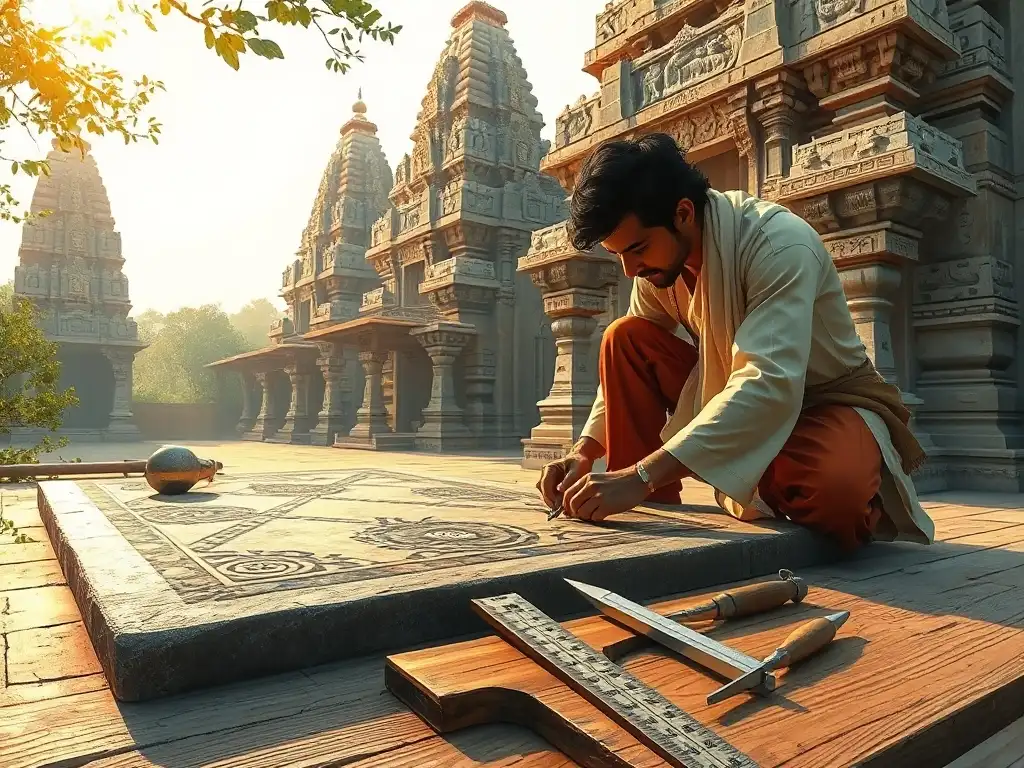
The application of geometry in ancient Indian temple architecture was not only a matter of aesthetic appeal but also an intricate process that involved sophisticated techniques and specialized tools. Builders and architects of the time meticulously employed geometric principles to ensure structural integrity, spatial harmony, and religious symbolism. The techniques used often blended art with science, allowing for the creation of magnificent temples that reflected the cultural and spiritual ethos of the time.
One of the most notable techniques was the use of proportionate ratios, derived from sacred texts, which guided the dimensions of various elements within the temple. For instance, the concept of mandala, a geometric diagram, was often utilized to lay out the temple's floor plan. This not only ensured that the structure was in harmony with cosmic principles but also facilitated a systematic approach to construction.
The tools used by ancient Indian architects were also pivotal in achieving precision. From wooden measuring rods to more advanced instruments like the shanku (a plumb line) and chakra (a circle-making tool), these implements allowed for careful measurement and alignment. Such tools were instrumental in realizing complex geometric designs that characterized temple architecture.
Measuring and Constructing: Tools of the Trade
Ancient Indian architects relied on a variety of measuring tools to achieve the precision necessary for temple construction. Among the most prominent was the shanku, a plumb bob that helped builders ensure vertical alignment. This tool was essential for maintaining the upright structure of temples, which often soared to impressive heights.
Another important tool was the danda, a straight rod used for measuring distances and angles. This tool facilitated accurate measurements, allowing architects to plot out the temple's layout effectively. Additionally, the use of ropes with knots at specific intervals helped in measuring longer distances, ensuring that the proportions of the temple adhered to prescribed geometrical ratios.
In addition to physical tools, ancient texts such as the Vāstu Shāstra provided guidelines on measurements, alignments, and proportions. This ancient science offered a comprehensive framework that integrated mathematical principles with architectural practices, ensuring that every aspect of the temple's design was intentional and meaningful.
The Role of Astronomical Alignments in Temple Design
Astronomical alignments played a crucial role in the geometric design of ancient Indian temples. Architects often oriented temples according to celestial events, such as the rising and setting of the sun, which held significant spiritual importance. For example, many temples were designed so that the first rays of the sun would illuminate the sanctum sanctorum at dawn, symbolizing the arrival of divine light.
The alignment with key celestial bodies was not merely functional; it was also deeply symbolic. Temples were often positioned to align with specific stars or constellations, linking the earthly structure to the cosmic order. This attention to astronomical detail exemplified the ancient Indian belief that architecture was a reflection of the universe itself.
Moreover, the geometric designs often included intricate carvings that depicted astronomical phenomena, further emphasizing the intertwining of geometry, architecture, and astronomy. The careful consideration of these alignments showcases the advanced understanding ancient Indians had of both geometry and the cosmos.
Conclusion: The Lasting Legacy of Geometry in Ancient Indian Temples
The legacy of geometry in ancient Indian temple architecture is profound and enduring. The precise geometric principles employed in the construction of these structures not only contributed to their aesthetic beauty but also reinforced their spiritual significance. Temples such as the Brihadeeswarar Temple in Thanjavur and the Sun Temple in Konark stand as testaments to the mastery of geometry and its application in creating spaces that resonate with the divine.
The meticulous planning and execution found in these temples reflect a sophisticated understanding of mathematical concepts that were far ahead of their time. As a result, the influence of these ancient geometric principles continues to be felt in contemporary architecture, where symmetry, proportion, and harmony remain central tenets in design.
Reflections on the Influence of Geometry in Modern Architecture
The principles of geometry that guided ancient Indian temple construction have found resonance in modern architecture. Contemporary architects often draw inspiration from these ancient designs, utilizing geometric forms to create buildings that embody harmony and balance. The emphasis on proportionate ratios and spatial organization can be seen in various modern architectural endeavors, where the aesthetic appeal is carefully balanced with functional requirements.
Moreover, the use of advanced software and modeling techniques in modern architecture has allowed for a revival of interest in ancient geometric principles. Architects today are often looking back at ancient practices to inform their designs, merging traditional wisdom with modern technology to create innovative structures that pay homage to the past.
Future Research Directions in the Study of Ancient Indian Geometry
The study of geometry in ancient Indian architecture remains a rich field for future research. Scholars are encouraged to delve deeper into the mathematical texts and architectural treatises of the time to uncover further insights into the techniques and principles that governed temple design. Interdisciplinary approaches, incorporating fields such as archaeology, astronomy, and materials science, could yield new understandings of how geometry was applied in ancient structures.
Additionally, exploring the regional variations in temple architecture across different parts of India could provide valuable context regarding local adaptations of geometric principles. Such studies can illuminate how cultural and religious factors influenced architectural choices, leading to a deeper appreciation of the diversity within ancient Indian geometry.
As scholars continue to investigate these themes, the legacy of geometry in ancient Indian temples will not only enrich our understanding of the past but also inspire future generations of architects and historians.
References and Further Reading on Geometry in Ancient Indian Temples
Exploring the role of geometry in ancient Indian temple architecture uncovers a wealth of knowledge that reflects the intricate relationship between mathematics, spirituality, and art. For those interested in delving deeper into this fascinating subject, numerous resources are available that provide comprehensive insights and analyses.
Suggested Books and Articles for Further Exploration
-
"The Temples of India: A Historical and Architectural Study" by John M. Fritz and George Michell
This book offers an in-depth analysis of various temple styles across India, highlighting the geometric principles employed in their design and construction.
-
"Indian Temple Architecture: Form and Transformation" by Adam Hardy
Hardy's work explores the evolution of temple architecture in India, with a particular focus on the geometrical patterns and proportions that define the sacred spaces.
-
"The Geometry of the Indian Temple" by K. A. Nilakanta Sastri
This article provides an insightful examination of the geometric configurations in temple layouts, drawing connections between mathematics and religious significance.
-
"Sacred Geometry in Indian Temple Architecture" by Ravi K. G.
This text investigates the spiritual meanings embedded in the geometric alignments and designs of ancient temples, emphasizing their cultural importance.
-
"Mathematics and the Indian Temple" by A. J. M. B.
This analytical paper discusses the mathematical concepts utilized in the construction of temples, including symmetry, fractals, and other geometric properties.
Online Resources for Understanding Ancient Indian Architecture
-
Digital Library of India
A rich repository of texts and manuscripts related to Indian architecture, including several works on temple design and geometry. This online resource is invaluable for researchers and enthusiasts alike.
-
The Archaeological Survey of India (ASI) Website
ASI provides detailed information about various archaeological sites, including temple architecture. The website features reports, images, and research papers that illustrate the geometric intricacies of ancient temples.
-
India's Cultural Heritage: An Interactive Online Resource
This platform offers interactive content, including 3D models of famous Indian temples, allowing users to explore the geometric structures and spatial arrangements in-depth.
-
YouTube Educational Channels
Channels such as "Ancient Indian History" and "Epic History TV" offer documentaries and discussions on temple architecture, often touching on the role of geometry in their construction.
-
Scholarly Journals
Journals like the "Journal of Asian Architecture and Building Engineering" often publish articles focusing on the architectural techniques of ancient India, including the mathematical principles that guided temple design.
By engaging with these resources, readers can deepen their understanding of how geometry influenced the grandeur and intricacy of ancient Indian temples, enriching their appreciation of this remarkable architectural heritage.
- Introduction to Geometry in Ancient Indian Temples
- Historical Context of Geometry in Temple Design
- Key Geometric Principles in Ancient Indian Temples
- Regional Variations in Geometric Applications
- Notable Examples of Geometry in Ancient Indian Temples
- The Role of Geometry in Symbolism and Spirituality
- Techniques and Tools Used in Ancient Indian Geometry
- Conclusion: The Lasting Legacy of Geometry in Ancient Indian Temples
- References and Further Reading on Geometry in Ancient Indian Temples
- What is the significance of geometry in ancient Indian temples?
- How did ancient Indian architects incorporate geometry in their designs?
- Can you give examples of temples that showcase geometry in their architecture?
- What materials were commonly used in temple construction alongside geometry?
- How does the study of geometry in ancient temples contribute to our understanding of Indian culture?
Frequently Asked Questions
What is the significance of geometry in ancient Indian temples?
Geometry played a crucial role in temple design, influencing both aesthetic appeal and spiritual significance. The precise calculations ensured structural stability and harmony.
How did ancient Indian architects incorporate geometry in their designs?
Architects utilized geometric principles such as symmetry, proportion, and spatial relationships. These elements were integral in achieving divine representation and enhancing the overall spiritual experience.
Can you give examples of temples that showcase geometry in their architecture?
Notable examples include the Kandariya Mahadeva Temple and the Brihadeeswarar Temple. Both exhibit intricate geometric patterns and layouts that reflect the mathematical precision of ancient Indian architecture.
What materials were commonly used in temple construction alongside geometry?
Ancient Indian temples were primarily built using stone, brick, and wood. The choice of materials complemented the geometric designs, contributing to the temples' durability and aesthetic quality.
How does the study of geometry in ancient temples contribute to our understanding of Indian culture?
Studying geometry in temple architecture reveals insights into ancient Indian beliefs, artistic practices, and scientific knowledge. It highlights the integration of religion, mathematics, and art in shaping Indian civilization.
Final Reflection: The Timeless Influence of Geometry in Ancient Indian Temples
The exploration of Geometry in Ancient Indian Temples reveals not only the architectural brilliance of the past but also its profound relevance in today's world. As we navigate through modernity, the intricate designs and mathematical precision found in these ancient structures remind us of the enduring connection between art, science, and spirituality. The legacy of these temples serves as a striking testament to how geometry can transcend time, influencing contemporary architecture and design in ways we are only beginning to understand.
The impact of geometry in temple architecture has profoundly shaped our cultural and social landscape, fostering a deep appreciation for the harmony between form and function. This connection to our heritage encourages us to reflect on the values embedded in these designs, such as balance, symmetry, and proportion. As the renowned architect Louis Kahn once said, "> The architecture is the thoughtful making of space." This sentiment resonates strongly when we consider how ancient Indian temples were not merely structures but sacred spaces that embodied the cosmos, inviting us to contemplate our place within it.
As we conclude this exploration, I invite you to reflect on how the principles of geometry can inspire your own life and work. Consider the ways in which balance and harmony can be integrated into your daily routines, relationships, and creative endeavors. Let the wisdom of ancient Indian temple architecture guide you in crafting spaces—both physical and metaphorical—that resonate with beauty and purpose. Embrace the lessons of the past as you build your future, and remember that geometry is not just a mathematical concept; it is a pathway to understanding the world around us.
Unveil the Secrets of Ancient Geometry in Temples!
Thank you for exploring the fascinating intersection of geometry and ancient Indian temple architecture with us! We hope you now appreciate how these timeless structures not only house spirituality but also embody mathematical elegance. Are you ready to dive deeper into this extraordinary world? Here’s how you can continue your journey:
- Join a workshop or a local class focused on architectural design to experience geometry from a fresh perspective.
- Visit a nearby temple to observe and document the intricate geometric patterns in person, then share your discoveries with friends or on social media.
- Engage with our community by sharing your thoughts below about your favorite architectural features and their geometric significance.
Which aspect of temple geometry intrigues you the most, and how do you think it reflects the rich culture of ancient India?