
The Philosophy of Space and Time in Ancient Indian Thought


Welcome to Ancient India History, where we embark on a fascinating journey through the intricate tapestry of ancient Indian civilizations. As we delve into the philosophy of space and time in ancient Indian thought, prepare to uncover how these profound concepts shaped not only the sciences but also the cultural and spiritual frameworks of the time. What insights might the sages of yore offer us about our own understanding of existence? Join us as we unravel the mysteries of ancient Indian philosophy of time, inviting you to explore the remarkable intellect and legacy of this vibrant era.

Introduction to Ancient Indian Philosophy of Time
The exploration of time and space has long fascinated scholars and philosophers, particularly in the context of ancient civilizations. Ancient Indian philosophy offers a profound perspective on these concepts, intertwining them with notions of existence, morality, and cosmic order. The ancient Indian philosophy of time is not merely a scientific inquiry; it encompasses metaphysical, spiritual, and cultural dimensions that reflect the complexities of life and the universe. This article delves into the intricate relationship between time and space as perceived by ancient Indian thinkers, emphasizing how their insights continue to influence contemporary thought.
Overview of Ancient Indian Thought
Ancient Indian thought is characterized by a rich tapestry of ideas drawn from various philosophical schools, including Vedanta, Samkhya, and Buddhism. Each of these traditions offers unique interpretations of time and space, often reflecting the broader cosmological beliefs prevalent in society. For instance, the Vedas, the oldest scriptures of Hinduism, present time as a vast and cyclical concept, embodying the eternal rhythms of creation, preservation, and destruction.
Philosophers like Buddha and Kapila contributed significantly to discussions surrounding the nature of existence and temporality. Their teachings explored the interplay of the physical and metaphysical realms, framing time not only as a measure but as a fundamental aspect of the human condition. This philosophical groundwork laid the foundation for a nuanced understanding of the universe, emphasizing the interconnectedness of all beings and the importance of ethical living within the temporal framework.
Importance of Time and Space in Indian Philosophy
In ancient Indian philosophy, time and space are not mere backdrops for human activity; they are integral to understanding dharma (righteousness) and the moral order of the universe. Time is viewed as a cyclical phenomenon, often illustrated through concepts such as yugas (epochs) and the wheel of time (kalachakra), which symbolize the ongoing cycles of life, death, and rebirth. This cyclical view contrasts sharply with the linear progression of time found in many Western philosophies.
Space, similarly, is imbued with meaning, often associated with sacred geography and the cosmic order. The ancient Indian texts describe the universe's structure, encompassing both the physical dimensions and a spiritual essence that connects all entities. Understanding time and space within this framework offers insights into the moral responsibilities individuals hold in their lives, urging them to act in harmony with the cosmos.
Key Concepts in Ancient Indian Philosophy of Time
The Nature of Time in Indian Philosophy
Ancient Indian thinkers approached time as a multifaceted concept that transcends simple measurement. Rather than being viewed solely as a linear progression of moments, time is often seen as an eternal continuum. This perspective is articulated in various philosophical texts, where time is described as an illusion (maya) that can be transcended through spiritual practice and enlightenment.
The notion of kala (time) is central, representing both the physical and metaphysical aspects of existence. It is often linked with concepts of cosmic cycles, suggesting that individual lives are but fleeting moments within a grand, eternal narrative. Thus, time becomes a canvas upon which the dramas of existence unfold, inviting individuals to engage deeply with their own lives and the universe.
Cyclical vs. Linear Time
The dichotomy between cyclical and linear time is a significant theme in ancient Indian philosophy. While many cultures view time as a straight line moving from past to future, ancient Indian traditions predominantly embrace a cyclical concept of time. This cyclical view is evident in the yugas, which delineate vast epochs of cosmic history, each characterized by distinct qualities and moral decline.
The cyclical perspective not only emphasizes the inevitability of change but also suggests that time is inherently regenerative. Life, death, and rebirth form a continuous loop, offering a profound understanding of existence and the potential for spiritual growth. This contrasts with linear time, which often implies a one-time journey toward a final goal or end state.
The Role of Dharma in the Perception of Time
In the context of ancient Indian philosophy, dharma plays a crucial role in shaping the perception of time. Dharma refers to the moral and ethical duties individuals must adhere to, which are often contextualized within their unique circumstances and the broader cosmic order. The timing of actions, the appropriateness of decisions, and the understanding of one's responsibilities are all influenced by this principle.
Philosophers posited that aligning one's actions with dharma not only fosters individual well-being but also contributes to the harmony of the universe. Consequently, the perception of time becomes intertwined with ethical living, urging individuals to consider the implications of their choices on the cyclical nature of existence. Through this lens, time is not merely a sequence of moments but a dynamic interplay of actions and consequences, intricately connected to the moral fabric of life.
The Influence of Cosmology on the Ancient Indian Philosophy of Space
Ancient Indian philosophy of space is deeply intertwined with the cosmological views that emerged from religious and metaphysical thought. The understanding of space in ancient India was not merely a physical dimension but was often seen as a reflection of the metaphysical principles governing the universe. The cosmos was perceived as a vast, interconnected web of existence where every element had its place and significance. This perspective influenced not only the philosophical discourse but also the practical applications in fields like astronomy, mathematics, and architecture.
Cosmology in ancient India served as a framework within which philosophers explored the nature of reality, existence, and the relationship between the individual and the cosmos. The philosophical inquiries into space were often accompanied by reflections on time, leading to a holistic understanding of the universe. The ancient texts, particularly the Vedas and Upanishads, provide insights into how these concepts shaped the intellectual landscape of the period.
Vedic Cosmology and Spatial Understanding
Vedic cosmology, as outlined in the Rigveda and later texts, presented a universe characterized by a vast and complex structure. The idea of 'Vaastu', or spatial arrangement, is crucial in Vedic texts, reflecting a deep understanding of how space affects human life and spiritual practice. The cosmos was viewed as layered, with different realms such as the physical world (Prithvi), the atmospheric realm (Antariksha), and the celestial sphere (Swarga).
In Vedic thought, space was not an empty void but filled with divine energy and consciousness. The concept of 'Akasha' (ether) held special significance, indicating a medium through which sound and other forms of energy travel. This metaphysical understanding of space influenced various aspects of life, including rituals, architecture, and even the layout of settlements. The meticulous design of temples and cities often reflected the cosmic order as perceived by the ancient Indians, creating spaces that resonated with spiritual significance.
The Concept of Brahman and Cosmic Space
The philosophical notion of Brahman is pivotal in understanding ancient Indian thought regarding both space and time. Brahman is considered the ultimate reality, transcending all dualities and existing beyond the physical universe. It embodies the essence of everything that exists and is often equated with infinite space.
In the Upanishads, Brahman is described as 'Satyam' (truth), 'Jnanam' (knowledge), and 'Anantam' (infinite), reflecting the belief that true understanding transcends physical dimensions. The relationship between Brahman and space suggests that the cosmos is a manifestation of this ultimate reality, where space serves as a canvas for the play of creation, preservation, and dissolution. This perspective allows for a profound philosophical exploration of existence, emphasizing that the understanding of space is interlinked with the comprehension of the entire cosmos and its underlying principles.
Major Philosophical Schools and Their Views on Time
Different philosophical schools in ancient India presented varied interpretations of time, each contributing to a rich tapestry of thought. The views on time were not monolithic; rather, they encompassed a spectrum of ideas that reflected the complexities of existence and the human experience.
Samkhya Philosophy and Time
Samkhya philosophy, one of the oldest systems of Indian thought, posits a dualistic framework that distinguishes between Purusha (consciousness) and Prakriti (matter). In this context, time is perceived as a linear progression governed by the transformations of Prakriti, with cycles of creation and dissolution. The Samkhya view emphasizes that while time is real, it operates within the realm of Prakriti and is thus subject to change and impermanence.
Time is classified into three aspects: past, present, and future. The Samkhya system regards the present moment as the only reality, with the past being a memory and the future an anticipation. This perspective invites individuals to focus on the present, acknowledging its significance while understanding the transient nature of existence.
Advaita Vedanta's Perspective on Time and Space
Advaita Vedanta offers a non-dualistic interpretation of reality, asserting that only Brahman is real, while the phenomenal world, including time and space, is illusory (Maya). In this view, time is not an absolute entity but a relative experience shaped by human consciousness. The past, present, and future are seen as constructs of the mind, with the ultimate truth lying beyond temporal constraints.
From the Advaita perspective, realizing the oneness of Brahman transcends the limitations of time and space, leading to liberation (Moksha). This philosophical stance encourages practitioners to meditate on the nature of reality, allowing them to experience a state beyond the dualities of time and space, fostering a deeper understanding of existence as an eternal present.
Buddhist Views on Time and Impermanence
Buddhism, with its foundational teaching of impermanence (Anicca), presents a unique perspective on time. According to Buddhist philosophy, all phenomena are in a constant state of flux, and nothing remains the same over time. This understanding leads to the acknowledgment that clinging to transient experiences only leads to suffering (Dukkha).
In Buddhism, time is often viewed cyclically, encapsulated in the concept of Samsara, the cycle of birth, death, and rebirth. This cyclical view emphasizes the importance of mindfulness and living in the present moment, as each moment is an opportunity for awakening and liberation. By understanding the impermanent nature of existence, individuals can cultivate a deeper appreciation for life and reduce attachment to the past and future, ultimately leading to enlightenment.
Contributions of Ancient Indian Mathematicians to the Understanding of Time
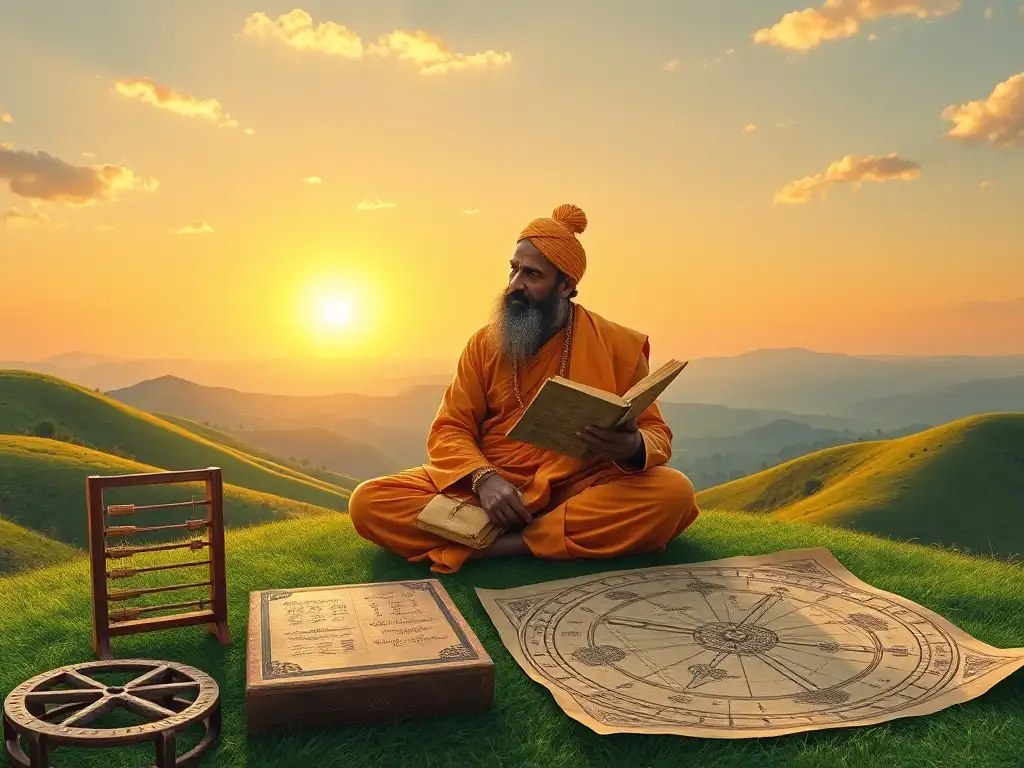
Ancient Indian mathematicians made significant strides in the understanding and measurement of time, laying foundational principles that influenced not only Indian thought but also the broader field of mathematics and astronomy. Their work encompassed various theories and methodologies, which were intricately tied to their philosophical views on the cosmos. The precision in measuring time was paramount, as it was essential for various rituals, agricultural activities, and astronomical observations.
Mathematicians like Aryabhata and Brahmagupta introduced concepts and techniques that were revolutionary for their time. They developed intricate calendars that accounted for solar and lunar cycles, leading to more accurate predictions of celestial events. The advances in time measurement were not merely practical; they also reflected a deeper philosophical understanding of the universe, suggesting an interconnectedness between time, space, and the cosmos.
Aryabhata's Work on Time Measurement
Aryabhata, one of the most renowned mathematicians and astronomers of ancient India, made pivotal contributions to the philosophy of time. In his seminal work, the Aryabhatiya, he presented a systematic approach to time measurement, emphasizing the need for precision. Aryabhata introduced the concept of "yuga," which referred to a large cycle of time. He calculated the length of the year to be 365.358 days, a remarkably accurate figure for his era.
His methods for calculating time included the use of astronomical observations to determine the positions of celestial bodies, which were crucial for understanding the passage of time. Aryabhata’s work established a framework for later scholars and influenced the development of astronomical instruments in India. His philosophical insights positioned time as a cyclical concept, integral to the laws governing the universe.
The Concept of Zero and Its Impact on Time Calculations
The introduction of the concept of zero by ancient Indian mathematicians was a groundbreaking advancement that fundamentally changed mathematical calculations, including those related to time. The numeral system developed in ancient India, which included zero, allowed for more complex calculations and a better understanding of the decimal system.
This innovation facilitated advancements in astronomical calculations, enabling mathematicians to perform intricate time-related computations with greater accuracy. For instance, the use of zero in equations allowed scholars to express large intervals of time and make precise astronomical predictions. The ability to represent time mathematically with clarity and precision laid the groundwork for future developments in mathematics and science, influencing various civilizations across the globe.
The Relationship Between Astronomy and the Ancient Indian Philosophy of Time
In ancient India, astronomy was closely intertwined with the philosophy of time. The movements of celestial bodies were not only observed for practical purposes but were also seen as a reflection of cosmic cycles that governed life on Earth. Ancient Indian thought posited that time was both cyclical and linear, with various philosophical schools offering differing interpretations of its nature.
Astronomical phenomena were linked with timekeeping and were essential for various religious and cultural practices. The meticulous observation of celestial events allowed scholars to create calendars that were significant for both agricultural cycles and spiritual rituals, reinforcing the belief that time was a divine element influencing human existence.
Celestial Bodies and Their Influence on Time
Celestial bodies played a crucial role in ancient Indian concepts of time. The movements of the sun, moon, and planets were meticulously recorded, and their cycles formed the basis for the Hindu calendar. The ancient Indian philosophy viewed these celestial bodies as manifestations of divine order, influencing not just timekeeping but also human behavior and societal organization.
For instance, the lunar phases were essential for determining auspicious timings for various religious ceremonies. The idea of "muhurta," a specific moment deemed favorable for action, was deeply rooted in the observations of celestial movements. Thus, the relationship between celestial phenomena and time underscores the ancient Indian belief in the harmony of the universe and its impact on earthly affairs.
Astrological Implications of Time in Ancient India
Astrology in ancient India was fundamentally linked to the philosophy of time. It was believed that the positions of celestial bodies at the time of a person's birth influenced their life path and personality. This belief system, known as Jyotisha, integrated astronomy and astrology, providing a framework for interpreting time in a mystical context.
Astrologers meticulously calculated planetary positions and their movements to create horoscopes, which were used to make predictions about future events. The cyclical nature of time in Hindu philosophy was reflected in astrological practices, where periods known as "dashas" represented different phases in an individual's life, each associated with specific planetary influences. The profound connection between time and astrology indicates a holistic understanding of existence, where time was not just a linear measure but a complex interplay of cosmic forces shaping human destiny.
Conclusion: Legacy of Ancient Indian Philosophy of Time
The ancient Indian philosophy of time represents a profound journey into understanding the nature of existence, reality, and the cosmos. Rooted in texts like the Vedas and the Upanishads, this philosophy offers a unique perspective that diverges significantly from Western conceptions of linear time. Ancient Indian thinkers perceived time not merely as a chronological sequence but as a cyclical concept deeply intertwined with the cycles of nature, life, and consciousness.
This rich philosophical legacy has laid the groundwork for various fields, including astronomy, mathematics, and metaphysics, influencing not only Indian but also global philosophical traditions. The intricate relationship between time and space as explored in ancient Indian thought continues to resonate, providing insights into the nature of reality, the self, and the universe. As modern science grapples with concepts such as relativity and quantum mechanics, the ideas embedded in ancient Indian philosophy invite a reevaluation of how we perceive and understand time.
Continued Relevance in Modern Thought
The ancient Indian philosophy of time remains relevant in contemporary discussions, particularly in areas such as metaphysics, ethics, and the philosophy of science. Modern philosophers and scientists are increasingly recognizing the value of cyclical time concepts in understanding ecological cycles, human behavior, and even technological advancements. The emphasis on interconnectedness and the holistic view of time fosters a deeper appreciation for sustainability and the environment in today’s fast-paced world.
In fields like psychology and cognitive science, the ancient insights into human perception of time and its subjective experience have become crucial. The understanding that time may not be perceived uniformly opens avenues for research into how cultural contexts shape our experience of temporality, resulting in a richer discourse on well-being and mental health.
Influence on Contemporary Philosophical Discussions
The discussions surrounding the philosophy of time in ancient India have influenced a variety of contemporary philosophical dialogues. Scholars engaged in comparative philosophy often draw parallels between the cyclical view of time in ancient India and the theories of time proposed by modern physicists such as Albert Einstein and Julian Barbour. The exploration of simultaneity, the nature of past and future, and the reality of present moments echo the ancient debates found in texts like the Bhagavad Gita and the Samkhya philosophy.
Moreover, the philosophical implications of dharma (duty/righteousness) and karma (action and its consequences) provide a framework for contemporary ethical considerations. These concepts encourage a reflection on the temporality of human actions and their ripple effects through time, reinforcing the idea that our choices are not isolated but part of a larger cosmic order.
References
Key Texts on Ancient Indian Philosophy of Time
- Vedas: The foundational texts of Hinduism, which contain hymns and philosophical discussions on the nature of existence and time.
- Upanishads: Philosophical treatises that delve into the concepts of time, space, and the self, often discussing the eternal nature of reality.
- Bhagavad Gita: A crucial text that explores the nature of duty and action in relation to time and the cycles of life.
- Samkhya Sutras: Texts that outline the dualistic framework of reality, emphasizing the interplay between purusha (consciousness) and prakriti (matter) over time.
Suggested Readings for Further Exploration
- "Time and Eternity: The Quest for the Ultimate Reality" by Swami Sivananda: This book examines the concept of time in relation to the eternal nature of the soul from a spiritual perspective.
- "The Indian Philosophy of Time" by Richard G. H. B. P.: An analytical work that compares ancient Indian views on time with Western philosophies.
- "Cycles of Time: An Extraordinary New View of the Universe" by Julian Barbour: Although not exclusively about ancient Indian philosophy, this book discusses concepts of time that resonate with the cyclical views found in ancient Indian thought.
- "The Origins of Time: A Philosophical Inquiry" by M. M. Sharma: This text offers a deeper understanding of the philosophical inquiries surrounding the concept of time in various cultures, including ancient India.
- Introduction to Ancient Indian Philosophy of Time
- Key Concepts in Ancient Indian Philosophy of Time
- The Influence of Cosmology on the Ancient Indian Philosophy of Space
- Major Philosophical Schools and Their Views on Time
- Contributions of Ancient Indian Mathematicians to the Understanding of Time
- The Relationship Between Astronomy and the Ancient Indian Philosophy of Time
- Conclusion: Legacy of Ancient Indian Philosophy of Time
- References
- What is the significance of time in ancient Indian philosophy?
- How did ancient Indian thinkers perceive the relationship between space and time?
- What are the key texts that discuss the philosophy of time in ancient India?
- How does the ancient Indian philosophy of time compare to Western philosophies?
- What contributions did ancient Indian civilizations make to our understanding of time?
Frequently Asked Questions
What is the significance of time in ancient Indian philosophy?
Time is seen as a cyclical concept in ancient Indian philosophy, emphasizing the interconnectedness of past, present, and future, and is often linked to cosmic rhythms.
How did ancient Indian thinkers perceive the relationship between space and time?
Ancient Indian thinkers viewed space and time as interdependent, with each influencing the other, reflecting a holistic understanding of the universe and existence.
What are the key texts that discuss the philosophy of time in ancient India?
Key texts include the Vedas, Upanishads, and the Mahabharata, which contain profound insights into the nature of time and its impact on life and existence.
How does the ancient Indian philosophy of time compare to Western philosophies?
While Western philosophies often view time as linear, ancient Indian philosophy embraces a cyclical understanding, reflecting on reincarnation and eternal cosmic cycles.
What contributions did ancient Indian civilizations make to our understanding of time?
Ancient Indian civilizations contributed significantly to the mathematical and astronomical understanding of time, developing concepts such as zero, calendars, and the measurement of celestial bodies.
Final Reflection: Embracing the Depths of Ancient Indian Philosophy of Time
The exploration of the ancient Indian philosophy of time reveals profound insights that resonate deeply with our contemporary understanding of existence. In an age where the relentless pace of life often overshadows the essence of time, the teachings from ancient Indian thought remind us to pause and reflect. The intricate relationship between time and consciousness, as articulated by sages, invites us to reconsider how we perceive our own temporal experiences and the impact they have on our lives.
The ancient Indian philosophy of time has not only shaped spiritual practices but has also influenced modern discussions on the nature of reality and existence. This philosophical framework encourages us to view time not merely as a linear progression but as a cyclical phenomenon, rich with meaning and interconnectedness. As the philosopher J. Krishnamurti once said, The moment you take the position that you know, you are already in conflict.
This perspective challenges us to embrace uncertainty and to appreciate the fluidity of time, fostering a deeper connection with the present moment.
As we conclude this journey through ancient Indian thought, I invite you to reflect on your own relationship with time. Consider how the lessons of patience, mindfulness, and cyclical existence can enrich your daily life. Let the wisdom of the ancients inspire you to cultivate a more profound awareness of the present, allowing you to navigate the complexities of modern existence with grace and insight. Embrace the timeless teachings of the past, and let them guide you toward a more harmonious understanding of your place within the vast tapestry of time.
Unveil the Wisdom of Space and Time!
Thank you for exploring the rich philosophy of space and time in ancient Indian thought! You’ve uncovered profound insights into how these concepts shaped societal beliefs and practices. Now, let’s take your journey further by engaging with this timeless wisdom.
- Dive Deeper: Explore specific texts, such as the Upanishads or the Bhagavad Gita, to discover how these philosophies can be applied to contemporary life.
- Share Your Thoughts: Engage with us on social media or in the comments section—your perspective could inspire others!
- Join the Community: Become part of forums or groups that focus on ancient philosophies, where you can connect with others who share your interests.
What new understanding or perspective do you think ancient Indian philosophy can contribute to today’s discussions on space and time?