
Buddhism - Teachings and Spread
Buddhism - Teachings and Spread
63 articles in this topic
Read more about this topic
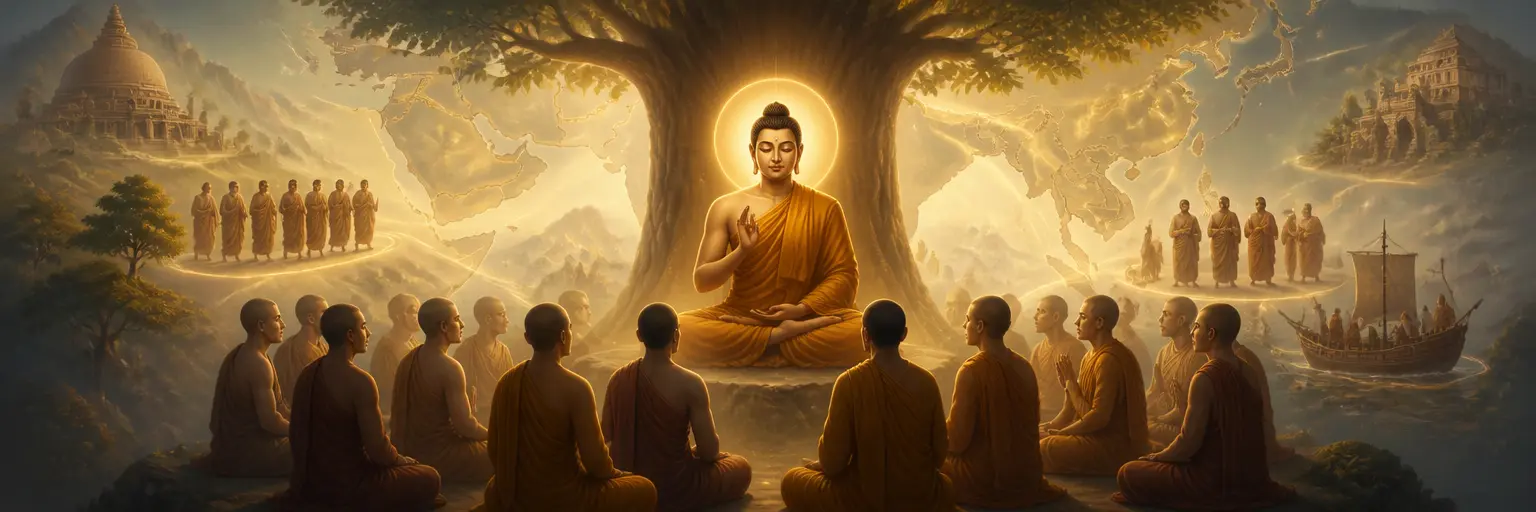
Explore Buddhism’s teachings and spread across ancient India, from the Buddha’s Four Noble Truths and Eightfold Path to the growth of monastic communities and influential centers of learning. Discover how missionaries, trade routes, royal patronage, and Emperor Ashoka helped carry Buddhist philosophy, art, and culture throughout Asia, shaping one of the world’s most influential religions.
More in Buddhism - Teachings and Spread
Buddhism - Teachings and Spread
The Impact of Ashoka the Great: How a Ruler Propagated Buddhism

Buddhism - Teachings and Spread
The Influence of Buddhism on Martial Arts: Philosophy in Motion

Buddhism - Teachings and Spread
The Relationship Between Buddhism and Hinduism: A Complex Interplay
Buddhism - Teachings and Spread
The Role of Meditation in Buddhism: Insights from Ancient Practices
Buddhism - Teachings and Spread
The Teachings of Theravada Buddhism: A Closer Look at the Elders’ Path
Buddhism - Teachings and Spread
The Historical Figures Who Shaped Buddhism: Leaders and Innovators

Buddhism - Teachings and Spread
The Historical Impact of Buddhism on Southeast Asia: A Cultural Exchange
Buddhism - Teachings and Spread
The Role of Sacred Texts in Buddhism: From Tripitaka to Sutras
Buddhism – Teachings and Spread 🪷
Explore the origins, philosophy, teachings, and global spread of Buddhism within the broader history of Ancient Indian Religions. This subcategory examines how Siddhartha Gautama, the Buddha, inspired a major religious and intellectual tradition in ancient India, as well as how Buddhist ideas, institutions, art, and literature reached regions across Asia. Discover accessible explanations of Buddhist doctrine, the historical development of the sangha, and the lasting influence of Buddhism on Indian civilization and world history.
🌿 The Life and Enlightenment of the Buddha
Learn about Siddhartha Gautama, traditionally known as the Buddha, and the historical setting in which Buddhism emerged. Articles explore his early life, renunciation, meditation, enlightenment at Bodh Gaya, first sermon at Sarnath, and final passing into parinirvana. Understanding the Buddha’s life provides essential context for the development of Buddhist teachings and the religious changes taking place in ancient India.
Readers can also examine important places associated with the Buddha, including Lumbini, Bodh Gaya, Sarnath, and Kushinagar. These sacred sites became central destinations for pilgrims and helped shape the geography of Buddhist history. Expect clear discussions of traditional accounts, historical evidence, and the cultural significance of the Buddha’s journey.
📜 Core Buddhist Teachings and Philosophy
Discover the foundational principles of Buddhism, including the Four Noble Truths, the Noble Eightfold Path, the Middle Way, karma, rebirth, impermanence, suffering, and non-self. This section explains how Buddhist philosophy addresses the causes of dissatisfaction and presents ethical conduct, meditation, and wisdom as a path toward liberation.
Articles also introduce key concepts such as nirvana, mindfulness, compassion, dependent origination, and the five aggregates. Whether you are studying Buddhism for school, researching ancient Indian philosophy, or seeking a deeper understanding of Buddhist thought, these resources present complex ideas in a structured and approachable way.
🧘 The Sangha, Monastic Life, and Buddhist Communities
Explore the formation of the Buddhist sangha, the community of monks and nuns established to preserve and practice the Buddha’s teachings. Learn about the Vinaya, the rules governing monastic discipline, and the relationship between religious specialists and lay followers. Monastic institutions played a crucial role in preserving Buddhist scriptures, education, and traditions throughout ancient India.
This section also examines Buddhist monasteries, stupas, pilgrimage networks, and centers of learning. Institutions such as Nalanda demonstrate how Buddhism supported advanced study in philosophy, medicine, grammar, logic, and literature. Readers can discover how monasteries functioned as spiritual centers, educational institutions, and important links in long-distance cultural exchange.
🏛️ Ashoka and the Expansion of Buddhism
Learn how Emperor Ashoka of the Mauryan Empire became one of the most influential patrons of Buddhism. Following the Kalinga War, Ashoka promoted dhamma through inscriptions, public works, moral principles, and support for Buddhist communities. His rock and pillar edicts provide valuable evidence for the religious, political, and social history of ancient India.
Articles explore Ashoka’s role in supporting Buddhist missions beyond the Indian subcontinent, including traditions connected with Sri Lanka, Central Asia, and other parts of Asia. Ashoka’s patronage helped transform Buddhism from a regional movement into an important international religion, while also demonstrating the relationship between ancient Indian kingship, ethics, and religious institutions.
🌏 The Spread of Buddhism Across Asia
Trace the movement of Buddhism from northern India to Sri Lanka, Central Asia, China, Korea, Japan, Southeast Asia, Tibet, and beyond. Discover how merchants, monks, missionaries, travelers, and rulers contributed to the transmission of Buddhist teachings along land and maritime trade routes. This global history highlights the connections between religion, commerce, diplomacy, and cultural exchange.
Readers can compare the development of major Buddhist traditions, including Theravada, Mahayana, and Vajrayana. The spread of Buddhism also encouraged the translation of scriptures, the creation of new artistic styles, and the construction of temples, stupas, caves, and monasteries. These resources explain how Buddhism adapted to different societies while preserving central principles.
🎨 Buddhist Art, Architecture, and Literature
Discover the artistic and architectural achievements associated with Buddhism in ancient India. Topics may include stupas, relic worship, railings, gateways, cave temples, sculptures, and the development of Buddha images in the Gandhara and Mathura traditions. Buddhist art offers important visual evidence for understanding religious beliefs, devotional practices, and cultural interaction.
Explore Buddhist literary traditions, including the Tripitaka, Jataka stories, Sanskrit sutras, commentaries, inscriptions, and travel accounts. These sources reveal how Buddhist teachings were preserved, interpreted, and communicated to diverse audiences. Readers can also learn how Buddhist narratives influenced Indian literature, moral storytelling, education, and regional artistic traditions.
⚖️ Buddhist Schools, Councils, and Historical Development
Examine the emergence of different Buddhist schools and the debates that shaped the religion after the Buddha’s death. Buddhist councils, scriptural collections, and philosophical discussions helped communities define doctrine, discipline, and authority. This section provides historical background on the early development of Buddhist traditions without treating Buddhism as a single, unchanging system.
Learn how evolving interpretations contributed to the rise of Nikaya traditions, Theravada, Mahayana, and Vajrayana Buddhism. Articles may discuss influential thinkers, major texts, meditation systems, and changing devotional practices. Studying Buddhist diversity reveals the adaptability and intellectual richness of one of ancient India’s most influential religious traditions.
❓ Frequently Asked Questions About Buddhism – Teachings and Spread
What are the main teachings of Buddhism?
The main teachings of Buddhism include the Four Noble Truths and the Noble Eightfold Path. Buddhism teaches that suffering and dissatisfaction arise from craving and attachment, and that ethical conduct, meditation, and wisdom can lead toward liberation and nirvana.
Where did Buddhism begin?
Buddhism began in the northeastern regions of the Indian subcontinent during the fifth or sixth century BCE, traditionally associated with Siddhartha Gautama. Important locations include Lumbini, Bodh Gaya, Sarnath, and Kushinagar.
How did Buddhism spread beyond India?
Buddhism spread through the work of monks, merchants, missionaries, pilgrims, and rulers. Emperor Ashoka played an important role in supporting Buddhist missions, while trade routes connected India with Sri Lanka, Central Asia, China, Southeast Asia, Tibet, Korea, and Japan.
What role did Ashoka play in the spread of Buddhism?
Ashoka supported Buddhist institutions and promoted ethical principles through inscriptions placed across his empire. He encouraged missions, pilgrimage, public welfare, and the preservation of dhamma, helping Buddhism develop into a major transregional religion.
What is the difference between Theravada, Mahayana, and Vajrayana Buddhism?
Theravada, Mahayana, and Vajrayana are major Buddhist traditions that developed in different historical and cultural contexts. They share core Buddhist principles but differ in scriptures, philosophical interpretations, devotional practices, meditation methods, and views of the bodhisattva ideal.