
Deciphering Ancient Scripts
Deciphering Ancient Scripts
40 articles in this topic
Read more about this topic
Unlock the secrets of ancient India 🔍 Explore the art and science of deciphering ancient scripts, from enigmatic inscriptions to early writing systems that illuminate the lives, beliefs, languages, and achievements of past civilizations. Discover how epigraphists interpret symbols, compare linguistic patterns, and piece together historical evidence from the Indus Valley, Mauryan, and Gupta periods—bringing India’s remarkable written heritage to life.
More in Deciphering Ancient Scripts
Deciphering Ancient Scripts
The Influence of Ancient Indian Scripts on Modern Languages
Deciphering Ancient Scripts
The Mysteries of the Indus Script: Theories and Controversies

Deciphering Ancient Scripts
The Role of Digital Humanities in Deciphering Ancient Indian Scripts
Deciphering Ancient Scripts
How Inscriptions Documented the Rise and Fall of Dynasties
Deciphering Ancient Scripts
Inscriptions as Historical Documents: Validating Ancient Narratives
Deciphering Ancient Scripts
The Legacy of Ancient Inscriptions: Preservation and Modern Relevance
Deciphering Ancient Scripts
Unraveling the Mysteries: The Significance of Ancient Indian Scripts
Deciphering Ancient Scripts
Decoding Brahmi: The Script That Shaped Indian History
🔍 Deciphering Ancient Scripts: Unlocking India’s Written Past
Welcome to Deciphering Ancient Scripts, a specialized subcategory within Inscriptions and Epigraphy at Ancient India History. Explore how scholars interpret the symbols, languages, writing systems, and engraved records that preserve the history of ancient Indian civilizations. From the Indus Valley script and Brahmi inscriptions to Kharosthi, Tamil-Brahmi, Sanskrit, Prakrit, and early regional scripts, this section explains the methods used to read, translate, date, and understand India’s earliest written sources. Discover how epigraphists, linguists, archaeologists, and historians reconstruct political, religious, social, and economic life through ancient Indian inscriptions.
🪨 Understanding Ancient Indian Writing Systems
Readers can expect clear explanations of the major writing systems associated with ancient India, including Brahmi script, Kharosthi script, Tamil-Brahmi, Gupta script, and other regional forms. Articles examine the shapes of letters, changes in writing styles, writing materials, regional variations, and the relationship between scripts and historical languages such as Prakrit, Sanskrit, and early Tamil.
This section also explains why deciphering a script requires more than recognizing individual symbols. Researchers compare inscriptions, examine repeated patterns, study historical context, and identify connections between language and script. These insights help readers understand how writing developed across the Indian subcontinent and how ancient scripts influenced later South Asian writing traditions.
📜 The Indus Valley Script and Its Unsolved Mystery
Explore the evidence surrounding the Indus Valley script, one of the most intriguing undeciphered writing systems in world history. Discussions cover seals, pottery marks, tablets, inscriptions, sign sequences, archaeological discoveries, and the debate over whether the symbols represent a complete writing system, a symbolic tradition, or another form of communication.
Readers will also learn about the major challenges facing attempts to decode the Indus signs, including the short length of inscriptions, the absence of a bilingual inscription, uncertainty about the underlying language, and the limited number of surviving examples. This balanced approach distinguishes established archaeological evidence from speculative claims about Indus script decipherment.
🏛️ Brahmi, Kharosthi, and the Rise of Historical Records
Discover how the decipherment of Brahmi and Kharosthi transformed the study of ancient Indian history. Articles explain the importance of early inscriptions, including the edicts associated with Emperor Ashoka, and show how their interpretation revealed information about Mauryan administration, Buddhism, ethics, governance, and communication across a vast empire.
The subcategory also examines the methods used to identify ancient letters and connect inscriptions with known languages. Comparisons between scripts, coins, manuscripts, rock edicts, pillar inscriptions, and later historical records demonstrate how scholars established reliable readings and built chronological frameworks for ancient India.
🧠 Methods Used to Decipher Ancient Inscriptions
Learn how epigraphists and historians approach the decipherment of ancient scripts. Key methods include identifying recurring signs, comparing bilingual or multilingual inscriptions, analyzing grammatical patterns, studying phonetic values, dating letter forms, and comparing inscriptions with coins and manuscripts. Palaeography, the study of ancient handwriting and letter development, plays a central role in this process.
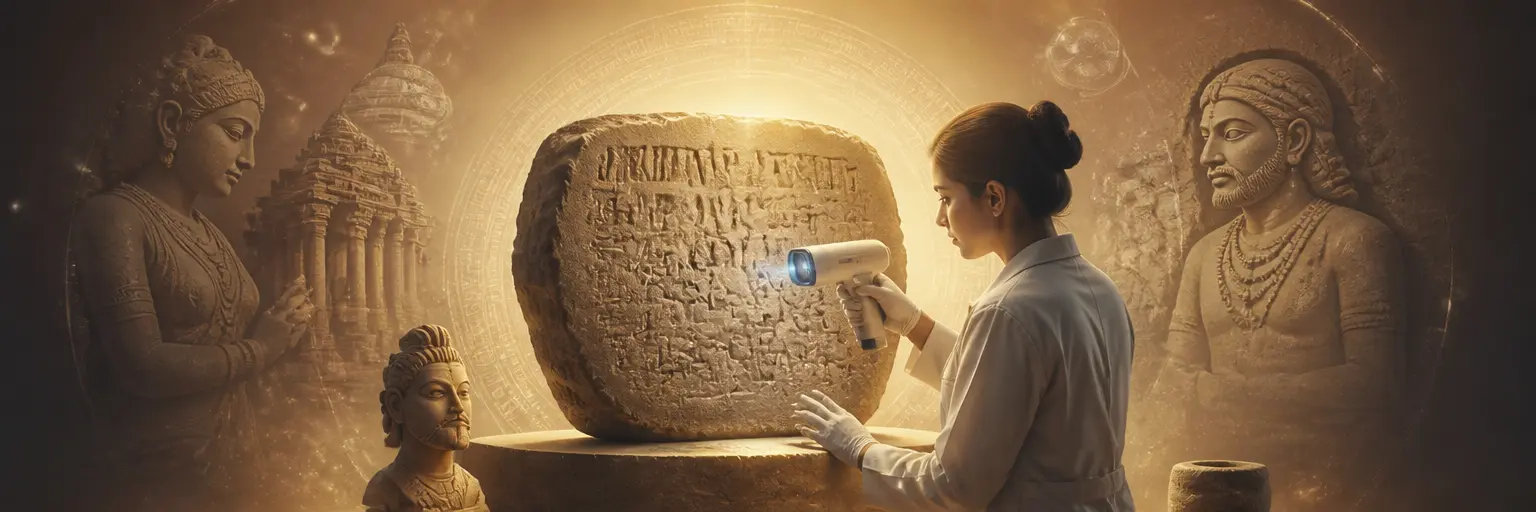
Modern research also uses digital photography, 3D scanning, infrared imaging, geographic information systems, and computational analysis to examine damaged or weathered inscriptions. These tools can reveal faint marks and support more accurate readings while allowing scholars to preserve, share, and study inscriptions without repeatedly handling fragile monuments.
🗣️ Languages Behind Ancient Indian Scripts
Ancient Indian scripts were used to record several languages, and understanding this relationship is essential for accurate interpretation. Explore the roles of Prakrit inscriptions, Classical Sanskrit, Pali, Tamil, and other early languages in religious texts, royal proclamations, donations, administrative records, and memorial inscriptions.
Readers can expect explanations of how the same script could represent different languages and how language changes help historians date and interpret an inscription. Articles also consider spelling variations, regional pronunciation, loanwords, grammatical forms, and the influence of political and religious communities on the development of written language.
👑 Royal Edicts, Religious Records, and Everyday Voices
Deciphered inscriptions provide valuable evidence about rulers, dynasties, temples, monasteries, land grants, taxation, trade, warfare, social groups, and religious practices. This section explores how inscriptions associated with the Mauryas, Satavahanas, Kushans, Guptas, Cholas, Pallavas, and other ancient Indian powers reveal the organization and priorities of their societies.
Beyond royal monuments, readers will discover records created by merchants, guilds, monks, donors, officials, and local communities. Everyday inscriptions on caves, pottery, coins, sculptures, and boundary stones can illuminate personal names, occupations, family relationships, economic networks, and regional cultural traditions often absent from literary sources.
🧭 Dating, Translating, and Verifying Ancient Texts
Deciphering an inscription is only the first stage of historical analysis. Researchers must determine its date, location, authorship, purpose, and reliability. Articles explain how scholars use letter styles, rulers’ names, regnal years, archaeological layers, associated monuments, coin evidence, and references to known historical events to establish a credible chronology.
Translation also requires careful attention to context. A single word may carry political, religious, legal, or cultural meanings that cannot be understood through a literal translation alone. Readers will learn why critical editions, alternative readings, damaged characters, uncertain interpretations, and transparent scholarly notes are important when studying ancient Indian epigraphy.
❓ Frequently Asked Questions About Deciphering Ancient Scripts
What does deciphering an ancient script mean?
Deciphering an ancient script means identifying the symbols, determining their sound or meaning, understanding the language they represent, and translating the complete inscription. Scholars use repeated patterns, known languages, bilingual texts, archaeological context, and comparisons with related scripts. Decipherment may produce a confident reading, a partial interpretation, or a carefully stated hypothesis.
Which ancient Indian script was first successfully deciphered?
Brahmi was among the most important ancient Indian scripts to be successfully deciphered in the nineteenth century, largely through the study of inscriptions connected with Ashoka. Its interpretation made it possible to read many Mauryan and later records. Kharosthi was also deciphered through comparative evidence, especially coins and inscriptions from northwestern India.
Has the Indus Valley script been deciphered?
The Indus Valley script remains undeciphered by mainstream scholarship. Researchers have proposed different interpretations, but no reading has achieved broad academic acceptance. The short inscriptions, uncertain underlying language, lack of a bilingual inscription, and limited evidence make the Indus script especially difficult to interpret.
Why are inscriptions important for studying ancient India?
Inscriptions are primary historical sources that provide direct evidence about rulers, political authority, religious traditions, land donations, trade, social organization, languages, and regional cultures. Unlike many later literary texts, inscriptions can be linked to specific places, monuments, and historical contexts, making them essential for reconstructing ancient Indian history.
How do modern technologies help decipher ancient inscriptions?
Modern technologies such as high-resolution photography, digital epigraphy, 3D scanning, multispectral imaging, and computer-assisted analysis help researchers examine worn, damaged, or difficult-to-access inscriptions. These tools can reveal faint characters, preserve accurate records, compare letter forms, and support collaboration between epigraphists, archaeologists, historians, and linguists.