

Historical Significance of Inscriptions

Historical Significance of Inscriptions
42 articles in this topic
Start here
- Historical Significance of InscriptionsFrom Ashoka to the Gupta: The Continuity of Inscriptions Across Dynasties
- Historical Significance of InscriptionsInscriptions as a Catalyst for Cultural Exchange in Ancient India
- Historical Significance of InscriptionsThe Interplay of Politics and Religion in Ancient Indian Inscriptions
Read more about this topic
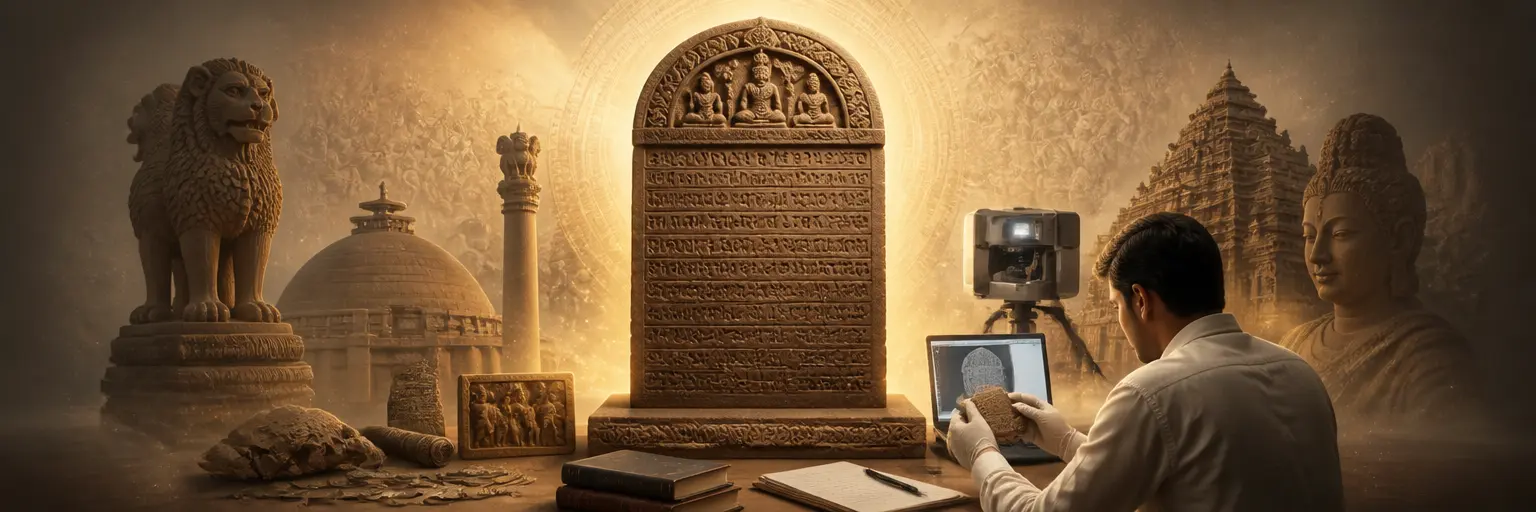
Discover how ancient inscriptions reveal India’s past through royal edicts, religious teachings, social customs, and everyday life. Explore the historical significance of inscriptions in tracing dynasties, languages, trade, administration, and cultural exchange—from the Indus Valley to the Gupta Empire. These enduring records offer invaluable insights into ancient Indian history, epigraphy, archaeology, and civilization, bringing forgotten voices and historic achievements to life.
More in Historical Significance of Inscriptions
Historical Significance of Inscriptions
The Archaeological Impact of Inscriptions: Discoveries That Changed Our Understanding of Ancient India
Historical Significance of Inscriptions
Inscriptions and Identity: How They Shaped the SelfPerception of Ancient Indian Societies
Historical Significance of Inscriptions
The Challenges of Translating and Interpreting Ancient Indian Inscriptions

Historical Significance of Inscriptions
The Significance of Inscriptions in Trade and Commerce in Ancient India
Historical Significance of Inscriptions
The Preservation of Culture: How Inscriptions Serve as Historical Narratives
Historical Significance of Inscriptions
Inscriptions as Time Capsules: What They Reveal About Ancient Indian Society

Historical Significance of Inscriptions
Inscriptions as a Reflection of Gender Roles in Ancient Indian Society
Historical Significance of Inscriptions
The Significance of Inscriptions in Documenting Ancient Indian Festivals and Rituals
Historical Significance of Inscriptions in Ancient India
Explore how inscriptions preserve the political, religious, social, and cultural history of ancient India. Within Inscriptions and Epigraphy, this subcategory examines rock edicts, pillar inscriptions, copper-plate grants, temple records, seals, and other archaeological sources that reveal the development of Indian civilization from the Indus Valley Civilization to the Gupta Empire and beyond. Discover how epigraphic evidence helps historians reconstruct dynasties, understand ancient languages, trace administrative systems, and interpret the beliefs and everyday lives of past communities.
🏛️ Inscriptions as Primary Sources of Ancient Indian History
Inscriptions are among the most valuable primary sources for ancient Indian history. Engraved on stone, metal, pottery, walls, pillars, and monuments, they often provide direct evidence about rulers, officials, religious institutions, land ownership, taxation, military achievements, and public works. Unlike later literary traditions, inscriptions were frequently created during or close to the events they describe.
Readers can learn how historians use epigraphic evidence to verify royal genealogies, establish dates, identify historical places, and compare inscriptions with texts, coins, and archaeological remains. This approach makes inscriptions essential for understanding the rise of kingdoms, the expansion of empires, and the changing political landscape of ancient India.
👑 Royal Inscriptions, Dynasties, and Political Power
Royal inscriptions offer important information about the Mauryas, Satavahanas, Kushanas, Guptas, Chalukyas, Pallavas, Cholas, and other Indian dynasties. Rulers used inscriptions to record victories, proclaim laws, announce donations, define territories, and present ideals of kingship. The edicts of Ashoka, for example, provide firsthand evidence of Mauryan administration, dhamma, and imperial communication.
This section explores how inscriptions shaped political memory and legitimized authority. Readers will discover how titles, royal lineages, conquest narratives, and references to ministers or provincial officers help reconstruct ancient Indian political history and understand the relationship between monarchs, local elites, religious communities, and the wider population.
🕉️ Religious Beliefs and the Spread of Indian Religions
Inscriptions provide detailed evidence about the growth of Buddhism, Hinduism, and Jainism across the Indian subcontinent. Donations to monasteries, stupas, temples, caves, and religious teachers reveal the participation of kings, merchants, artisans, women, guilds, and ordinary devotees. Such records demonstrate how religious institutions were supported and how sacred spaces developed.
Readers can examine the role of inscriptions in tracing pilgrimage networks, sectarian traditions, temple rituals, and the movement of religious ideas. Epigraphic records also show the interaction between religion and political authority, illustrating how rulers used donations and public monuments to express devotion, promote ethical values, and strengthen social relationships.
🌾 Land Grants, Economy, and Agrarian Society
Copper-plate grants and temple inscriptions are crucial for understanding the economic history of ancient India. They record land donations, boundaries, irrigation rights, taxes, exemptions, agricultural production, and the responsibilities of villagers and officials. These documents help historians study the expansion of settled agriculture and the organization of rural communities.
This subcategory also explores evidence relating to merchants, craft guilds, trade routes, markets, occupations, and donations. By studying terminology and administrative details, readers can learn how inscriptions reveal the development of landholding systems, taxation practices, commercial networks, and local economies in different regions and historical periods.
👥 Society, Communities, and Everyday Life
Although many inscriptions celebrate rulers or religious institutions, they also preserve details about the lives of diverse social groups. Names of donors, occupational titles, guild affiliations, family relationships, women patrons, soldiers, administrators, farmers, and artisans provide valuable insights into ancient Indian society.
Readers can discover how epigraphic records contribute to the study of social identity, caste and community organization, gender roles, mobility, education, and local leadership. These sources do not represent every voice equally, but careful interpretation helps historians identify patterns of participation and understand how communities interacted with political and religious institutions.
🗣️ Languages, Scripts, and the Development of Writing
The study of inscriptions is closely connected with the history of ancient Indian languages and scripts. Records written in Brahmi, Kharosthi, Sanskrit, Prakrit, Tamil, and other regional languages reveal changes in pronunciation, grammar, vocabulary, and literary style. They also help researchers trace the development of scripts and regional writing traditions.
Readers will learn how epigraphists date inscriptions, identify scripts, compare letter forms, and interpret damaged or incomplete texts. Understanding language and script is essential for studying the historical significance of inscriptions because even small changes in terminology can reveal information about chronology, administration, religion, and cultural exchange.
🗺️ Geography, Trade Routes, and Cultural Exchange
Inscriptions often mention towns, villages, rivers, mountains, ports, roads, temples, monasteries, and territorial divisions. This geographical information helps historians reconstruct ancient landscapes and identify important centers of settlement, trade, pilgrimage, and political administration. Inscriptions are therefore valuable sources for studying historical geography of India.
Records found along trade routes also reveal connections between different regions and cultures. References to foreign merchants, overseas contacts, donations, and imported traditions demonstrate the movement of people, goods, religious ideas, artistic styles, and languages across South Asia and beyond.
🔍 How Epigraphists Interpret Historical Evidence
Epigraphy involves more than simply reading an engraved text. Scholars examine the material, location, script, language, formula, historical context, and physical condition of an inscription. They may compare multiple copies, analyze palaeography, study archaeological surroundings, and assess whether a record is complete, altered, or later than it claims to be.
This section introduces readers to the methods used in inscription research, including decipherment, translation, dating, transcription, and contextual analysis. It also explains why historians must evaluate royal praise, religious claims, and land-grant language carefully rather than treating every statement as completely objective.
❓ Frequently Asked Questions About the Historical Significance of Inscriptions
What is the historical significance of inscriptions?
Inscriptions are important because they provide direct evidence about rulers, dates, laws, religious practices, land ownership, social groups, languages, and administrative systems. They help historians reconstruct events and institutions that may not be described in surviving literary sources.
Why are Ashokan inscriptions important for ancient Indian history?
Ashokan inscriptions are among the earliest extensive written records from the Indian subcontinent. They reveal Mauryan governance, the idea of dhamma, religious tolerance, public welfare, administrative communication, and the geographical reach of Emperor Ashoka’s authority.
What types of inscriptions are found in ancient India?
Major types include rock edicts, pillar inscriptions, cave inscriptions, temple inscriptions, hero stones, boundary records, seals, coins, and copper-plate grants. Each type provides different information about political power, religion, economy, warfare, land administration, and local society.
How do inscriptions help historians understand ancient Indian society?
Inscriptions mention donors, occupations, families, guilds, officials, women, religious communities, and local institutions. These details help researchers study social organization, economic activity, gender participation, community identity, and relationships between local groups and ruling authorities.
What is the role of epigraphy in studying ancient India?
Epigraphy is the scholarly study of inscriptions. It uses decipherment, palaeography, linguistic analysis, archaeology, and historical comparison to interpret engraved records. By combining these methods, researchers can establish dates, identify rulers, reconstruct administrative systems, and understand cultural change across ancient India.