
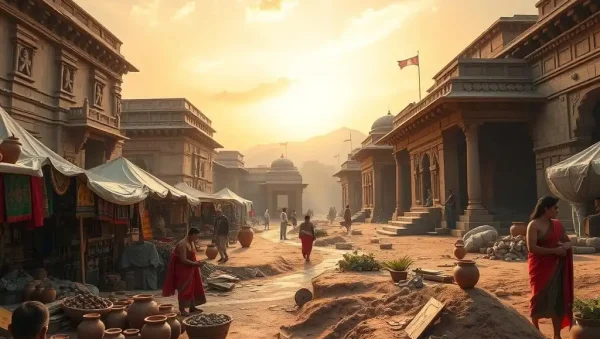
External Trade and Commerce
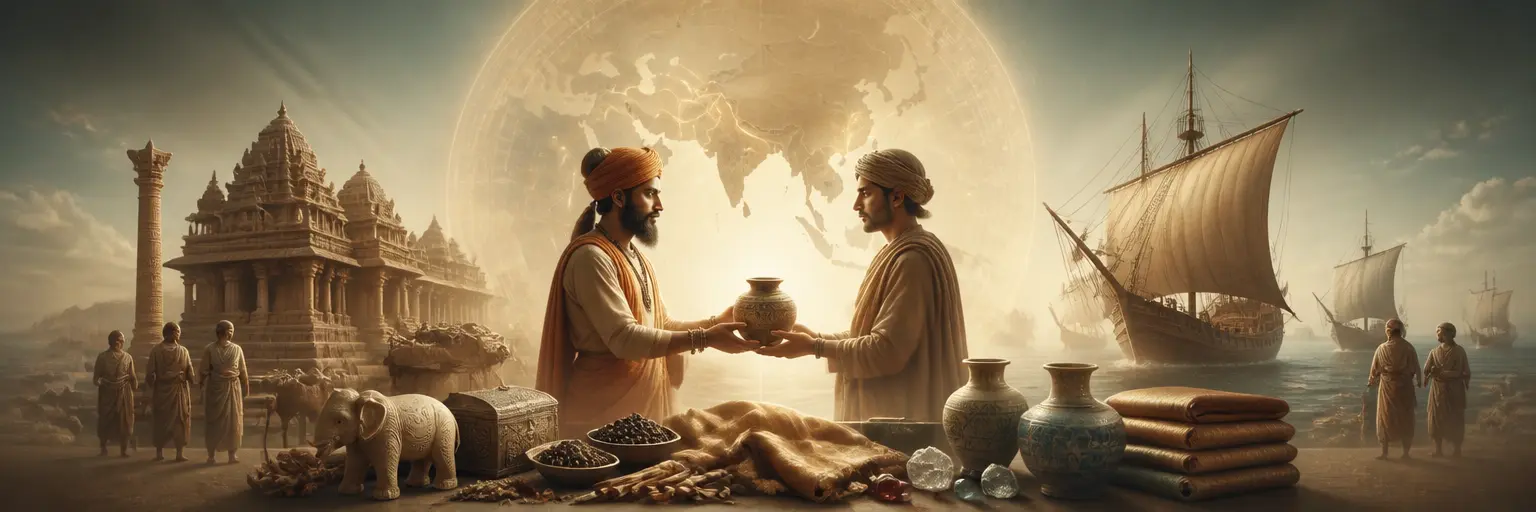

External Trade and Commerce
52 articles in this topic
Read more about this topic
Explore how ancient India shaped external trade and commerce through vibrant maritime routes, overland networks, and diplomatic exchanges. Discover the movement of spices, textiles, precious stones, metals, and ideas between Indian kingdoms and regions across Asia, Africa, and the Mediterranean. ⚓🌏 Learn about ports, merchants, trade guilds, foreign contacts, and economic connections that powered prosperity from the Indus Valley to the Gupta Empire.
More in External Trade and Commerce

External Trade and Commerce
Trade Agreements of Ancient India: Diplomacy Through Commerce

External Trade and Commerce
The Role of Guilds in Shaping Ancient Indian Trade Practices
External Trade and Commerce
The Contribution of Ancient Indian Trade to the World Economy
External Trade and Commerce
The Maritime Trade Networks of Ancient India: A Deep Dive
External Trade and Commerce
Ancient Indian Trade Regulations: Laws and Customs That Shaped Commerce
External Trade and Commerce
The Rise and Fall of Trade Cities in Ancient India: A Historical Overview
External Trade and Commerce
The Spice Trade: How Ancient India Influenced Culinary Cultures Worldwide

External Trade and Commerce
The Significance of Trade Routes in the Spread of Ancient Indian Philosophies
🌍 External Trade and Commerce in Ancient India
Explore the history of external trade and commerce in ancient India, including the maritime routes, overland networks, ports, merchants, commodities, and cultural exchanges that connected the Indian subcontinent with Asia, Africa, the Middle East, and the Mediterranean world. This subcategory examines how ancient Indian kingdoms developed powerful commercial relationships through the Indian Ocean, Silk Roads, coastal trade routes, and caravan networks. Discover how goods such as spices, textiles, gemstones, ivory, cotton, pepper, pearls, and precious metals supported the growth of cities, ports, and empires from the Indus Valley Civilization to the Gupta period and beyond.
⚓ Ancient Indian Ports and Maritime Trade
Learn about the important ports that made ancient India a major center of Indian Ocean trade. Coastal settlements on the Arabian Sea, Bay of Bengal, and southern peninsula connected Indian merchants with Arabia, Persia, East Africa, Sri Lanka, Southeast Asia, and the Roman world. Topics may include ports such as Bharuch, Sopara, Muziris, Arikamedu, Tamralipti, and Kaveripattinam.
Readers can discover how monsoon winds, shipbuilding techniques, coastal navigation, and harbor facilities supported long-distance maritime commerce. These ports were not only places where goods were exchanged but also centers of cultural interaction, religious movement, language development, and urban growth. Maritime trade in ancient India played a vital role in strengthening regional kingdoms and linking local economies to international markets.
🐪 Overland Trade Routes and Caravan Networks
Ancient Indian external commerce also depended on extensive overland trade routes crossing mountains, deserts, river valleys, and frontier regions. Merchants traveled through the northwestern passes toward Central Asia, Persia, and the Mediterranean, while other routes connected the Gangetic plain with the Deccan and the western coast.
Explore the role of caravans, merchant guilds, roads, rest houses, and trading settlements in the movement of commodities and ideas. The Uttarapatha and Dakshinapatha helped connect major cities and political centers, while links with the Silk Roads allowed Indian goods, artistic styles, religious beliefs, and technologies to reach distant civilizations.
🧂 Major Exports and Imports of Ancient India
Discover the products that made ancient India famous in international markets. Indian exports included spices, cotton textiles, silk, indigo, ivory, pearls, gemstones, sandalwood, medicines, steel, and aromatic substances. Black pepper and fine fabrics were especially valued by merchants in the Roman Empire, West Asia, and Southeast Asia.
Ancient Indian kingdoms also imported horses, gold, silver, wine, glassware, coral, precious metals, and luxury goods. Studying these commodities reveals the economic needs of different regions and explains how trade influenced royal wealth, urban prosperity, craft production, and the development of specialized markets.
🪙 Roman Trade with Ancient India
Examine the thriving commercial relationship between ancient India and the Roman Empire. Roman merchants sailed across the Red Sea and Indian Ocean to reach Indian ports, using knowledge of seasonal monsoon winds. Historical sources, Roman coins, archaeological discoveries, and texts such as the Periplus of the Erythraean Sea provide valuable evidence of this international trade.
Roman gold coins found in southern India demonstrate the scale of commerce between the two regions. Indian spices, textiles, gemstones, and luxury products were exchanged for Roman bullion, glass, wine, and manufactured goods. This Roman-Indian trade network contributed to the rise of port cities and enriched several South Indian dynasties.
🛕 Trade, Religion, and Cultural Exchange
External commerce encouraged the movement of more than merchandise. Merchants, sailors, monks, diplomats, and artisans carried Buddhism, Jainism, Hindu traditions, scripts, artistic ideas, and architectural styles across Asia. Trade routes helped connect India with Sri Lanka, Central Asia, Myanmar, Thailand, Cambodia, Indonesia, and China.
Explore how commercial communities supported monasteries, temples, and religious institutions along major routes. Inscriptions and archaeological remains show that merchant guilds often donated money and buildings, helping trade centers become important locations for education, worship, and cultural exchange.
🏛️ Merchant Guilds and Trade Organizations
Ancient Indian merchants organized themselves into guilds and professional associations that regulated commerce, protected trading interests, and supported long-distance journeys. Guilds such as the shreni played an important role in managing production, setting standards, arranging finance, and representing artisans and traders.
These organizations contributed to the stability of ancient markets and helped merchants operate across political boundaries. Their activities are recorded in inscriptions, literary works, coins, and legal texts, offering insight into business practices, trade partnerships, taxation, contracts, and the economic life of ancient Indian cities.
📜 Historical Sources for Ancient Indian Commerce
Understand how historians reconstruct the story of external trade through diverse sources. Archaeological evidence includes coins, pottery, beads, ship remains, warehouse structures, inscriptions, seals, and imported objects found at ancient settlements and ports.
Written sources such as the Arthashastra, Sangam literature, Buddhist and Jain texts, Roman accounts, Chinese records, and Greek geographical works provide additional information about merchants, commodities, routes, taxes, and foreign relations. Comparing these sources allows readers to develop a clearer picture of ancient Indian economic history.
❓ Frequently Asked Questions About External Trade and Commerce
What did ancient India export to other countries?
Ancient India exported spices, pepper, cotton and silk textiles, ivory, pearls, gemstones, indigo, sandalwood, medicines, perfumes, and high-quality metal products. These goods were valued in Roman, Persian, Arabian, Central Asian, and Southeast Asian markets.
Which countries traded with ancient India?
Ancient India traded with the Roman Empire, Greece, Persia, Arabia, Egypt, Central Asia, Sri Lanka, China, and Southeast Asian regions. Commercial links changed over time and expanded through both maritime routes and overland trade networks.
Why were monsoon winds important for Indian Ocean trade?
Monsoon winds changed direction according to the season, allowing sailors to travel from the Red Sea and Arabian coast to India and return during another season. Knowledge of these winds made long-distance sea travel faster, safer, and more predictable.
What evidence proves that ancient India had international trade?
Evidence includes Roman gold coins, foreign pottery, inscriptions, ancient port remains, trade-related literature, ship imagery, imported artifacts, and references in Roman, Greek, Chinese, Indian, and Arab accounts. Archaeological sites such as Arikamedu provide particularly important evidence of overseas commerce.
How did external trade influence ancient Indian society?
External trade encouraged urbanization, strengthened kingdoms, increased royal revenue, supported merchant guilds, expanded craft industries, and encouraged cultural exchange. It also helped spread religions, artistic traditions, technologies, languages, and ideas across Asia and the wider Indian Ocean world.