

Economic Practices and Systems

Economic Practices and Systems
58 articles in this topic
Read more about this topic
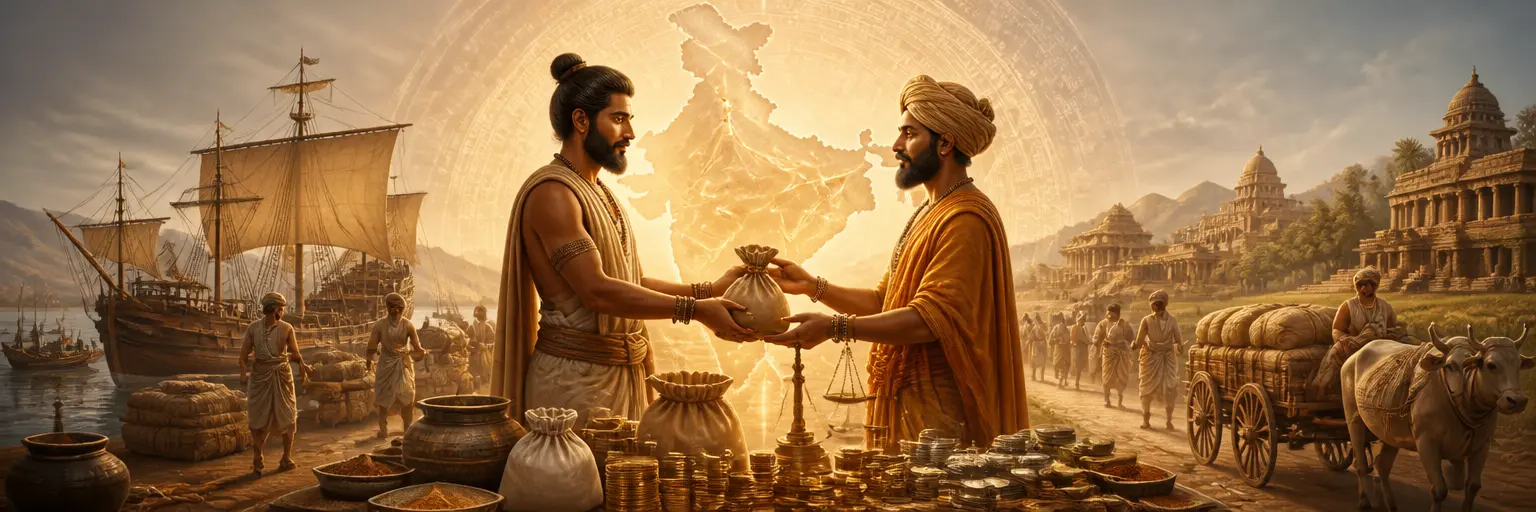
Explore Economic Practices and Systems in ancient India, where agriculture, trade, taxation, craft production, coinage, and markets shaped prosperous civilizations from the Indus Valley to the Gupta Empire. Discover how merchants, artisans, farmers, guilds, and rulers supported regional and long-distance commerce, revealing the foundations of India’s economic history and its enduring influence on society, culture, and trade.
More in Economic Practices and Systems
Economic Practices and Systems
The Legacy of Ancient Indian Trade Practices in Today’s Economy
Economic Practices and Systems
The Significance of Precious Stones and Metals in Ancient Indian Trade

Economic Practices and Systems
How Ancient Indian Economies Contributed to Global Trade Networks
Economic Practices and Systems
The Role of Barter Systems in Ancient Indian Societies: A Historical Perspective

Economic Practices and Systems
The Cultural Significance of Trade Goods in Ancient India

Economic Practices and Systems
Ancient Indian Currency: The Birth of Coinage and Its Economic Impact

Economic Practices and Systems
The Interplay of Culture and Commerce in Ancient Indian Societies

Economic Practices and Systems
The Role of Philosophical Thought in Shaping Economic Practices
📈 Economic Practices and Systems in Ancient India
Explore the economic practices and systems that shaped ancient India, from the urban markets of the Indus Valley Civilization to the commercial expansion of the Mauryan and Gupta periods. This subcategory examines agriculture, taxation, trade routes, crafts, coinage, guilds, labor, land ownership, and state revenue, revealing how ancient Indian societies produced, exchanged, and managed wealth. Discover how rivers, monsoon patterns, cities, ports, merchants, and political institutions influenced the development of the ancient Indian economy.
🌾 Agriculture, Land, and Rural Production
Learn how farming formed the foundation of the ancient Indian economy. Articles explore the cultivation of wheat, barley, rice, cotton, sugarcane, pulses, and other crops, as well as the importance of irrigation, wells, reservoirs, plows, animal power, and seasonal monsoons. These resources explain how agricultural surplus supported towns, armies, temples, administrators, and expanding kingdoms.
Readers can also examine land ownership, village communities, tenancy, rural labor, and agrarian taxation across different historical periods. By studying inscriptions, literary sources, and archaeological evidence, this section shows how land revenue and agricultural production connected rural settlements with royal courts and urban centers.
🏺 Trade, Markets, and Commercial Networks
Discover the internal and long-distance trade networks that connected ancient Indian regions with one another and with Central Asia, Southeast Asia, the Roman world, and the Middle East. Topics include overland caravan routes, river transport, coastal shipping, major ports, market towns, and the movement of textiles, spices, precious stones, metals, ivory, ceramics, and agricultural goods.
This section highlights ancient Indian commerce, merchant communities, market regulation, prices, transport, and exchange systems. It also explains how geography and political stability influenced trade, and how commercial links encouraged cultural exchange, technological development, and the spread of religions such as Buddhism and Hinduism.
🪙 Coinage, Currency, and Ancient Finance
Understand the development of money and coinage in ancient India, including punch-marked coins, cast coins, Indo-Greek currency, Kushan gold coins, and Gupta coin traditions. Articles explain how coins provide evidence about rulers, political authority, economic activity, trade relationships, religious symbolism, and the circulation of wealth.
Readers will learn about monetary systems, weights and measures, bullion, credit, loans, interest, deposits, and commercial payments. Where written evidence is limited, archaeological discoveries and hoards help reconstruct how currency was used in markets, taxation, military payments, religious donations, and international trade.
🧵 Crafts, Industries, and Skilled Labor
Explore the craft industries that made ancient Indian cities important centers of production. This includes weaving, dyeing, metalworking, pottery, bead-making, carpentry, stone carving, shipbuilding, jewelry production, and ivory craftsmanship. Archaeological remains and literary references reveal the sophisticated techniques used by artisans in the Indus Valley, early historic, Mauryan, Satavahana, Kushan, and Gupta periods.
This section also examines artisans, occupational communities, workshops, apprenticeships, labor organization, and the economic value of specialized skills. Readers can discover how craft production served local consumers, royal courts, religious institutions, and overseas markets while contributing to urban growth and social development.
🤝 Guilds, Merchants, and Economic Organization
Learn about ancient Indian guilds, often associated with groups of merchants, artisans, financiers, and producers. These organizations helped regulate professional standards, train workers, manage production, protect members, arrange commercial partnerships, and support religious or public works. Inscriptions provide valuable information about guild donations and their influence in urban society.
Articles explore the role of shrenis, merchant associations, caravan leaders, bankers, and wealthy commercial families. By studying these institutions, readers can better understand how economic communities operated alongside kings, local authorities, temples, monasteries, and village councils.
👑 Taxation, Administration, and State Revenue
Examine how ancient Indian states financed government, armies, public works, courts, and administration. Sources such as the Arthashastra, inscriptions, Buddhist and Jain literature, and legal texts describe taxes on land, trade, crafts, forests, mines, animals, tolls, and manufactured goods. These systems varied according to period, region, political authority, and local economic conditions.
This section explains ancient Indian taxation, customs duties, land revenue, treasury management, fiscal administration, and royal economic policy. It also considers the relationship between taxation and political power, including how rulers attempted to encourage production, protect trade routes, regulate markets, and maintain the prosperity of their kingdoms.
🏙️ Cities, Ports, and Urban Economies
Discover how cities such as Harappa, Mohenjo-daro, Taxila, Pataliputra, Ujjain, Mathura, Amaravati, and ancient port settlements became centers of trade, administration, manufacturing, and cultural exchange. Their streets, drainage systems, warehouses, marketplaces, workshops, monuments, and residential districts reveal the complexity of ancient urban economies.
Readers can explore the connections between urbanization, commerce, migration, craft specialization, political capitals, and port economies. This approach shows why cities expanded, how they depended on surrounding agricultural regions, and how transport networks connected local markets to wider economic systems.
🌊 Maritime Trade and International Exchange
Study ancient India’s maritime connections across the Arabian Sea, Bay of Bengal, and Indian Ocean. Monsoon winds enabled ships to travel between Indian ports and regions such as Arabia, East Africa, Sri Lanka, Southeast Asia, and the Mediterranean world. Exported goods included textiles, spices, gems, aromatics, ivory, and luxury products.
This section examines Indian Ocean trade, ancient ports, sailing technology, merchant voyages, maritime customs, and cross-cultural exchange. It also explains how overseas commerce introduced foreign goods, artistic influences, religious ideas, scripts, and economic practices into Indian societies.
📜 Sources for Studying Ancient Indian Economy
Learn how historians reconstruct economic life through archaeology, inscriptions, coins, literary works, religious texts, foreign accounts, seals, pottery, tools, structures, and environmental evidence. Each source provides different insights into production, trade, taxation, social organization, and consumption.
Readers will also encounter the importance of critical historical analysis. Ancient sources may reflect the viewpoint of rulers, religious institutions, merchants, or elite communities, so comparisons between material evidence and written records are essential for developing a balanced understanding of economic practices and systems in ancient India.
❓ Frequently Asked Questions About Economic Practices and Systems
What were the main foundations of the ancient Indian economy?
The main foundations were agriculture, animal husbandry, craft production, local markets, long-distance trade, taxation, and natural-resource use. Agricultural surplus supported urban centers, political administration, religious institutions, merchants, artisans, and armies.
Did ancient India use money and coins?
Yes. Ancient India used several forms of exchange, including barter, standardized weights, precious metals, and coins. Punch-marked coins were among the earliest widely recognized coin types, followed by regional and imperial currencies issued by rulers such as the Indo-Greeks, Kushans, and Guptas.
What role did guilds play in ancient Indian trade?
Guilds organized merchants and artisans according to their occupations. They could regulate standards, coordinate production, manage funds, protect members, support trade, and make donations to temples, monasteries, and public institutions.
How did the monsoon affect ancient Indian trade?
Monsoon winds made seasonal maritime travel across the Indian Ocean more predictable. Sailors used changing wind patterns to travel between Indian ports and overseas destinations, helping expand trade with Arabia, East Africa, Sri Lanka, Southeast Asia, and the Mediterranean world.
Which sources reveal information about ancient Indian economic systems?
Important sources include archaeological sites, coins, inscriptions, seals, pottery, tools, urban remains, the Arthashastra, Buddhist and Jain literature, legal texts, and accounts by foreign travelers. Comparing these sources helps historians study taxation, trade, agriculture, labor, markets, and economic change across different periods.