
The Importance of Inscriptions in Understanding Ancient Indian Astronomy and Science


Welcome to Ancient India History! Here, we invite you to embark on a fascinating journey through the rich tapestry of ancient Indian civilizations, where each thread tells a story of innovation and wisdom. Our latest article delves into ancient Indian astronomy insights, exploring the pivotal role of inscriptions in unlocking the secrets of celestial knowledge and scientific advancements from the Indus Valley to the Gupta Empire.
Prepare to be captivated as we unveil how these ancient texts not only shaped our understanding of the cosmos but also illuminate the brilliance of India's historical contributions to science. Discover the depths of history waiting to be uncovered—your exploration begins now!

Introduction to Ancient Indian Astronomy Insights
The study of ancient Indian astronomy offers a fascinating glimpse into the scientific achievements and intellectual pursuits of ancient civilizations. Through the examination of various inscriptions, scholars have uncovered a wealth of knowledge that reflects the sophisticated understanding of celestial phenomena by ancient Indian astronomers. These inscriptions not only serve as historical records but also provide insights into the methodologies and tools used in astronomical observations. As we delve into the significance of these inscriptions, we will uncover how they illuminate the advancements in science during a time when such knowledge was pivotal for agricultural, religious, and navigational purposes.
Overview of Ancient Indian Astronomy
Ancient Indian astronomy dates back to the Vedic period, where celestial bodies were not only seen as physical entities but also held significant mythological and philosophical importance. The Siddhantic tradition, which emerged later, laid the groundwork for systematic observations and calculations. Key texts such as the Aryabhatiya by Aryabhata and the Surya Siddhanta offered comprehensive theories and formulas that governed celestial movements.
- Key Themes in Ancient Indian Astronomy:
- Calculation of planetary positions
- Lunar and solar calendar systems
- Eclipses and their predictions
The profound insights garnered from these teachings illustrate the advanced state of ancient Indian astronomy and its cultural integration within society.
Significance of Inscriptions in Historical Context
Inscriptions serve as invaluable artifacts that provide context to the historical narrative of ancient Indian astronomy. They were inscribed on various materials, including stones, metal plates, and temple walls, often commemorating significant astronomical events or detailing scientific knowledge.
- Historical Importance of Inscriptions:
- Preservation of Knowledge: Inscriptions acted as a means to preserve and transmit astronomical information across generations.
- Cultural Insights: They reveal the social and cultural milieu of the time, showcasing how astronomy influenced art, religion, and governance.
- Verification of Textual Sources: Inscriptions help corroborate the data found in ancient texts, thereby enhancing the reliability of historical accounts.
The Role of Inscriptions in Documenting Astronomical Knowledge
Inscriptions play a crucial role in documenting the astronomical knowledge of ancient India, offering insights into various methodologies and findings. By analyzing these texts, researchers can reconstruct the astronomical practices and the scientific environment of the time.
Types of Inscriptions Related to Astronomy
The inscriptions related to astronomy can be categorized based on their content and purpose:
- Mathematical Texts: These include calculations of celestial phenomena, such as planetary positions and eclipses.
- Observational Records: They document specific astronomical events, such as solstices and equinoxes.
- Dedications and Commemorations: Inscriptions on temples often celebrate astronomical alignments or significant events in the celestial calendar.
Key Contributions of Inscriptions to Ancient Indian Science
The contributions of these inscriptions to ancient Indian science are profound and multifaceted. They not only illustrate the technical prowess of ancient astronomers but also highlight the interconnectedness of various scientific disciplines.
- Advancements in Calculative Techniques: Inscriptions reveal innovative methods for calculating astronomical positions with remarkable precision.
- Interdisciplinary Influence: Astronomy in ancient India was often linked with mathematics, astrology, and architecture, indicating a holistic approach to science.
- Cultural Legacy: The insights derived from these inscriptions have influenced subsequent generations of scholars and continue to be a source of inspiration in modern scientific discourse.
The study of inscriptions provides essential ancient Indian astronomy insights, allowing us to appreciate the rich tapestry of knowledge and its enduring impact on both historical and contemporary scientific thought.
Major Inscriptions that Provide Insights into Astronomy
Inscriptions from ancient India serve as crucial artifacts that illuminate the sophisticated understanding of astronomy held by Indian scholars. These inscriptions not only provide a glimpse into the astronomical knowledge of the time but also showcase the methodologies used by ancient astronomers to observe and calculate celestial phenomena. By examining prominent inscriptions, we can glean valuable insights into the evolution of astronomical thought and practice in ancient India.
The Aryabhata Inscription and Its Impact
The Aryabhata Inscription, found in the Aryabhata temple in Bihar, is a significant artifact that dates back to the 5th century CE. This inscription highlights the contributions of Aryabhata, one of the foremost mathematicians and astronomers of ancient India. It details his innovative concepts, such as the heliocentric model of the solar system and the calculation of the Earth's circumference.
Aryabhata's work emphasized the importance of zero and place value in mathematics, which greatly influenced astronomical computations. His calculations of planetary positions and eclipses, as outlined in the inscription, showcase the precision of ancient Indian astronomy. The inscription is pivotal, as it reflects the advanced level of scientific inquiry during Aryabhata's time, marking a transformative period in the history of ancient Indian astronomy.
The Surya Siddhanta and Its Epigraphic Evidence
The Surya Siddhanta, an ancient Sanskrit text, is another cornerstone of astronomical knowledge in India. Various inscriptions referencing the Surya Siddhanta reveal its significance in both astronomical and mathematical contexts. The text outlines methods for calculating the positions of planets and stars, the timing of eclipses, and the lengths of time in relation to celestial movements.
Inscriptions that cite the Surya Siddhanta often include specific calculations and corrections made by later astronomers, indicating a continuous tradition of knowledge transmission and refinement. These epigraphic records demonstrate how ancient Indian astronomers built upon previous works, creating a cumulative body of knowledge that reflected both practical applications and theoretical advancements in astronomy.
Other Notable Inscriptions and Their Contributions
Beyond the Aryabhata Inscription and Surya Siddhanta, several other inscriptions provide valuable insights into ancient Indian astronomy. For instance, the inscriptions from the Jantar Mantar observatories, constructed in the 18th century by Maharaja Jai Singh II, display elaborate instruments for astronomical observations and calculations. These inscriptions detail the functionalities of the instruments, revealing advancements in observational techniques and the integration of local astronomical knowledge.
Additionally, inscriptions from various temples often include references to celestial events, festivals linked to astronomical occurrences, and alignments of structures with celestial bodies. These records not only enrich our understanding of ancient astronomical practices but also highlight the cultural significance of astronomy in daily life and religious observance in ancient India.
How Inscriptions Enhance Our Understanding of Ancient Indian Science
Inscriptions serve as a vital link to understanding the scientific heritage of ancient India, particularly in the field of astronomy. They provide tangible evidence of the scientific methodologies employed by ancient scholars and the intellectual environment that fostered astronomical inquiry.
Decoding Astronomical Calculations through Inscriptions
Inscriptions often contain detailed calculations and astronomical tables that can be decoded to reveal the methodologies used by ancient astronomers. By analyzing these calculations, researchers can ascertain the precision and accuracy of ancient astronomical models. For instance, the calculations found in the Aryabhata Inscription allow modern scholars to compare ancient methods with contemporary astronomical practices, shedding light on the evolution of scientific thought.
Moreover, the use of specific terminologies and symbols in these inscriptions highlights the mathematical sophistication of ancient Indian astronomers. This enables scholars to trace the development of mathematical concepts such as trigonometry, which played a pivotal role in astronomical calculations.
The Intersection of Astronomy and Mathematics in Ancient Texts
Ancient Indian astronomy is deeply intertwined with mathematics, as evidenced by numerous inscriptions. The integration of mathematical principles in astronomical texts underscores the systematic approach ancient scholars took towards understanding the cosmos. Inscriptions reveal how mathematical theories were applied to solve practical astronomical problems, such as predicting eclipses and calculating planetary motions.
The inscriptions often reflect a dual focus on theoretical frameworks and practical applications, illustrating the comprehensive nature of ancient Indian science. This intersection of astronomy and mathematics not only advanced astronomical knowledge but also contributed to the broader intellectual heritage of ancient India, influencing generations of scholars and thinkers.
Comparative Analysis of Ancient Indian Astronomy and Other Civilizations
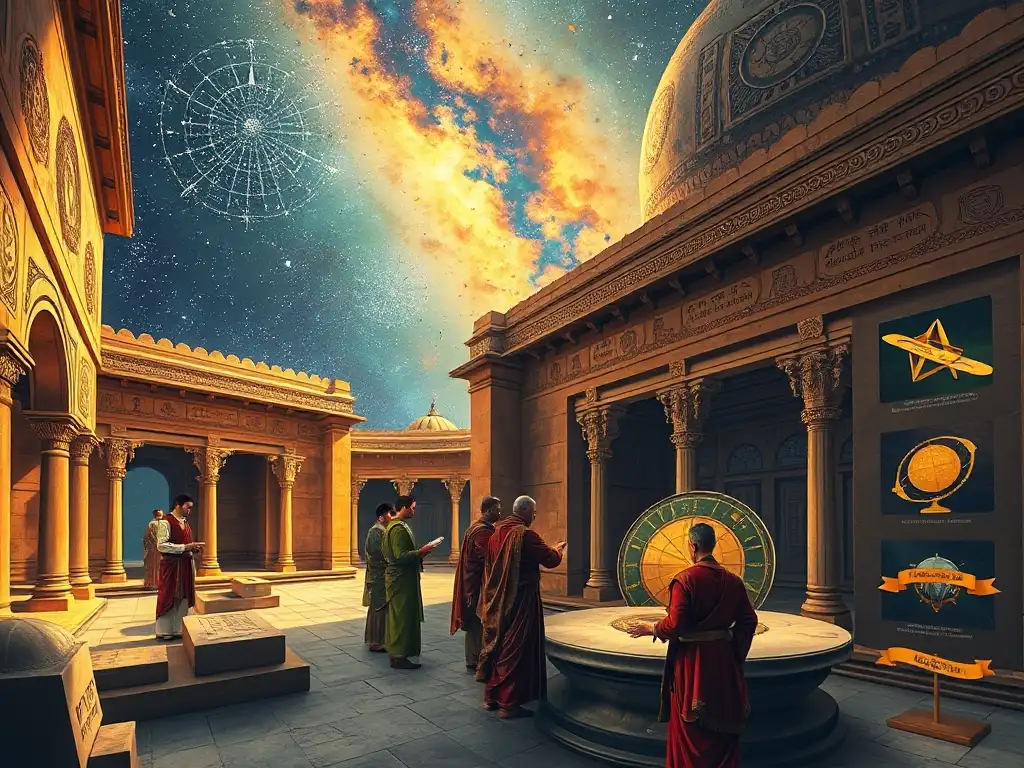
The study of ancient Indian astronomy reveals both unique insights and shared knowledge with other ancient civilizations, particularly Mesopotamia and Greece. Through the careful examination of inscriptions, scholars can draw parallels that illuminate the cognitive and cultural exchanges between these societies. This comparative analysis not only enhances our understanding of ancient Indian astronomy but also underscores the interconnectedness of human thought across different civilizations.
Similarities with Mesopotamian and Greek Astronomy
Ancient Indian astronomy shares several similarities with Mesopotamian and Greek astronomical systems. For instance, all three civilizations employed a sexagesimal (base-60) system for their astronomical calculations, which is evident in the division of the day into hours and minutes. Additionally, the use of astronomical tables to predict celestial events—such as eclipses and planetary movements—was a common practice.
Inscriptions from ancient India, particularly from the Gupta period, reflect an understanding of celestial bodies similar to that of the Greeks. The concepts of planetary motion and ephemerides seen in texts like the Surya Siddhanta resonate with Greek texts like Ptolemy's Almagest. Furthermore, the mathematical methods employed in both cultures, including trigonometric calculations, showcase a shared intellectual heritage that transcends geographical boundaries.
Unique Features of Ancient Indian Astronomical Practices
Despite the similarities, ancient Indian astronomy is distinguished by its unique features and methodologies. One notable aspect is the emphasis on observational astronomy, which is deeply rooted in religious and cultural practices. The positioning of temples and the construction of observatories, such as Jantar Mantar in Jaipur, highlight the integration of astronomy with architecture and spirituality.
Moreover, ancient Indian astronomers developed intricate systems for calculating eclipses that were often more advanced than their contemporaries. The Aryabhatiya, authored by Aryabhata, introduced innovative concepts, such as the concept of zero and place value, which revolutionized mathematical calculations. This focus on theoretical foundations set ancient Indian astronomy apart, emphasizing a philosophical approach to understanding celestial phenomena that was not as prevalent in Mesopotamian and Greek traditions.
Challenges in Interpreting Inscriptions for Astronomy
While inscriptions provide invaluable insights into ancient Indian astronomy, interpreting them presents several challenges. These challenges stem from the complexities of language, context, and the interdisciplinary nature of the subject.
Issues of Translation and Interpretation
One significant challenge in interpreting astronomical inscriptions lies in the nuances of language. The ancient Sanskrit texts often contain metaphorical and symbolic language that can complicate direct translation. Additionally, the scientific terminology used in these inscriptions may differ from modern terminology, leading to potential misinterpretations.
Scholars must therefore approach these texts with a deep understanding of both linguistic and cultural contexts. For example, terms related to celestial bodies and their movements may have had different connotations or significance in ancient times compared to contemporary understanding. This requires careful analysis and sometimes consensus among scholars from various disciplines to arrive at an accurate interpretation.
The Need for Multidisciplinary Approaches
Given the complexities involved in interpreting inscriptions related to astronomy, a multidisciplinary approach is essential. This involves collaboration between historians, linguists, astronomers, and archaeologists to construct a comprehensive understanding of the texts.
By combining insights from different fields, researchers can contextualize the astronomical knowledge embedded in inscriptions within the broader framework of ancient Indian culture, technology, and philosophy. For instance, understanding the socio-political context in which these inscriptions were created can shed light on their intended purpose and significance, leading to more robust interpretations of ancient Indian astronomy.
While inscriptions offer a window into the astronomical practices of ancient India, a collaborative and nuanced approach is crucial for unlocking the rich insights they hold about ancient Indian astronomy and its place within the broader tapestry of human knowledge.
Conclusion: The Lasting Impact of Inscriptions on Ancient Indian Astronomy Insights
Inscriptions play a pivotal role in unraveling the complexities of ancient Indian astronomy. They provide a direct link to the thoughts, beliefs, and practices of astronomers from centuries past. Through detailed records, such as astronomical calculations, observations, and even star catalogues, these inscriptions illuminate how ancient Indian civilizations understood celestial phenomena.
This understanding not only reflects their scientific acumen but also demonstrates the integration of astronomy with religious and cultural practices. The insights gained from these inscriptions serve as a foundation for contemporary scholars, enriching our comprehension of ancient scientific thought and its evolution. As we continue to explore these inscriptions, their profound impact on our understanding of ancient Indian astronomy will undoubtedly persist, guiding future generations in their quest for knowledge.
Future Research Directions in Epigraphy and Astronomy
The intersection of epigraphy and astronomy holds immense potential for future research. Scholars are encouraged to delve deeper into the analysis of lesser-known inscriptions, particularly those from regional texts that may provide new insights into local astronomical practices. Moreover, advancements in technology, such as digital imaging and machine learning, can aid in deciphering damaged or eroded inscriptions, revealing data previously lost to time.
Collaboration between historians, astronomers, and epigraphists can foster interdisciplinary studies that explore how ancient astronomical knowledge influenced various fields, including agriculture, navigation, and architecture. Expanding the scope of research to include comparative studies with other ancient civilizations can also enrich our understanding of global astronomical practices.
The Importance of Preserving Inscriptions for Cultural Heritage
Preserving inscriptions is crucial for safeguarding the cultural heritage of ancient India. These artifacts not only represent the scientific achievements of past civilizations but also embody their languages, scripts, and artistic expressions. The loss of inscriptions due to environmental factors, neglect, or urbanization can result in the irrevocable disappearance of historical knowledge.
Therefore, it is imperative to implement conservation strategies that protect these valuable resources. Initiatives such as cataloging, digitizing, and restoring inscriptions can ensure their protection for future generations. Additionally, public awareness campaigns can educate communities about the significance of these inscriptions, fostering a collective responsibility towards preserving our shared cultural heritage.
References for Further Reading on Ancient Indian Astronomy and Inscriptions
Suggested Books and Articles
- "Astronomy in Ancient India" by S. R. Sarma - This book provides an in-depth analysis of astronomical practices in ancient India, supported by inscriptions and texts.
- "Inscriptions and Their Significance in Ancient Indian Science" by R. K. Sharma - A comprehensive study on how inscriptions contribute to our understanding of science in ancient India.
- "The Role of Epigraphy in Understanding Ancient Cultures" by N. Gupta - This article discusses the broader implications of epigraphy in historical research, with a focus on Indian contexts.
- "Celestial Wisdom: Ancient Indian Astronomy" by A. Chatterjee: - An exploration of the astronomical concepts present in ancient inscriptions and texts.
Key Scholars and Researchers in the Field
- Dr. J. C. Bhattacharya - Renowned for his work on ancient Indian mathematics and astronomy, particularly focusing on inscriptions.
- Dr. M. S. Raghavendra - A leading epigraphist who specializes in deciphering ancient scripts and their astronomical implications.
- Dr. P. N. K. Rao - Known for interdisciplinary research that combines astronomy, epigraphy, and cultural studies in ancient India.
- Prof. A. R. Desai - A prominent figure in the study of ancient Indian science, with numerous publications on the relevance of inscriptions.
- Introduction to Ancient Indian Astronomy Insights
- The Role of Inscriptions in Documenting Astronomical Knowledge
- Major Inscriptions that Provide Insights into Astronomy
- How Inscriptions Enhance Our Understanding of Ancient Indian Science
- Comparative Analysis of Ancient Indian Astronomy and Other Civilizations
- Challenges in Interpreting Inscriptions for Astronomy
- Conclusion: The Lasting Impact of Inscriptions on Ancient Indian Astronomy Insights
- References for Further Reading on Ancient Indian Astronomy and Inscriptions
- What role did inscriptions play in ancient Indian astronomy?
- How did ancient Indian astronomers contribute to global astronomy?
- What are some examples of notable inscriptions related to astronomy?
- How does the study of inscriptions enhance our understanding of ancient Indian science?
- Why is it important to explore ancient Indian astronomy insights today?
Frequently Asked Questions
What role did inscriptions play in ancient Indian astronomy?
Inscriptions serve as historical records that provide insights into astronomical practices and scientific knowledge in ancient India, helping us understand the cultural context of their astronomical advancements.
How did ancient Indian astronomers contribute to global astronomy?
Ancient Indian astronomers made significant contributions, including the concept of zero, advancements in trigonometry, and detailed celestial observations, which influenced both Eastern and Western scientific thought.
Inscriptions such as the Aryabhata's Aryabhatiya and the Brahmasphutasiddhanta contain valuable information on planetary positions, eclipses, and other astronomical phenomena, showcasing the depth of ancient knowledge.
How does the study of inscriptions enhance our understanding of ancient Indian science?
Studying these inscriptions allows researchers to trace the evolution of scientific thought and identify technological advancements, revealing the interconnectedness of astronomy and culture in ancient India.
Why is it important to explore ancient Indian astronomy insights today?
Exploring these insights not only enriches our understanding of historical scientific achievements but also highlights the cultural heritage and the intellectual legacy of ancient Indian civilizations, inspiring future generations.
Final Reflection: Unveiling the Cosmic Wisdom of Ancient Indian Astronomy
The exploration of ancient Indian astronomy insights reveals a profound connection between our past and present, highlighting the importance of understanding how these early scholars shaped our comprehension of the universe. Today, as we navigate an era dominated by technology and scientific advancements, the wisdom embedded in ancient inscriptions serves as a reminder of the intellectual legacy that continues to influence modern science. The intricate observations and calculations of ancient Indian astronomers not only reflect their advanced understanding but also challenge us to appreciate the depth of knowledge that existed long before our contemporary frameworks.
The impact of these ancient insights transcends mere historical interest; they resonate within our cultural and scientific narratives, encouraging a deeper appreciation for the interconnectedness of knowledge across time and space. The meticulous records left by these scholars offer a glimpse into a civilization that valued inquiry, observation, and the pursuit of truth. As Carl Sagan once said, "> We are made of star-stuff. We are a way for the universe to know itself." This sentiment encapsulates the essence of ancient Indian astronomy, reminding us that our quest for understanding the cosmos is a shared journey that spans millennia.
As we reflect on the lessons from ancient Indian astronomy, let us embrace the call to explore, question, and connect with the universe around us. I invite you to delve into your own inquiries, drawing inspiration from the past to inform your present and future. Whether through studying the stars, engaging with scientific principles, or simply contemplating our place in the cosmos, may we honor the legacy of those who came before us and continue to seek knowledge that transcends time.
Unlock the Secrets of Ancient Indian Science!
Thank you for diving into the fascinating world of ancient Indian astronomy and science with us! By exploring the significance of historical inscriptions, you’ve uncovered valuable insights into the rich intellectual heritage of India. Now, let’s take the next steps to deepen your understanding and appreciation of this incredible history.
- Join our community by signing up for our newsletter to receive exclusive content and updates on the wonders of ancient Indian science.
- Explore further by checking out related articles on our website that delve into specific astronomical texts and their implications for contemporary science.
- Share the knowledge! Discuss what you’ve learned with friends or post your thoughts on social media to inspire others to discover the marvels of ancient India.
What aspect of ancient Indian astronomy fascinates you the most, and how do you believe it can influence modern scientific thought?