
The Influence of Ancient Indian Universities on Islamic Golden Age Scholars


Welcome to Ancient India History, where we embark on a fascinating journey through the rich tapestry of ancient Indian civilizations. Here, we delve into the profound influence of ancient Indian universities on scholars of the Islamic Golden Age. These venerable institutions were not just centers of learning; they were beacons of knowledge that shaped intellectual thought across cultures. What insights did these universities offer that resonate even today? Join us as we uncover the legacy of education that flourished in ancient India, and discover how it continues to inform our understanding of the world. Your exploration starts here!

The remarkable contributions of ancient Indian universities played a pivotal role in shaping the intellectual landscape of the Islamic Golden Age. Institutions such as Nalanda and Takshashila were not merely centers of learning; they became vital hubs for the exchange of knowledge, ideas, and culture that transcended geographical boundaries.
As scholars from diverse regions converged at these universities, they cultivated an environment rich in philosophical inquiry, scientific exploration, and literary achievement. This article delves into how ancient Indian universities influenced Islamic scholars and contributed to the broader tapestry of education during the Islamic Golden Age, ultimately affecting various fields such as mathematics, astronomy, medicine, and philosophy.
Introduction to Ancient Indian Universities
Overview of Ancient Indian Educational Systems
Ancient Indian universities, particularly Nalanda and Takshashila, emerged around the 5th century BCE and flourished until the 12th century CE. These institutions were characterized by their comprehensive educational systems, which were deeply rooted in the cultural and philosophical traditions of India. The curriculum was robust, encompassing a diverse array of subjects, including:
- Philosophy
- Mathematics
- Astronomy
- Medicine
- Logic
- Grammar
Students from across Asia, including China, Tibet, Korea, and the Middle East, traveled great distances to seek knowledge at these prestigious universities. The rigorous training and scholarly debates encouraged critical thinking and innovation, laying a strong foundation for future generations.
Importance of Universities like Nalanda and Takshashila
Nalanda University, often regarded as the epitome of ancient Indian education, was home to thousands of students and renowned scholars. It not only served as a center for learning but also as a melting pot of cultures and ideas. Similarly, Takshashila, known for its emphasis on practical knowledge, contributed significantly to the fields of medicine and governance.
- Cultural Exchange: These universities facilitated the exchange of ideas between Indian and Islamic scholars, which would later influence the intellectual climate of the Islamic Golden Age.
- Legacy of Knowledge: The teachings and texts produced in these institutions laid the groundwork for advancements in various fields that would be further developed by Islamic scholars.
The Role of Ancient Indian Universities in Education
Curriculum and Subjects Taught in Ancient Indian Universities
The curriculum at ancient Indian universities was meticulously designed to provide a holistic education. Students were exposed to various subjects that not only included theoretical knowledge but also practical application. The emphasis on subjects like mathematics and astronomy provided the foundation for significant advancements in these fields during the Islamic Golden Age.
- Mathematics: Indian scholars made significant contributions, such as the concept of zero and advancements in algebra.
- Astronomy: The knowledge of celestial movements and calculations was crucial for later Islamic astronomers.
The Faculty and Scholars of Ancient Indian Universities
The faculty at these universities consisted of esteemed scholars who were well-versed in multiple disciplines. Their expertise and pedagogical methods were instrumental in shaping the educational experience of students. Notable figures such as Aryabhata and Charaka emerged from these institutions, leaving behind a legacy that would profoundly impact both Indian and Islamic scholarship.
- Influential Scholars: Many scholars from Nalanda and Takshashila traveled to the Islamic world, sharing their knowledge and works.
- Collaborative Learning: The interaction between students and faculty fostered an environment of collaborative learning, which was crucial for intellectual growth.
The influence of ancient Indian universities on Islamic Golden Age scholars is a testament to the enduring legacy of Indian education systems, emphasizing the significance of cultural and intellectual exchange throughout history.
The Islamic Golden Age: Context and Significance
The Islamic Golden Age, spanning approximately from the 8th to the 14th century, was a period marked by profound intellectual, cultural, and scientific advancements in the Islamic world. This era emerged following the establishment of the Islamic Caliphate and coincided with significant developments in trade, philosophy, and technology. Scholars from diverse backgrounds, including Arabs, Persians, Turks, and others, contributed to a flourishing of knowledge that would leave a lasting impact on various fields, including mathematics, astronomy, medicine, and philosophy.
This period is significant not only for the innovations it produced but also for its role as a bridge between ancient civilizations. It served as a conduit for the transmission of knowledge from regions such as India, Greece, and Persia to Europe, laying the groundwork for the Renaissance. The synthesis of ideas during the Islamic Golden Age helped shape modern science and education, reflecting a rich tapestry of intercultural exchange that defined this remarkable epoch.
Overview of the Islamic Golden Age
The Islamic Golden Age is often considered a pivotal moment in human history. It began with the rise of the Abbasid Caliphate in the 8th century, which established Baghdad as a center of learning and culture. The House of Wisdom in Baghdad became a notable institution where scholars translated and preserved works from various cultures, including Greek and Indian texts. This collaborative environment fostered an atmosphere of inquiry and innovation, leading to significant advancements in various domains.
Key features of this era included the establishment of universities, libraries, and observatories, which facilitated the study of mathematics, medicine, and philosophy. The emphasis on empirical observation and experimentation was revolutionary and laid the foundations for modern scientific methodologies. Furthermore, the patronage from caliphs and wealthy merchants enabled scholars to pursue their studies, resulting in a vibrant intellectual culture that would influence generations to come.
Key Contributions of Islamic Scholars during the Golden Age
Islamic scholars made numerous contributions that transformed various fields of study. In mathematics, figures such as Al-Khwarizmi pioneered algebra, which derived its name from his seminal work, "Al-Kitab al-Mukhtasar fi Hisab al-Jabr wal-Muqabala." His contributions laid the groundwork for modern mathematics.
In the realm of medicine, scholars like Al-Razi and Ibn Sina (Avicenna) advanced medical knowledge through clinical observations and the compilation of comprehensive medical texts. Ibn Sina's "The Canon of Medicine" became a standard reference in Europe for centuries.
Additionally, Islamic scholars excelled in astronomy, with notable figures such as Al-Battani and Al-Farghani who improved astronomical tables and developed instruments for celestial observations. Their work influenced European astronomy during the Renaissance and facilitated advancements in navigation.
The Influence of Ancient Indian Universities on Islamic Scholars
Ancient Indian universities, particularly renowned institutions like Nalanda and Takshashila, were pivotal centers of learning that drew scholars from various regions, including the Islamic world. The exchange of knowledge between these universities and Islamic scholars significantly influenced the intellectual landscape of the time. The profound philosophical and scientific traditions cultivated in India merged with Islamic thought, fostering a rich dialogue that propelled advancements in various disciplines.
Exchange of Knowledge Between Ancient India and the Islamic World
The exchange of knowledge between ancient Indian universities and the Islamic world can be traced back to as early as the 7th century. Scholars from the Islamic world traveled to India to study various subjects, including mathematics, astronomy, and philosophy. The translation of Indian texts into Arabic facilitated the dissemination of knowledge, making it accessible to a broader audience.
Notably, Indian mathematics, including the concept of zero and the decimal system, had a profound impact on Islamic scholars. This mathematical knowledge was later transmitted to Europe and became foundational for modern mathematics. Furthermore, the works of Indian philosophers such as Aryabhata and Brahmagupta were instrumental in informing Islamic astronomical practices.
The mutual respect and curiosity between scholars from both cultures fostered an environment conducive to learning. This exchange not only enriched Islamic scholarship but also contributed to a deeper understanding of various scientific principles, thereby enhancing the intellectual achievements of the Islamic Golden Age.
Prominent Islamic Scholars Influenced by Ancient Indian Universities
Several prominent Islamic scholars were notably influenced by their studies in ancient Indian universities. One such scholar was Al-Khwarizmi, whose introduction of Indian numerical systems and concepts profoundly shaped mathematical practices in the Islamic world and beyond. His works laid the foundation for algebra and arithmetic as we know them today.
Another significant figure was Al-Biruni, who traveled to India in the 11th century and conducted extensive studies on Indian astronomy, mathematics, and culture. His works, including "Kitab al-Hind," provided valuable insights into Indian science and philosophy, demonstrating the synthesis of knowledge from both traditions.
Additionally, Ibn Rushd (Averroes) was influenced by Indian philosophical texts, which he integrated into his own works, bridging the gap between Aristotelian thought and Islamic philosophy. These scholars exemplify the profound impact that ancient Indian universities had on the intellectual development of the Islamic Golden Age, highlighting a legacy of cross-cultural collaboration that continues to resonate in contemporary scholarship.
Comparative Analysis of Educational Philosophies
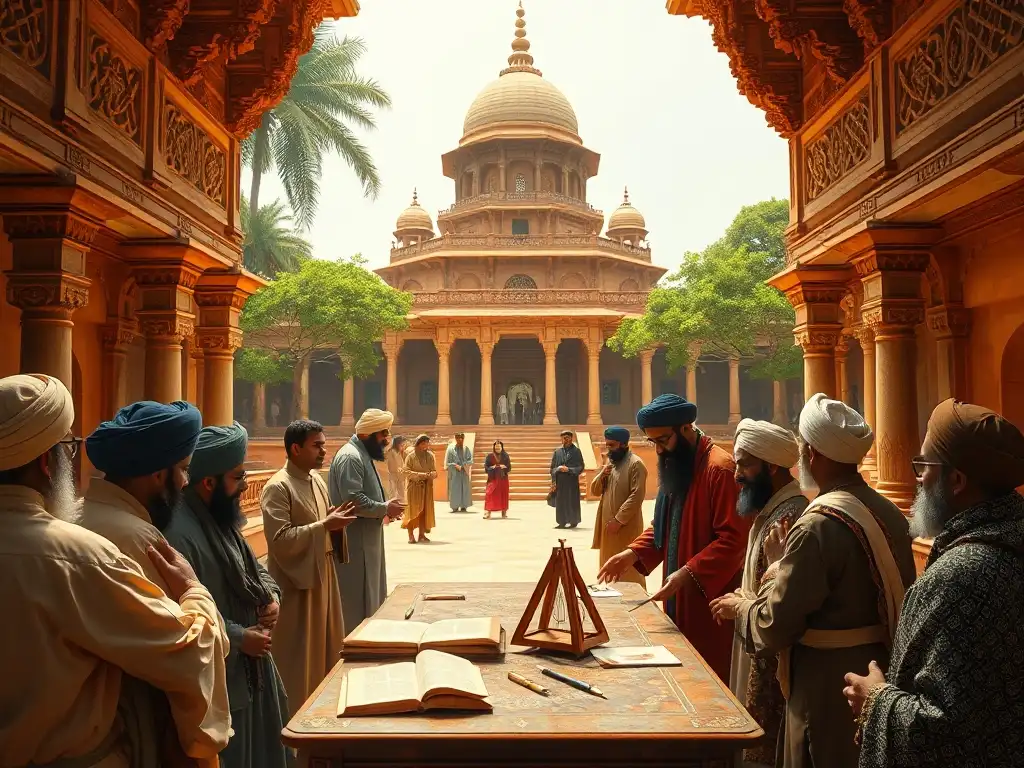
The educational philosophies of ancient Indian universities and their Islamic counterparts during the Golden Age present a fascinating study in contrasts and similarities. Ancient Indian universities, such as Nalanda and Takshashila, emphasized a holistic approach to education, integrating various disciplines including philosophy, mathematics, astronomy, and medicine. Learning was not merely an accumulation of knowledge but a transformative experience aimed at the development of the individual’s character and intellect.
On the other hand, Islamic educational practices that emerged during the Golden Age were heavily influenced by the teachings of the Quran and the Hadith. The focus was primarily on religious scholarship, jurisprudence, and the sciences that supported Islamic teachings. Educational institutions like the Madrasahs were established to foster a deep understanding of religious texts, but they also expanded to include subjects such as mathematics, astronomy, and medicine, reflecting the expansive nature of knowledge sought during this period.
This comparative analysis reveals that while both educational systems valued knowledge, their methodologies and underlying philosophies differed significantly. Ancient Indian universities promoted a more secular and diverse curriculum, while Islamic scholars initially focused on religious texts, later incorporating broader scientific disciplines as the need for comprehensive knowledge grew.
Ancient Indian Educational Philosophy vs. Islamic Educational Practices
The foundations of ancient Indian educational philosophy were rooted in the Guru-Shishya tradition, which emphasized a close mentor-student relationship. This approach encouraged critical thinking, debate, and independent inquiry. Students lived with their Gurus, learning not only through formal instruction but also through practical experiences and discussions. This method cultivated a deep understanding and a sense of respect for knowledge.
In contrast, Islamic educational practices during the Islamic Golden Age were characterized by a more structured approach. Education was often more formalized and institutionalized, with a clear hierarchy in the teaching process. Scholars, known as Ulema, played a crucial role in disseminating knowledge, and the curriculum was heavily influenced by religious doctrines. The educational practices included memorization and recitation of texts, especially the Quran, which was a central focus of learning.
Despite these differences, both systems valued the pursuit of knowledge and contributed significantly to the intellectual landscape of their respective eras. The eventual blending of these philosophies led to an enriched scholarly environment, particularly in the medieval period, where ideas from both traditions were exchanged and integrated.
Influence of Guru-Shishya Tradition on Islamic Scholars
The Guru-Shishya tradition of ancient India had a profound impact on Islamic scholars who interacted with Indian educational systems. When Islamic scholars traveled to Indian universities, they encountered a model of education that emphasized personal mentorship, dialogue, and the pursuit of wisdom. This practice resonated with the Islamic emphasis on knowledge as a means to understanding God and the universe.
Notably, scholars such as Al-Farabi and Ibn Sina (Avicenna) were influenced by the philosophical teachings they encountered in Indian universities. They adopted the reflective and dialectical methods of inquiry that were characteristic of the Guru-Shishya tradition. The importance placed on mentorship also encouraged Islamic scholars to value personal relationships with their teachers, fostering an environment conducive to intellectual growth and collaboration.
This cultural exchange not only enriched Islamic scholarship but also facilitated the synthesis of various philosophical ideas, leading to advancements in fields such as mathematics, astronomy, and medicine.
Legacy and Impact of Ancient Indian Universities
The legacy of ancient Indian universities extends far beyond their immediate geographical and temporal confines. Their influence on the intellectual traditions of the Islamic Golden Age is particularly noteworthy, as these institutions served as critical hubs for the transmission of knowledge across cultures. The interaction between Indian and Islamic scholars resulted in a rich tapestry of ideas that shaped the course of scientific and philosophical thought.
Long-term Effects on Islamic Scholarship and Science
The long-term effects of ancient Indian universities on Islamic scholarship are evident in the advancements made during the Islamic Golden Age. Scholars like Al-Khwarizmi, who is often referred to as the father of algebra, were heavily influenced by Indian mathematical concepts, particularly the numeral system and zero. The works of Indian mathematicians were translated into Arabic, further disseminating this knowledge across the Islamic world.
Moreover, the methodologies developed in Indian universities—focusing on observation, experimentation, and critical reasoning—found their way into the scientific practices of Islamic scholars. This fusion of ideas not only advanced fields such as mathematics and astronomy but also laid the groundwork for the European Renaissance, as many of these texts were later translated into Latin and circulated throughout Europe.
Preservation and Transmission of Knowledge
Ancient Indian universities played a crucial role in the preservation and transmission of knowledge during a time of great intellectual activity. The libraries and learning centers in institutions like Nalanda housed vast collections of manuscripts that included works from various disciplines. This treasure trove of knowledge was not only preserved but also translated and disseminated among scholars from different cultures.
The collaboration between Indian and Islamic scholars facilitated the exchange of ideas and texts, ensuring that the scientific and philosophical advancements of ancient India were not lost to history. As a result, the legacies of these ancient universities continue to influence contemporary education and scholarship, highlighting the importance of cross-cultural dialogue in the advancement of human knowledge.
Conclusion
The influence of ancient Indian universities, particularly renowned institutions like Nalanda and Takshashila, extends far beyond their geographical boundaries and historical timelines. These universities were not merely centers of learning; they were vibrant hubs of intellectual exchange, where scholars from various cultures and backgrounds converged. The rich academic traditions and the diversity of knowledge cultivated in these institutions significantly shaped the intellectual landscape of the Islamic Golden Age, leaving an indelible mark on the development of various fields such as mathematics, astronomy, philosophy, and medicine.
Summary of the Influence of Ancient Indian Universities
Ancient Indian universities played a pivotal role in the exchange of knowledge during the early medieval period. Scholars from the Islamic world, drawn to the advanced studies offered at these institutions, assimilated various philosophical and scientific ideas that were critical in shaping their own scholarly pursuits. The curriculum at universities like Nalanda included subjects such as logic, rhetoric, and the sciences, which were crucial for the scholarly endeavors of Islamic thinkers. Notably, the contributions of Indian mathematicians and astronomers, such as Aryabhata, were instrumental in influencing Islamic scholars, who further developed these ideas and transmitted them to Europe.
Moreover, the interactions between Indian and Islamic scholars fostered a unique blend of cultural and intellectual traditions, which enriched both civilizations. This exchange also facilitated the translation and preservation of ancient texts, enabling the continuity of knowledge across generations. The collaborative spirit of these ancient institutions ultimately laid the groundwork for the development of modern educational systems, emphasizing the importance of a diverse and inclusive approach to learning.
The Lasting Impact on Global Education Systems and Cultures
The legacy of ancient Indian universities continues to resonate in contemporary education systems worldwide. Their emphasis on critical thinking, interdisciplinary studies, and the importance of dialogue and debate set a precedent for modern universities. The integration of various fields of knowledge, as practiced in ancient Indian institutions, remains a cornerstone of today's educational philosophy, promoting a holistic approach to learning.
Furthermore, the cultural exchanges facilitated by these universities contributed to a broader understanding of global knowledge systems. The synthesis of Indian, Persian, and Greek thought during the Islamic Golden Age exemplifies how ancient Indian universities influenced not just the scholars of their time but also the trajectory of global intellectual history. This collaborative ethos is reflected in modern educational practices that value diversity, inclusivity, and the exchange of ideas across cultural boundaries.
The influence of ancient Indian universities on Islamic Golden Age scholars signifies a vital chapter in the history of education, illustrating how interconnectedness in learning can lead to profound advancements in knowledge and culture. Their enduring legacy is a testament to the power of education as a transformative force in society.
- Introduction to Ancient Indian Universities
- The Role of Ancient Indian Universities in Education
- The Islamic Golden Age: Context and Significance
- The Influence of Ancient Indian Universities on Islamic Scholars
- Comparative Analysis of Educational Philosophies
- Legacy and Impact of Ancient Indian Universities
- Conclusion
- What were the main ancient Indian universities?
- How did ancient Indian universities influence Islamic scholars?
- What subjects were taught in ancient Indian universities?
- What was the significance of the university system in ancient India?
- Are there any notable scholars from ancient Indian universities?
Frequently Asked Questions
What were the main ancient Indian universities?
Ancient Indian universities like Nalanda and Taxila were renowned centers of learning, attracting scholars from various regions, including China, Korea, and the Middle East.
How did ancient Indian universities influence Islamic scholars?
These universities played a crucial role in disseminating knowledge in fields such as mathematics, astronomy, and medicine, significantly impacting the Islamic Golden Age.
What subjects were taught in ancient Indian universities?
The curriculum included a wide range of subjects, such as philosophy, grammar, logic, and metaphysics, emphasizing both theoretical and practical knowledge.
What was the significance of the university system in ancient India?
The university system fostered a culture of scholarly exchange, laying the groundwork for academic pursuits and influencing educational systems in neighboring regions.
Are there any notable scholars from ancient Indian universities?
Yes, scholars like Aryabhata and Brahmagupta emerged from these institutions, contributing significantly to mathematics and astronomy, which later influenced Islamic scholars.
Final Reflection: The Enduring Legacy of Ancient Indian Universities
The profound influence of ancient Indian universities on the scholars of the Islamic Golden Age is a testament to the interconnectedness of knowledge across cultures. In an era where intellectual pursuits transcended geographical boundaries, these institutions served as beacons of learning, fostering an environment where diverse ideas could flourish. Today, as we navigate a world increasingly defined by division, the lessons from this rich history remind us of the power of collaboration and shared wisdom.
Cultural exchange has always been a catalyst for innovation and progress. The contributions of ancient Indian universities not only shaped the intellectual landscape of their time but continue to resonate in contemporary scholarship. As we reflect on this legacy, we recognize that the spirit of inquiry and the pursuit of knowledge are timeless endeavors that bind us together. Knowledge knows no boundaries; it is a bridge that connects us all.
As we look to the future, let us embrace the lessons of the past and commit ourselves to fostering an inclusive environment for learning and growth. I invite you to reflect on how you can contribute to this legacy in your own life. Whether through sharing knowledge, engaging in dialogue, or promoting cultural understanding, each of us has a role to play in nurturing the seeds of wisdom that have been sown throughout history. Together, we can honor the influence of ancient Indian universities and ensure that their spirit continues to inspire generations to come.
Unveil the Legacy: Take Action Now!
Thank you for exploring the fascinating influence of ancient Indian universities on scholars during the Islamic Golden Age! You’ve uncovered a rich narrative that not only reshapes our understanding of history but also inspires us to reflect on the enduring legacy of education.
Now, let’s bring this knowledge to life with some actionable steps:
- Explore Historical Texts: Dive deeper into primary sources from ancient Indian universities. Look for translated texts that showcase the significant contributions of these scholars.
- Share Your Thoughts: Join the conversation! Share this article on social media and highlight what you found most intriguing about this historical connection.
- Connect with Others: Seek out local or online study groups that focus on the intersection of cultures during this period, and engage in discussions about their impacts on today’s world.
What insights can we draw from the collaboration between ancient Indian scholars and their Islamic counterparts that are relevant to today’s educational systems?