

Gupta Empire - Science and Mathematics
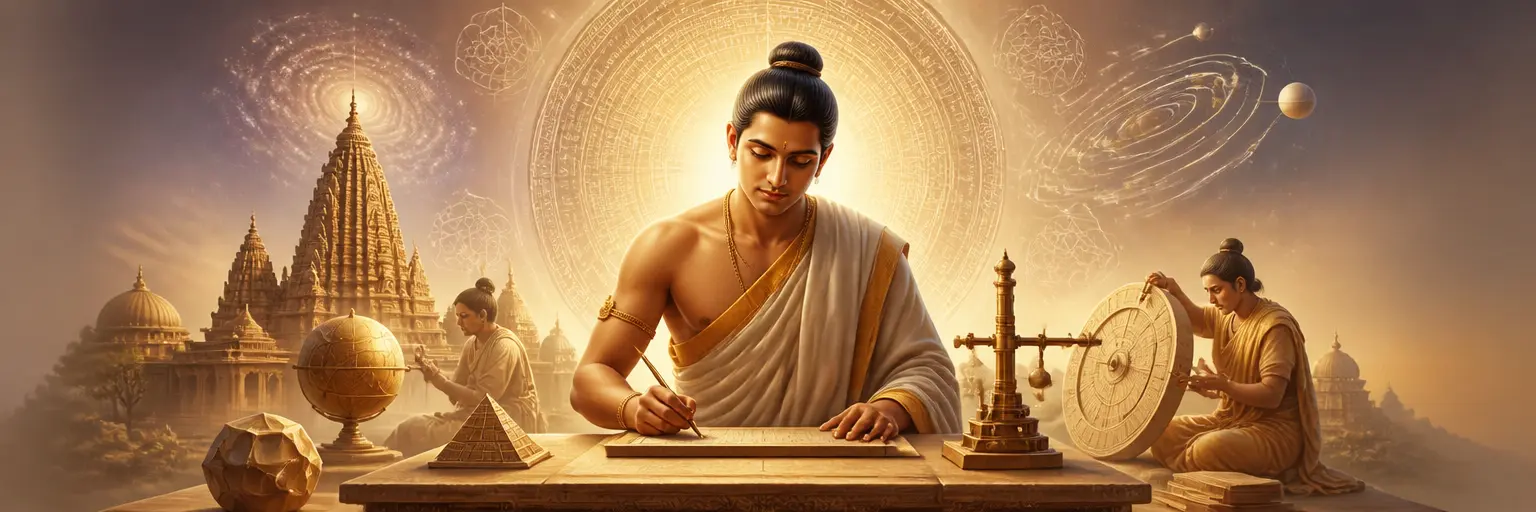

Gupta Empire - Science and Mathematics
53 articles in this topic
Start here
- Gupta Empire - Science and MathematicsUnraveling the Mysteries of Ancient Indian Astronomy During the Gupta Period
- Gupta Empire - Science and MathematicsThe Legacy of the Gupta Empire in the Global History of Science and Mathematics
- Gupta Empire - Science and MathematicsMathematical Puzzles of the Gupta Era: Engaging Minds Through Challenges
Read more about this topic
Discover the scientific and mathematical achievements of the Gupta Empire, a golden age of ancient Indian innovation. Explore breakthroughs in mathematics, astronomy, medicine, metallurgy, and education—including the development of the decimal system, early concepts of zero, and Aryabhata’s influential astronomical theories. Uncover how Gupta-era scholars shaped knowledge that continues to inspire the modern world.
More in Gupta Empire - Science and Mathematics

Gupta Empire - Science and Mathematics
Mathematics in the Gupta Era: The Birth of Zero and Its Impact

Gupta Empire - Science and Mathematics
The Gupta Contributions to Environmental Awareness and Sustainability Practices

Gupta Empire - Science and Mathematics
Gupta Astronomy: Predicting Eclipses and Their Cultural Significance

Gupta Empire - Science and Mathematics
The Gupta Empire’s Influence on Mathematical Notation: A Historical Journey

Gupta Empire - Science and Mathematics
Ancient Indian Mathematics: The Notion of Infinity in Gupta Scholars’ Works

Gupta Empire - Science and Mathematics
The Role of Astronomy in Gupta Agriculture: Predicting Seasons and Harvests

Gupta Empire - Science and Mathematics
Gupta Era Innovations in Textile Science: Mathematics Meets Craftsmanship

Gupta Empire - Science and Mathematics
How the Gupta Empire Fostered Curiosity and Critical Thinking in Science
Gupta Empire – Science and Mathematics: Discover India’s Golden Age of Knowledge
The Gupta Empire’s science and mathematics represent one of the most influential chapters in the history of ancient India. This subcategory explores the remarkable achievements of Gupta-era scholars in mathematics, astronomy, medicine, metallurgy, engineering, and scientific thought. Readers can learn how the Gupta period, often described as India’s Golden Age, helped develop ideas that shaped Indian civilization and influenced knowledge across Asia and the wider world.
🌟 The Gupta Golden Age of Scientific Discovery
The Gupta period, generally dated from the 4th to the 6th century CE, encouraged intellectual growth through royal patronage, urban learning centers, temple institutions, and scholarly debate. Articles in this section examine how science was connected with education, philosophy, religion, agriculture, trade, architecture, and everyday life during the Gupta Empire.
Readers can expect accessible explanations of important discoveries, historical context, and the achievements of famous scholars. The content highlights how Gupta scientists built upon earlier knowledge from the Indus Valley Civilization, Vedic traditions, and pre-Gupta Indian kingdoms while creating new approaches to calculation, observation, medicine, and technology.
🔢 Gupta Mathematics and the Development of Numbers
Gupta mathematics played a major role in the development of India’s numerical traditions. This section explores the use of the decimal place-value system, large numbers, arithmetic methods, geometry, algebraic ideas, and zero-related concepts. It also explains how mathematical knowledge supported astronomy, taxation, construction, commerce, calendrical calculations, and administration.
Special attention is given to the work of Aryabhata, whose mathematical treatise, the Aryabhatiya, presented innovative ideas about arithmetic, geometry, trigonometry, and astronomical calculation. Readers will discover why ancient Indian mathematics remains important to the history of global science and how Indian numerical concepts eventually traveled to the Islamic world and Europe.
🌌 Aryabhata and Gupta Astronomy
Aryabhata is one of the most important scientific figures associated with ancient India. Articles in this subcategory examine his views on the rotation of the Earth, planetary motion, eclipses, the length of the year, lunar calculations, and trigonometric tables. His work demonstrates the advanced level of mathematical astronomy achieved during the Gupta age.
Readers can expect explanations of how Gupta astronomers observed the skies and developed systems for measuring time and predicting celestial events. The section also considers the relationship between astronomy, calendars, religious festivals, navigation, agriculture, and the organization of society in ancient India.
🧮 Zero, the Decimal System, and Indian Numerical Knowledge
The history of zero and the decimal place-value system is an essential topic in the study of Gupta mathematics. This section explores how Indian scholars used numerical notation and positional values to make complex calculations more efficient. It also discusses the evidence, inscriptions, manuscripts, and later developments connected with the history of zero in India.
Readers will learn why the Indian number system was revolutionary and how it transformed arithmetic, astronomy, accounting, and scientific communication. The content presents the subject carefully, distinguishing between the gradual development of zero as a placeholder and its later recognition as a number with independent mathematical value.
⚕️ Medicine, Ayurveda, and Gupta Scientific Traditions
Scientific learning during and around the Gupta period included important developments in Ayurveda, surgery, anatomy, pharmacology, diagnosis, and preventive healthcare. This section examines how ancient Indian medical traditions preserved and expanded knowledge associated with physicians such as Charaka and Sushruta, while placing those traditions within the broader history of Gupta-era scholarship.
Readers can expect discussions of medicinal plants, theories of health, surgical techniques, medical education, and the organization of healthcare. The articles also explain how ancient medical texts should be understood in their historical context, recognizing both their significant contributions and the differences between traditional medicine and modern scientific practice.
⚒️ Metallurgy, Engineering, and Technological Achievement
The Gupta Empire is also associated with impressive achievements in metallurgy and ancient Indian technology. Topics include ironworking, bronze and copper production, coin making, weapons, tools, construction methods, and the famous Iron Pillar of Delhi, whose resistance to corrosion reflects advanced metalworking knowledge.
This section explores how technical skills supported military power, architecture, agriculture, trade, and religious institutions. Readers will learn how Gupta craftsmen combined practical experience with specialized knowledge, creating durable objects and structures that provide valuable evidence for understanding ancient Indian science and technology.
🏛️ Architecture, Construction, and Applied Science
Gupta architecture reflects the application of geometry, engineering, material knowledge, and artistic design. Articles in this subcategory examine temple construction, structural planning, sculpture, stone carving, cave architecture, urban development, and water management during the Gupta age.
Readers can discover how scientific principles influenced the creation of temples, monasteries, roads, reservoirs, and other public works. The content connects architectural evidence with the wider history of ancient Indian civilization, showing how mathematics and technical expertise contributed to cultural and religious expression.
📚 Scholars, Texts, and Centers of Learning
The Gupta era produced and supported influential scholars, teachers, astronomers, mathematicians, physicians, philosophers, and writers. This section introduces figures such as Aryabhata and examines important Sanskrit works that preserved knowledge in mathematics, astronomy, medicine, grammar, and logic.
Readers can expect information about education, scholarly networks, libraries, monasteries, debate traditions, and the transmission of knowledge across India. The section also considers the role of institutions such as Nalanda and other learning centers in the development and preservation of ancient Indian scientific traditions.
🌏 The Global Influence of Gupta Science and Mathematics
Gupta scientific achievements did not remain isolated within the Indian subcontinent. This section traces how Indian mathematics and astronomy influenced later scholars in Central Asia, the Islamic world, Southeast Asia, and Europe. Key themes include the spread of Indian numerals, decimal calculation, astronomical methods, and mathematical texts.
Readers will gain a broader understanding of ancient India’s place in world history. By following the movement of ideas through translation, travel, trade, and scholarly exchange, the articles show how Gupta-era knowledge contributed to the long-term development of global science.
❓ Frequently Asked Questions About Gupta Science and Mathematics
1. Why is the Gupta period called the Golden Age of Indian science?
The Gupta period is called a Golden Age because it witnessed major advances in mathematics, astronomy, medicine, metallurgy, literature, education, and art. Royal support and established scholarly traditions created an environment in which influential thinkers such as Aryabhata could produce important works.
2. What were Aryabhata’s main contributions?
Aryabhata contributed to arithmetic, algebraic reasoning, geometry, trigonometry, and astronomy. He explained eclipses through astronomical principles, discussed the rotation of the Earth, calculated astronomical values, and created mathematical tables that influenced later Indian scholars.
3. Did the Gupta Empire invent zero?
Zero developed gradually within Indian mathematics. Gupta-era scholars helped advance the decimal place-value system, while later inscriptions and mathematical texts provide clearer evidence of zero as a symbol and number. It is therefore more accurate to describe zero as the result of a long Indian mathematical development rather than a single invention.
4. What scientific technologies were used during the Gupta period?
Gupta-era technologies included advanced iron and steel production, coin minting, construction techniques, irrigation, agricultural tools, astronomical instruments, and medical practices. The Iron Pillar is a notable example of sophisticated ancient Indian metallurgy.
5. How did Gupta mathematics influence the modern world?
Gupta-era mathematical traditions contributed to the development of the decimal system, positional notation, arithmetic procedures, trigonometry, and astronomical calculation. These ideas later traveled through scholarly exchanges into the Islamic world and eventually influenced mathematical practice in Europe and beyond.