
Indus Valley Civilization - Origins and Evolution
Indus Valley Civilization - Origins and Evolution
63 articles in this topic
Start here
- Indus Valley Civilization - Origins and EvolutionThe Indus Valley Civilization: A Testament to Human Ingenuity
- Indus Valley Civilization - Origins and EvolutionThe Fascinating Trade Goods of the Indus Valley Civilization
- Indus Valley Civilization - Origins and EvolutionThe Connection Between the Indus Valley Civilization and the Aryan Invasion Theory
Read more about this topic
Explore the origins and evolution of the Indus Valley Civilization, one of the world’s earliest urban cultures. Discover how settlements grew into advanced cities such as Harappa and Mohenjo-daro, featuring sophisticated town planning, drainage systems, trade networks, crafts, and distinctive seals. Uncover the archaeological evidence, cultural achievements, and enduring mysteries that illuminate this remarkable chapter of Ancient Indian history.
More in Indus Valley Civilization - Origins and Evolution
Indus Valley Civilization - Origins and Evolution
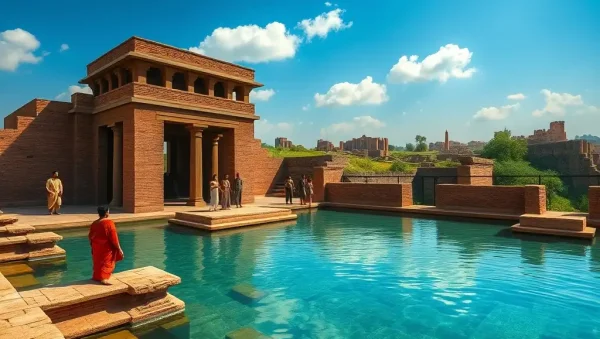
The Significance of the Great Bath: Rituals and Social Life in MohenjoDaro
Indus Valley Civilization - Origins and Evolution
The Language of the Indus Valley: Decoding the Script of an Enigmatic Civilization
Indus Valley Civilization - Origins and Evolution
The Role of Music and Dance in the Indus Valley Civilization
Indus Valley Civilization - Origins and Evolution
The Indus Valley Civilization’s Impact on Subsequent Indian Cultures
Indus Valley Civilization - Origins and Evolution
The Role of Religion in Shaping the Indus Valley Civilization
Indus Valley Civilization - Origins and Evolution
The Art and Architecture of the Indus Valley: A Reflection of Cultural Sophistication
Indus Valley Civilization - Origins and Evolution
How the Indus Valley Civilization Contributed to Modern Urban Planning
Indus Valley Civilization - Origins and Evolution
The Role of Rituals in the Daily Lives of Indus Valley Inhabitants
Indus Valley Civilization – Origins and Evolution 🏺
Explore the origins, development, and transformation of the Indus Valley Civilization, one of the earliest urban civilizations in the world. This subcategory examines the rise of Harappan society across the Indus River basin, including its settlements, economy, technology, social organization, religion, art, and long-distance trade. Discover how the civilization evolved from early farming communities into sophisticated cities such as Harappa, Mohenjo-daro, Dholavira, and Rakhigarhi, and learn what archaeology reveals about its enduring contribution to ancient Indian history.
🌾 Early Settlements and the Birth of Harappan Culture
Learn how prehistoric villages and agricultural communities gradually developed into the cultural foundations of the Indus Valley Civilization. Articles in this section explore the transition from early Neolithic and Chalcolithic settlements to more organized communities, highlighting the importance of farming, animal domestication, pottery, craft production, and permanent habitation.
Readers can expect clear explanations of important archaeological sites, regional traditions, and early technological developments. Understanding these formative stages helps explain how food production, population growth, resource management, and social cooperation encouraged the emergence of complex Harappan culture.
🏙️ The Rise of Harappan Cities
Discover how the Indus Valley Civilization became famous for its carefully planned urban centers. This section focuses on the development of cities such as Harappa, Mohenjo-daro, Dholavira, Ganeriwala, and Rakhigarhi, with attention to streets, residential areas, citadels, drainage systems, wells, public structures, and standardized construction.
Explore why Harappan urban planning remains significant in the study of ancient civilizations. Advanced sanitation, water management, brick architecture, and organized civic design demonstrate the remarkable engineering knowledge and administrative coordination achieved by Indus Valley communities.
🧱 Regional Expansion and Cultural Evolution
The Indus Valley Civilization was not limited to a single city or river valley. Read about its wide geographical spread across present-day Pakistan and northwestern India, including the Punjab, Sindh, Haryana, Rajasthan, Gujarat, and regions near the Ghaggar-Hakra system. This section explains how local environments influenced settlement patterns and cultural practices.
Articles also examine the distinction between Early Harappan, Mature Harappan, and Late Harappan phases. These chronological stages reveal gradual changes in urban life, pottery styles, craft traditions, trade networks, settlement size, and social organization rather than a single sudden historical event.
🛠️ Technology, Crafts, and Innovation
Investigate the technologies that supported Harappan society, including fired-brick construction, copper and bronze metallurgy, bead-making, pottery production, stone working, textile manufacture, and sophisticated weighing systems. Archaeological evidence offers valuable insight into the skills of artisans and the organization of specialized labor.
Readers will also learn how tools, seals, ornaments, carts, boats, and construction techniques contributed to economic growth and cultural exchange. Harappan standardization, especially in weights, measures, bricks, and craft production, suggests strong traditions of knowledge sharing across distant settlements.
🌊 Rivers, Environment, and Settlement Patterns
Understand the vital role of rivers, seasonal rainfall, fertile plains, coastlines, and natural resources in the evolution of the Indus Valley Civilization. The Indus River system supported agriculture, transportation, settlement growth, and communication, while coastal and inland environments created opportunities for fishing, farming, pastoralism, and trade.
This section also explores environmental change, shifting river courses, drought, floods, and ecological pressure. Studying climate and geography helps explain why some settlements expanded, declined, or adapted during the transformation from the Mature Harappan period to later regional cultures.
⚓ Trade Networks and Contact with Other Civilizations
Explore the extensive trade connections maintained by Harappan communities with neighboring regions and distant civilizations. Evidence of Indus Valley goods and cultural contacts has been found in areas associated with Mesopotamia, the Persian Gulf, Afghanistan, Iran, and Central Asia. Important trade items included carnelian beads, shell objects, metals, timber, ceramics, and luxury goods.
Learn how rivers, overland routes, and maritime travel connected Harappan cities to broader networks of exchange. Trade encouraged technological development, cultural interaction, and urban prosperity, making the Indus Valley Civilization an important participant in the ancient world economy.
🪔 Society, Beliefs, and Everyday Life
Gain insight into the daily lives of farmers, merchants, craftspeople, builders, administrators, and other communities within Harappan society. Topics include houses, clothing, ornaments, food, household tools, children’s activities, occupational specialization, and the relationship between rural settlements and major cities.
Archaeological discoveries such as figurines, seals, burial practices, ritual objects, and public structures provide clues about Harappan beliefs. Because the Indus script remains undeciphered, interpretations must rely on material evidence and careful comparison with other ancient civilizations.
📜 Writing, Seals, and Historical Evidence
Study the mysterious Indus script, which appears on seals, pottery, tablets, ornaments, and other objects. This section introduces the main characteristics of Harappan writing, including its symbols, short inscriptions, possible uses, and relationship to trade, identity, administration, and religious expression.
Readers will also learn how archaeologists reconstruct the past through excavation, stratigraphy, artifacts, architecture, environmental research, and scientific analysis. Since the script has not been conclusively deciphered, multiple interpretations remain possible, making evidence-based scholarship especially important.
📉 Transformation and Decline of the Urban Phase
Examine the changes that affected the Mature Harappan urban system after approximately 1900 BCE. Rather than viewing the transformation as a single catastrophic collapse, historians and archaeologists investigate several factors, including climate change, reduced river flow, flooding, changing trade routes, resource pressures, and the movement of populations toward smaller settlements.
This section explains how Harappan traditions continued in later regional cultures through pottery, agricultural practices, craft techniques, settlement patterns, and religious or symbolic traditions. The end of large urban centers did not mean the disappearance of Harappan people; instead, the civilization experienced gradual regional reorganization and cultural continuity.
🔍 Frequently Asked Questions About the Indus Valley Civilization
What was the Indus Valley Civilization?
The Indus Valley Civilization, also called the Harappan Civilization, was an ancient urban culture that flourished mainly between approximately 2600 and 1900 BCE. It developed across parts of present-day Pakistan and northwestern India and is known for planned cities, drainage systems, standardized bricks, craft production, agriculture, and long-distance trade.
Where did the Indus Valley Civilization begin?
Its origins developed from earlier agricultural and village communities in regions connected with the Indus River system and neighboring areas. Important early cultural developments occurred in parts of Balochistan, the Punjab, Sindh, Haryana, Rajasthan, and Gujarat before the civilization reached its Mature Harappan urban phase.
Which were the major cities of the Harappan Civilization?
Major Harappan sites include Harappa, Mohenjo-daro, Dholavira, Rakhigarhi, Ganeriwala, Kalibangan, Lothal, and Banawali. These settlements differed in size and function, but many displayed features such as planned streets, brick buildings, wells, drainage systems, craft areas, and organized residential spaces.
Why is the Indus script still undeciphered?
The Indus script contains short inscriptions and has not been conclusively linked to a known language. Researchers lack a bilingual inscription, such as the Rosetta Stone, and the surviving texts are generally brief. As a result, scholars continue to study its symbols through archaeology, statistical analysis, comparisons, and contextual evidence.
How did the Indus Valley Civilization decline?
The transformation of the Indus Valley Civilization appears to have resulted from several interconnected factors rather than one event. Possible influences include climate change, weakening monsoon patterns, river shifts, flooding, reduced trade, and changing economic conditions. Urban centers declined, but many people moved to smaller settlements where Harappan cultural traditions continued.