
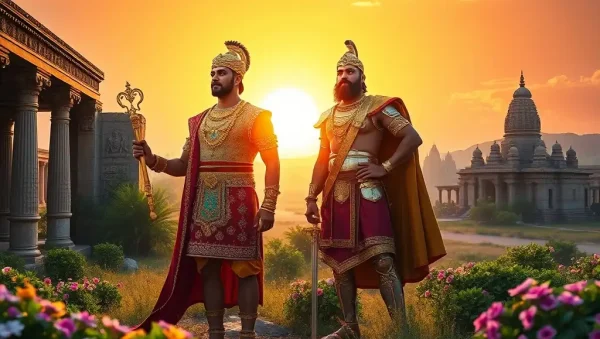
Gupta Empire - Golden Age Contributions


Gupta Empire - Golden Age Contributions
61 articles in this topic
Start here
- Gupta Empire - Golden Age ContributionsAstronomy and the Gupta Empire: Mapping the Stars of Ancient India
- Gupta Empire - Golden Age ContributionsThe Dynamics of Trade within the Gupta Empire: A Historical Analysis
- Gupta Empire - Golden Age ContributionsPhilosophy and Thought: The Intellectual Renaissance of the Gupta Period
Read more about this topic
Discover the Gupta Empire’s Golden Age contributions ✨—a remarkable era of innovation, learning, art, literature, science, mathematics, astronomy, medicine, and architecture in ancient India. Explore how Gupta scholars and artists shaped India’s cultural heritage, advanced knowledge, and influenced civilizations across Asia. 📚🔭🪷
More in Gupta Empire - Golden Age Contributions
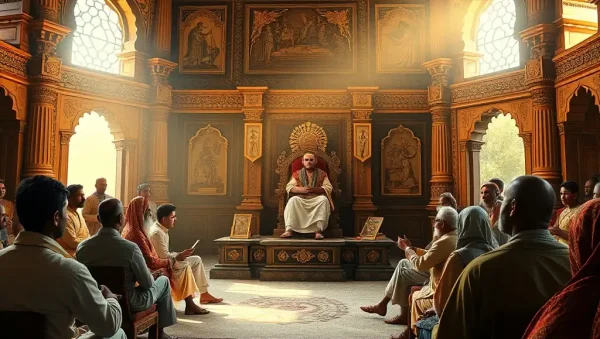
Gupta Empire - Golden Age Contributions
The Gupta Empire’s Contributions to Legal Systems and Governance

Gupta Empire - Golden Age Contributions
The Role of Festivals and Celebrations in Gupta Culture
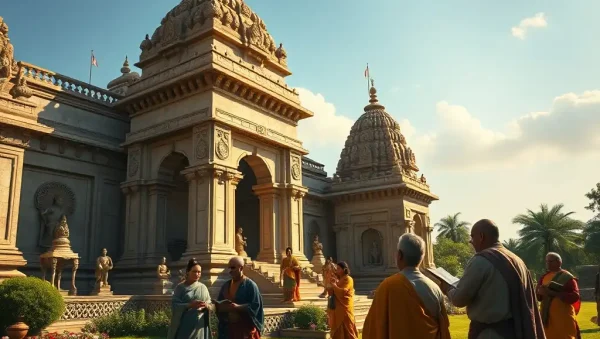
Gupta Empire - Golden Age Contributions
The Role of Religion in Gupta Society: Harmony and Diversity

Gupta Empire - Golden Age Contributions
Gupta Empire Urban Planning: How Cities Were Designed for Prosperity
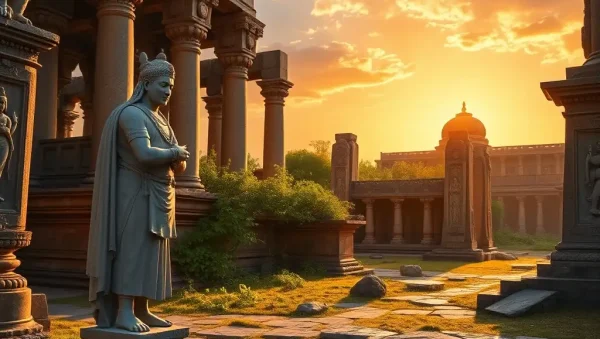
Gupta Empire - Golden Age Contributions
The Decline of the Gupta Empire: Lessons from the Golden Age

Gupta Empire - Golden Age Contributions
The Gupta Empire and Its Role in the Evolution of Indian Festivals

Gupta Empire - Golden Age Contributions
Medicine in the Gupta Empire: Ancient Practices that Influence Today

Gupta Empire - Golden Age Contributions
The Gupta Empire's Environmental Practices: Sustainability in Ancient Times
Gupta Empire – Golden Age Contributions 🌟
Explore the remarkable Gupta Empire, often remembered as India’s Golden Age, through its achievements in science, mathematics, medicine, literature, art, architecture, education, and political culture. This subcategory on Ancient India History examines how Gupta rulers and scholars shaped classical Indian civilization and influenced the intellectual and cultural development of South Asia. Discover the enduring legacy of ancient Indian knowledge, from the concept of zero and advances in astronomy to Sanskrit literature, temple art, and the celebrated universities of the Gupta period.
🏛️ The Gupta Empire and India’s Golden Age
Learn how the Gupta dynasty established one of the most influential empires in ancient Indian history between approximately the fourth and sixth centuries CE. Articles in this section explore the reigns of Chandragupta I, Samudragupta, Chandragupta II, Kumaragupta, and Skandagupta, highlighting their administration, military expansion, diplomacy, and support for learning.
Readers can expect clear explanations of why the Gupta period is called the Golden Age of India. Topics include political stability, economic prosperity, urban development, trade networks, religious tolerance, and the flourishing of Hindu, Buddhist, and Jain traditions across northern and central India.
🔢 Gupta Contributions to Mathematics and Science
Discover the important contributions of Gupta-era scholars to Indian mathematics and astronomy. This section explores the development and use of the decimal place-value system, early concepts associated with zero, arithmetic methods, geometry, planetary calculations, and the astronomical observations recorded by scholars such as Aryabhata.
Expect informative content about how ancient Indian scientific knowledge influenced later scholarship in the Islamic world and beyond. Articles may also examine developments in metallurgy, engineering, calendars, timekeeping, medicine, and traditional systems of knowledge that demonstrate the advanced intellectual culture of the Gupta period.
📚 Sanskrit Literature, Education, and Philosophy
Explore the flourishing of Sanskrit literature during the Gupta era, including poetry, drama, religious texts, historical writings, grammar, and philosophical works. The celebrated poet and playwright Kalidasa, along with other scholars, helped establish classical Sanskrit as a major language of artistic and intellectual expression.
This subcategory also examines education in ancient India, centers of learning, teacher-student traditions, and the transmission of knowledge through monasteries, temples, and scholarly communities. Readers will gain insight into how Gupta society valued literature, debate, philosophy, law, and religious learning.
🎨 Gupta Art, Architecture, and Sculpture
Study the distinctive features of Gupta art and architecture, widely regarded as a high point in classical Indian artistic development. Content covers stone sculpture, terracotta figures, coins, cave temples, structural temples, decorative motifs, and the idealized representations of Hindu, Buddhist, and Jain deities.
Readers can discover how Gupta artists created balanced forms, refined facial expressions, elegant clothing, and sophisticated symbolism. Examples such as the Dashavatara Temple at Deogarh, the Udayagiri Caves, Sarnath sculpture, and early temple architecture reveal the lasting influence of Gupta artistic traditions on later Indian architecture.
🛕 Religion, Society, and Cultural Development
Learn about the religious and social life of the Gupta Empire, including the growth of Vaishnavism, Shaivism, Buddhism, and Jainism. Articles explain how rulers supported different traditions while religious practices, pilgrimage, temple worship, philosophy, and devotional culture developed throughout the empire.
This section also considers daily life, social organization, women’s roles, occupations, education, festivals, clothing, food, and economic activity. By examining inscriptions, coins, literary sources, and archaeological evidence, readers can build a deeper understanding of Gupta society and ancient Indian culture.
⚔️ Administration, Economy, Trade, and Military Power
Understand how the Gupta rulers governed a large and diverse territory through royal administration, provincial officials, local authorities, land grants, taxation, and alliances. Content explores the role of inscriptions and coins in revealing the empire’s political organization and the authority of its kings.
Readers will also learn about agriculture, craft production, internal commerce, long-distance trade, gold coinage, and connections with Southeast Asia and other regions. Discussions of Gupta military campaigns, especially those associated with Samudragupta and Chandragupta II, explain the empire’s expansion and regional influence.
🌏 The Gupta Legacy in Ancient Indian History
Explore how Gupta achievements shaped later Indian kingdoms, languages, religious traditions, artistic styles, scientific ideas, and educational practices. The empire’s cultural influence extended beyond its political boundaries, leaving a powerful legacy in South Asia and contributing to the wider history of mathematics, astronomy, literature, and art.
This section also presents balanced historical perspectives, including the limits of the Golden Age narrative, regional differences, social inequalities, and debates among historians. Expect carefully explained content that connects Gupta Empire history with the broader development of ancient Indian civilization.
❓ Frequently Asked Questions About Gupta Empire Contributions
What was the Gupta Empire known for?
The Gupta Empire was known for major achievements in mathematics, astronomy, literature, art, architecture, medicine, education, and political culture. Its period is often called the Golden Age of India because of its intellectual and artistic growth, economic prosperity, and influence on later Indian civilization.
Why is the Gupta period called India’s Golden Age?
The Gupta period is called India’s Golden Age because classical Indian culture reached an exceptional level of development in many fields. Advances in Sanskrit literature, temple architecture, sculpture, astronomy, mathematics, education, trade, and religious thought made the era highly influential, although historians also recognize that prosperity was not equally experienced by every social group.
What did Gupta scholars contribute to mathematics?
Gupta-era scholars helped advance the decimal place-value system, arithmetic, algebraic reasoning, and astronomical calculations. Aryabhata, who lived near the end of the Gupta period, is especially associated with important work on planetary motion, eclipses, pi, and mathematical astronomy.
Which arts and architectural styles developed during the Gupta Empire?
Gupta artists developed refined sculpture, temple design, coin imagery, terracotta work, and cave art. Important examples include the Udayagiri Caves, the Dashavatara Temple at Deogarh, and the elegant Buddhist sculptures of Sarnath. These styles influenced later Hindu and Buddhist art across India and Asia.
How did the Gupta Empire influence later Indian civilization?
The Gupta Empire influenced later India through its Sanskrit literature, religious traditions, scientific ideas, administrative practices, coinage, temple architecture, sculpture, and educational culture. Its artistic and intellectual achievements also traveled through trade, pilgrimage, and cultural exchange to Southeast Asia and other parts of the wider Asian world.