
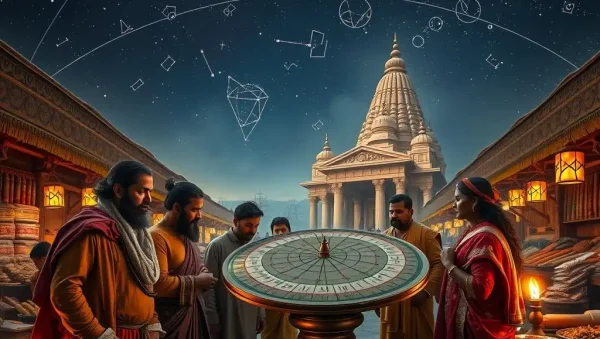
Astronomy and Mathematics in Ancient India
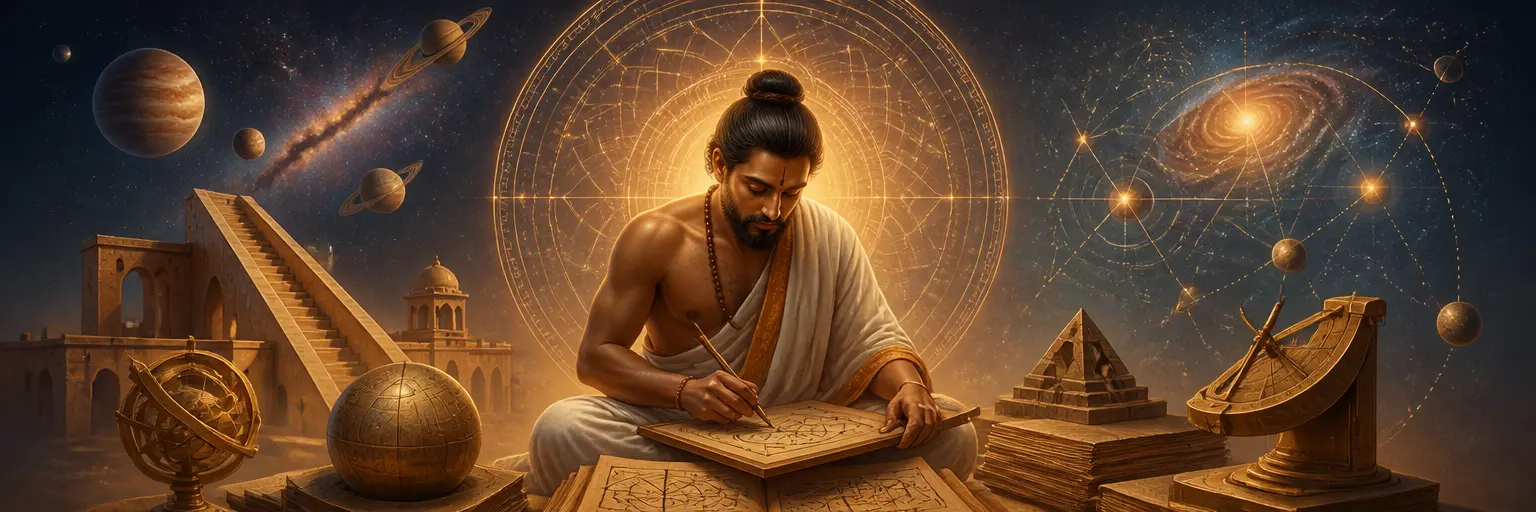

Astronomy and Mathematics in Ancient India
57 articles in this topic
Start here
- Astronomy and Mathematics in Ancient IndiaThe Connection Between Astronomy and Agriculture in Ancient India
- Astronomy and Mathematics in Ancient IndiaThe Philosophy of Space and Time in Ancient Indian Thought
- Astronomy and Mathematics in Ancient IndiaThe Astrological Implications of Ancient Indian Astronomy
Read more about this topic
Discover how ancient Indian scholars transformed astronomy and mathematics through groundbreaking observations, sophisticated calculations, and innovative theories. Explore the legacy of pioneers such as Aryabhata and Brahmagupta, whose work shaped concepts like zero, the decimal system, planetary motion, eclipses, and advanced calendrical science. 🌌📐 This fascinating journey reveals India’s enduring contributions to global science and medicine.
More in Astronomy and Mathematics in Ancient India

Astronomy and Mathematics in Ancient India
The Gupta Period: A Golden Age of Astronomy and Mathematics

Astronomy and Mathematics in Ancient India
The Mathematical Breakthroughs of Ancient India: A Comprehensive Overview

Astronomy and Mathematics in Ancient India
The Intersection of Science and Spirituality in Ancient Indian Astronomy

Astronomy and Mathematics in Ancient India
How Ancient Indian Scholars Documented Astronomical Phenomena

Astronomy and Mathematics in Ancient India
The Legacy of Ancient Indian Astronomy in Modern Scientific Practices
Astronomy and Mathematics in Ancient India
Vedic Mathematics: Unlocking the Secrets of Ancient Calculation Methods

Astronomy and Mathematics in Ancient India
The Concept of Time in Ancient Indian Astronomy: A Philosophical Insight

Astronomy and Mathematics in Ancient India
The Role of Ancient Indian Mathematics in Global Trade Routes
🔭 Astronomy and Mathematics in Ancient India
Discover the remarkable achievements of ancient Indian astronomy and mathematics, a subcategory dedicated to the scientific knowledge, theories, texts, and innovations that developed in India from the Indus Valley Civilization through the Gupta Empire and beyond. Explore how Indian scholars observed the skies, measured time, developed sophisticated numerical systems, and contributed ideas that continue to influence science today. This section of Ancient India History connects mathematics, astronomy, religion, calendar-making, architecture, medicine, and everyday life within the wider history of ancient Indian civilization.
🌌 Ancient Indian Astronomy and the Study of the Cosmos
Learn how astronomers in ancient India studied the Sun, Moon, planets, stars, eclipses, seasons, and celestial movements. Articles in this subcategory examine early sky observation, nakshatras, lunar and solar calendars, planetary calculations, and the ways astronomy supported agriculture, religious rituals, navigation, and the organization of time.
Readers can explore influential Sanskrit astronomical traditions and texts, including the Vedanga Jyotisha, Aryabhatiya, Surya Siddhanta, and later works associated with Indian mathematical astronomy. Content explains how ancient Indian scholars combined observation, calculation, geometry, and philosophical thought to create detailed models of the universe.
🧮 Mathematics and Numerical Innovation in Ancient India
This section explores the development of ancient Indian mathematics, including arithmetic, geometry, algebraic reasoning, fractions, powers, equations, and methods for solving practical problems. Discover how mathematicians created efficient calculation techniques that were used in astronomy, trade, taxation, construction, calendar systems, and education.
Special attention is given to the history of the decimal place-value system and the development of the number zero. Readers will also encounter the mathematical contributions of figures such as Aryabhata, Brahmagupta, and Bhaskara, whose work helped shape the global history of mathematics.
⭕ The History of Zero and the Decimal System
One of the most important subjects in this subcategory is the emergence of zero as both a placeholder and a number. Learn how Indian mathematicians transformed numerical notation through place value, making large calculations clearer, faster, and more systematic than many earlier systems.
Articles explain the significance of Brahmagupta’s rules for calculating with zero and negative numbers, as well as the later transmission of Indian numerals through the Islamic world to Europe. This history reveals why the modern decimal system is often described as the Hindu-Arabic numeral system.
📜 Aryabhata, Brahmagupta, and Other Indian Scholars
Meet the influential thinkers who advanced astronomy and mathematics in ancient and early medieval India. Explore Aryabhata’s calculations of the length of the year, planetary periods, eclipses, and the rotation of Earth, together with Brahmagupta’s work on zero, negative numbers, algebra, and astronomical computation.
The subcategory also introduces other important scholars, schools, and traditions, showing that scientific progress in India developed through centuries of debate, commentary, observation, and refinement. Readers can better understand the historical context behind major Sanskrit scientific texts and their lasting influence.
🗓️ Calendars, Timekeeping, and Eclipses
Ancient Indian astronomy was closely connected with the measurement of time. Discover how scholars developed systems based on lunar phases, solar movement, seasons, tithis, nakshatras, and planetary cycles. These methods supported religious festivals, agriculture, administration, and social organization.
Learn how Indian astronomers explained and calculated solar and lunar eclipses using mathematical models rather than relying only on mythological interpretations. Content also explores the relationship between astronomical calculation, panchangas, ritual calendars, and the practical needs of ancient communities.
📐 Geometry, Architecture, and Scientific Applications
Mathematics in ancient India was not limited to abstract theory. This section examines geometry found in altar construction, temple design, urban planning, measurement, land division, and engineering. The Sulba Sutras, for example, preserve important geometric procedures connected with the construction of ritual fire altars.
Readers can discover how mathematical knowledge supported the development of ancient cities, monumental architecture, water systems, and sacred spaces. These topics demonstrate the practical relationship between Indian science, mathematics, architecture, and cultural history.
🌍 The Global Influence of Indian Science
Explore how mathematical and astronomical ideas from India traveled across Asia, the Middle East, and eventually Europe. Indian numerals, decimal notation, astronomical tables, and computational methods were studied, translated, adapted, and expanded by scholars in other intellectual centers.
This global history places ancient Indian achievements within a wider network of scientific exchange. It also encourages readers to distinguish between historically documented influence, later interpretations, and claims that require careful evidence and scholarly evaluation.
❓ Frequently Asked Questions About Astronomy and Mathematics in Ancient India
What were the major achievements of ancient Indian astronomy?
Major achievements included detailed observations of celestial bodies, calculations of planetary periods, methods for predicting eclipses, lunar and solar calendar systems, and theories concerning the rotation of Earth. Texts such as the Vedanga Jyotisha, Aryabhatiya, and Surya Siddhanta preserve important elements of this tradition.
Did ancient India invent zero?
Indian mathematicians played a central role in developing zero as a mathematical number and as a placeholder within the decimal place-value system. Brahmagupta provided some of the earliest known written rules for arithmetic operations involving zero in the seventh century CE.
Who was Aryabhata?
Aryabhata was a celebrated Indian mathematician and astronomer who lived during the Gupta period. His work addressed arithmetic, algebra, trigonometry, eclipses, planetary motion, and the length of the solar year. He is also associated with the idea that Earth rotates on its axis.
What is the Surya Siddhanta?
The Surya Siddhanta is a major Sanskrit astronomical work that discusses time measurement, planetary positions, eclipses, trigonometry, calendars, and celestial calculations. Its contents reflect a long process of compilation, transmission, and scholarly commentary.
Why is ancient Indian mathematics important today?
Ancient Indian mathematics introduced or advanced ideas that remain fundamental to modern calculation, including decimal place value, zero, arithmetic procedures, algebraic methods, and trigonometric concepts. Studying this history helps explain the development of global science and the intellectual achievements of ancient Indian civilization.